Lateral thinking is a way of solving problems by moving sideways instead of pushing harder in the obvious direction. You question the usual starting point, try deliberately odd ideas and look for links that logic alone would not give you. The good news for beginners is that it is a set of habits, and you can practise them in about five minutes a day.

Lateral thinking basics: what you are actually learning
The Maltese physician and writer Edward de Bono coined the term in 1967. He wanted a name for the kind of thinking that rearranges how a problem is seen, rather than working step by step from the way it was first described.
If you want the history, the famous puzzles and the research, they have their own article: why practise lateral thinking. This page is the hands-on companion. It gives you seven small exercises, a few ready-made techniques and a week-long plan, so you can start today.
Vertical thinking versus lateral thinking
Most school work trains vertical thinking: you start from what you know and take one logical step after another, checking each as you go. That is exactly right for balancing an equation or marking a source. It is the heart of logical and creative thinking, and the two styles work as a pair.
Lateral thinking asks a different question. Instead of “what is the next correct step?” it asks “is this the only way to look at the problem?” Then it generates options first and judges them afterwards.
| Question you ask | Vertical thinking | Lateral thinking |
|---|---|---|
| Where do I start? | From the problem as it is written | From any angle, including a wrong-looking one |
| What counts as progress? | Each step must be correct | A step may be silly if it leads somewhere useful |
| How many answers? | Usually one best answer | As many options as you can make |
| When do I judge ideas? | All the time | Later, after the ideas exist |
Set the right mindset first
Three small rules make every exercise below work better.
- Defer judgement. Write the idea down before you decide whether it is good. A rejected idea can still be the stepping stone to a good one.
- Aim for quantity. Your first three ideas are usually the ones everybody else would have too. The more unusual ones often turn up only after the obvious answers are used up.
- Keep a notebook. A cheap pad, or the notes app on your phone, is enough. Writing forces you to keep going when your head says “that is all I can think of”.

Most of the exercises take two to five minutes, so a timer helps. Setting one stops you drifting off into worrying about whether you are doing it “right”. There is no right, only more or fewer options.
Exercise 1: find more uses for an ordinary object
This is the simplest warm-up and a lovely first step in thinking differently. Pick something dull: a brick, a paper cup, a coat hanger, an old CD. Set a timer for three minutes and list every use you can think of.
The first minute is easy: a brick holds a door open, builds a wall, props up a shelf. Then the list dries up. Keep going. This is the point where lateral thinking starts, because you have to stop thinking “what is a brick for?” and start thinking “what can a brick do?” It is heavy, rough, rectangular, hard and can be warmed up or cooled down. Each property opens new doors: a doorstop, a kitchen weight for pressing tofu, a plant-pot stand, a bookend.
A neat trick is to list the object’s properties first (size, weight, texture, shape, material) and then match each property to a job. You will find uses you would never find by staring at the whole object.
Try it: how many uses can you find for a paper cup in two minutes? What property did your best idea use?
Examples: a mini plant pot, a cone megaphone, a funnel, a paint pot, a bird feeder, a stand for a phone (cut a slot). Good answers name a property such as “holds liquid”, “cone-shaped” or “light and cheap”. Naming the property is what turns a lucky guess into a repeatable method.
Exercise 2: the random word technique
This one comes straight from de Bono’s toolkit and is called random entry. You take a problem, pick a word with no connection to it at all and force a link between the two.
Edward de Bono's own example of the technique pairs the random word “nose” with a photocopier. A nose smells, so could a photocopier give off a smell? That leads to a machine that releases a scent such as lavender when it is running low on paper. The point is not whether anyone built it: the path from “nose” to an idea you would never reach logically is the point.
How to do it in five steps
- Write your problem in one line, for example: “How can I remember my revision timetable?”
- Choose a random word. Open any book at any page and point, or use the first noun you see in the room.
- Write down five things the word is, does or is linked to. For “umbrella”: shelter, folds, opens, rain, handle.
- Force each link onto your problem: a timetable that folds into a pocket; a shelter time when no one may interrupt; a timetable that opens out on the day you need it.
- Circle the best one and ask how you would make it real.
Next up: how to turn a problem upside down.

Exercise 3: reverse the problem
Reversal means taking the problem or the obvious answer and turning it back to front. It is one of the fastest lateral thinking techniques for beginners because you can use it on almost anything.
Suppose your problem is “How can I revise better?” Flip it: “How could I make my revision as useless as possible?” Now list ideas quickly: revise with the phone buzzing next to you, read the notes once and never test yourself, start at 11 pm, copy the textbook word for word.
Look at the list again and turn every item over. Phone in another room. Test yourself from memory. Start earlier in the day. Rewrite in your own words. You have just built a revision plan, and the silly list made it easier to see what mattered than a blank page did.
Other ways to reverse
- Swap the roles. Instead of asking how a teacher can explain a topic, ask how a student could teach it to the teacher.
- Reverse the order. Start with the finished result and work backwards to the first step, like planning a journey from the arrival time.
- Reverse the direction. If everyone pushes, ask what would happen if you pulled.
Exercise 4: challenge the assumptions
Every problem arrives wrapped in assumptions that nobody mentions. Lateral thinkers unwrap them. The method is just a habit of asking “why is it done this way?” in a calm, curious tone rather than an angry one. De Bono called this part of the toolkit challenge: the question is not “you are wrong” but “is there a reason, and could there be another way?”
A classic exercise is to take a familiar object and ask why it has each of its features. Why does a coffee cup have a handle? Because the drink is hot. Does it need to be a loop? Could it be a cup you hold by the rim, a cup with a sleeve, or a cup with no handle that stays cool? The assumption “a cup must have a handle” was holding the thinking in place.
A three-step assumption hunt
- State the problem in one sentence.
- List the hidden rules. Write every “must” and “always” you can find, such as “homework must be done at a desk” or “a group project needs a leader”.
- Break one rule on purpose. Ask what you could do if that rule did not exist, then check whether the rule was real or just habit.
Here is a fun everyday case. Why are manhole covers round? One practical reason is that a circle has the same width in every direction, so a round cover cannot be tipped and dropped through its own opening. A square cover could slip through diagonally. The assumption many people make, that round is just “the usual shape”, hides a sensible design decision. Sometimes challenging an assumption confirms it, and that is fine too. You now know why.
Try it: write three hidden “must” rules about your school day. Which one could you test by breaking it for a day?
Examples: “I must revise on my own” (try a study partner who quizzes you), “I must start with my favourite subject” (try starting with the hardest) and “notes must be written, not drawn” (try a diagram). Good rules to test are small, safe and easy to compare, so choose one that does not risk anything important.
Exercise 5: provocation and the “Po” statement
This is the most unusual technique, and the one beginners find most fun. A provocation is a statement you know is wrong, impossible or ridiculous, which you use on purpose to knock your thinking off its usual track. De Bono marked such statements with the short word Po, so that everyone knew “this is a provocation, not a claim”.
The trick is not to argue with the statement but to use it. Ask: “What would be good about this? What would have to be true? What does it remind me of?” De Bono's best-known example, from his book Serious Creativity (1992), is “Po: the factory is downstream of itself”. It sounds nonsense. But it pushes you to ask what would happen if a factory had to live with its own waste water, and that leads to a real idea: make the factory take in its water downstream of its own outlet, so it has to clean what it releases. De Bono said this later became law in some countries.

Make your own Po in four steps
- Write the problem. For example: “Our class group chat is full of noise.”
- Make a provocation by exaggerating, reversing or removing something: “Po: nobody is allowed to read messages.”
- Ask what it makes you think of: messages that are only for writing, a weekly summary, a rule that only one person posts.
- Pull out one practical idea and improve it with ordinary logic: “One person posts a weekly summary of the important things.”
Other ways to build a provocation include wishful thinking (“Po: homework does itself”), exaggeration (“Po: every lesson is a hundred hours long”) and escape (“Po: ignore the thing that looks essential”). The aim is movement. You are trying to get unstuck, so the statement does not have to survive a fact-check.
Warm-up riddles to stretch the habit
Riddles are short practice sets for dropping a wrong assumption. Try each one before opening the answer. Do not worry about getting it fast; the useful bit is noticing which assumption was in your way.
Two girls were born to the same mother on the same day, in the same year. They are not twins. How is that possible?
They are two of a set of triplets (or more). Most people assume “same day, same mother” must mean twins, but nothing in the riddle said there were only two children.
A man asks a barman for a glass of water. The barman points a gun at him. The man says “thank you” and leaves. Why?
The man had hiccups. The shock of the gun cured them, so he no longer needed the water. The assumption in the way is that the man wanted the water to drink because he was thirsty.
What can you hold in your left hand but never in your right?
Your right hand. The riddle plays on the assumption that the answer must be a separate object. It is a quick reminder that a question’s wording can send you in the wrong direction.
If you enjoy these, the article on curiosity and imagination skills has further ways to keep the habit going outside lessons.
Exercise 6: try the Six Thinking Hats
De Bono’s book Six Thinking Hats (1985) is a related tool rather than a lateral thinking technique in itself. Lateral thinking is mostly about generating new ideas. The hats are about organising your thinking so that you do not try to do everything at once. Each coloured hat stands for one mode of thought, and you “wear” one at a time.
| Hat | What it asks for | Sample question |
|---|---|---|
| Blue | The big picture and managing the process | What are we trying to decide, and in what order shall we think? |
| White | Facts and information | What do we know, and what do we still need to find out? |
| Red | Feelings, hunches and emotions | How do I feel about this, without having to explain why? |
| Black | Caution and risks | What could go wrong, and where is the weak point? |
| Yellow | Benefits and positives | What is good about this, and who gains? |
| Green | New ideas and alternatives | What else could we try? What if we reversed it? |
The green hat is where lateral thinking lives. It is the hat for the random word, the reversal and the Po statement. The other five hats then help you sort, test and improve what the green hat produced.
In a group, the method is called parallel thinking: everyone wears the same hat at the same moment, instead of one person arguing for and another against. That is the difference from an ordinary debate, where people each defend a position.
Solo practice: a decision in six rounds
You can do this alone with a notebook. Choose a small real decision, such as whether to join a new club, and spend two minutes on each hat in this order:
- Blue: write the decision and what a good result would look like.
- White: list the facts, such as the day, the cost and the time it takes.
- Green: list at least five options, including odd ones (join for a month, go with a friend, start your own).
- Yellow: write the benefits of the two best options.
- Black: write the risks of those two.
- Red: finish with a gut check. Which one feels right, and does that agree with the lists?
The order is a choice, not a rule. Many people start with blue and white and end with blue again to decide what to do next.
Exercise 7: put the techniques together
The real strength of these methods appears when you chain them. Take one problem and run it through a short routine. Here is a ten-minute version that works well on a school project, a club event or a tricky essay question.
- Challenge (2 minutes). Write three hidden assumptions about the problem.
- Random entry (2 minutes). Pick a random word and force three links.
- Reversal or Po (2 minutes). Make one reversed or provocative statement and pull one idea out of it.
- Hats (4 minutes). Use yellow and black on your top three ideas, then a quick red hat to choose one.
Notice the pattern: the first three steps widen your options, and the last step narrows them. This is the same “two modes, one brain” idea from earlier, put into a timetable. For group work, the ideas also fit alongside a growth mindset in teamwork, because trying odd ideas needs a team that does not laugh at them.
Flip cards: the techniques at a glance
Tap each card to check you can say what the technique is for.
More ideas for your idea notebook
Once you have the basic routine, the following habits help you to keep going without a long session.
- Ask “what else?” three times before accepting any answer.
- Change the scale. What would the idea look like at ten times the size, or one-tenth?
- Borrow from another subject. How would a chef, an engineer or a gardener approach your problem?
- Combine two things. Merge two ordinary items or ideas and see what the hybrid could do.
- Sleep on it. Write the problem down before bed and look at it fresh the next morning.


The photos above are a reminder that a rough sketch, a paper model or a pile of sticky notes is a better thinking tool than a perfect plan. Make it quickly, look at it, change it.

Four habits to repeat every day
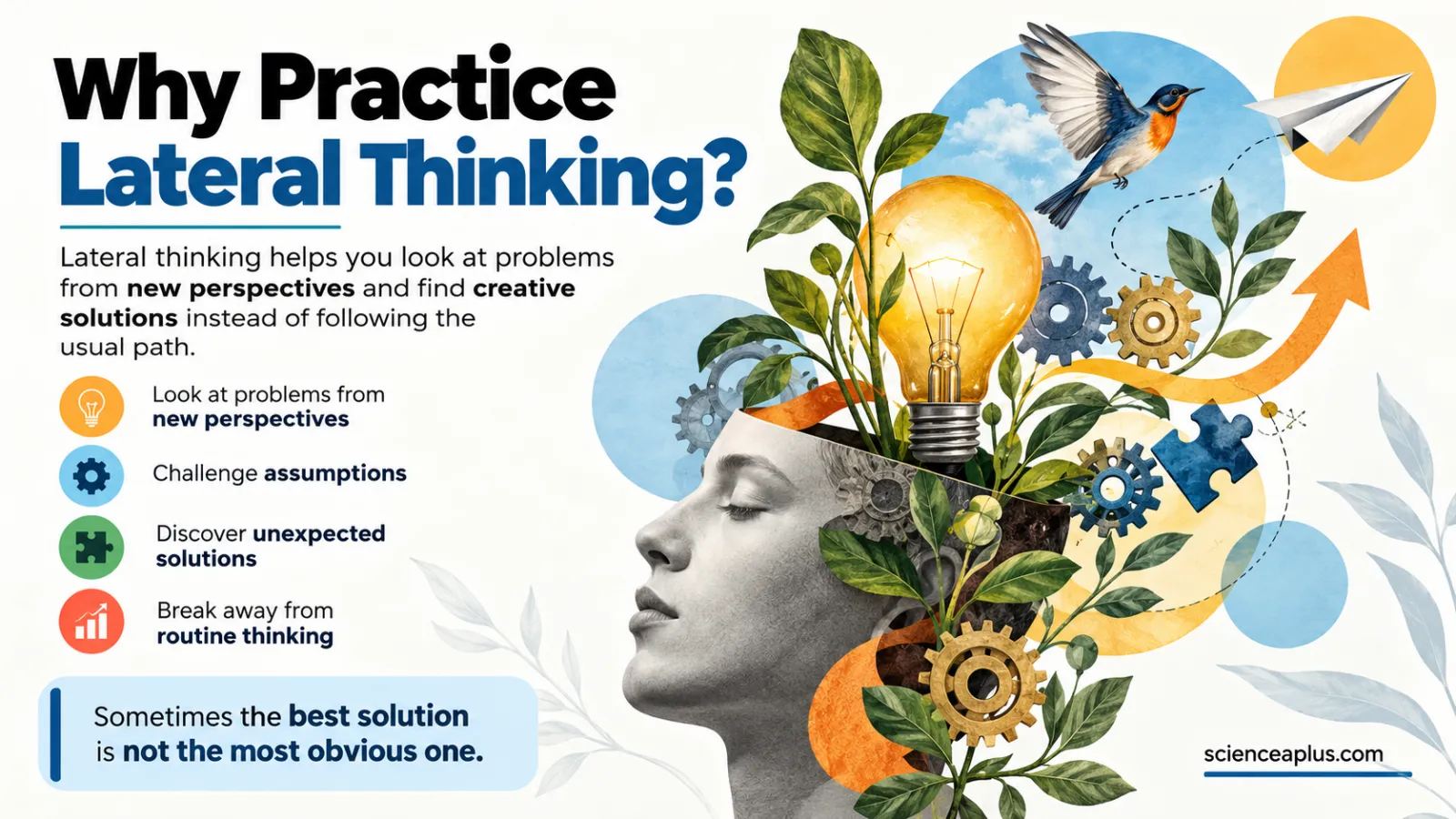
The exercises are only useful if you repeat them. The picture above sums up four habits that cover most of what you have learned: change the perspective, ask “why?” and “why not?”, combine ideas, and look for the unexpected. Think of them as the daily stretches that sit behind the longer workouts.
A good rule is little and often. Five minutes a day beats an hour once a month, because the aim is to make the questions automatic.
A seven-day lateral thinking plan
Here is a simple week for beginners. Tick each day when you have done it; your ticks are remembered in your browser on this device.
- Day 1: Alternative uses. Three minutes on a paper cup, brick or coat hanger. Write the property behind each idea.
- Day 2: Random word. Link a random noun to one real problem and find three connections.
- Day 3: Reversal. Ask “how could I make this worse?” about one routine, then flip the answers.
- Day 4: Challenge. List five “must” rules about your day and test one of them.
- Day 5: Po. Write one wild statement about a problem and pull out one practical idea.
- Day 6: Six hats. Walk one small decision through the six hats in your notebook.
- Day 7: Combine. Run the ten-minute routine on a real task and review which method helped most.
Common pitfalls to avoid
- Judging too soon. If you criticise every idea as it appears, you end up with only the obvious ones. Keep generating and judging in separate rounds.
- Stopping at the first good idea. The first workable answer is not always the best. Push for a few more.
- Ignoring facts. A creative idea that breaks a law of science or a safety rule is not a solution. Test every idea against reality.
- Doing it only when stuck. The habit grows with practice on easy, low-stakes problems, long before an exam or a real crisis.
- Treating it as a talent. Many people think they are “not creative”. These techniques are procedures you can follow, which is why they suit beginners.
Where lateral thinking helps in science and school
You do not need a special subject to use these habits. In science, a stubborn experiment can be approached by reversing the question (“what would make this fail?”) or by challenging an assumption in the method. In design and technology, random entry can give a fresh angle on a product. In English or history, a Po statement can reveal a counter-argument you had not considered.
Lateral thinking works best as the first half of a pair. Generate with these methods, then test with the logical skills in why critical thinking is important. If you are aiming at lab work or exams, critical thinking for science students shows how to check an idea once you have it, and improving critical thinking for your job carries the same pairing into the workplace.
Frequently asked questions about lateral thinking basics
What are the basics of lateral thinking?
The basics are to look at a problem from a new angle, generate many options before judging them, and then test the best ones with logic. Beginners can use simple techniques such as alternative uses, random words, reversal, challenging assumptions and Po statements.
How can I start thinking laterally?
Start with five minutes a day. List ten uses for an ordinary object, link a random word to a problem, or write down why something is done the way it is. Keep a notebook, set a timer and save the judging for the end.
What is an example of lateral thinking?
Linking the random word “nose” to a photocopier, so that it releases a pleasant scent when paper runs low, is Edward de Bono's own example. The idea comes from forcing a link between two unrelated things rather than reasoning step by step.
What are the main lateral thinking techniques?
De Bono described several, including random entry, provocation (Po), challenge, alternatives and reversal. Random entry links a problem to an unrelated word, provocation uses a deliberately wrong statement, and challenge asks why something is done in the usual way.
What is the difference between lateral and vertical thinking?
Vertical thinking moves forward one logical step at a time and checks each step. Lateral thinking moves sideways, trying other starting points and unusual ideas, and judges them later. Most real problems need both, with lateral thinking first and logic second.
What is the Six Thinking Hats method?
It is a thinking tool by Edward de Bono, published in 1985. Each hat is a mode: blue for the big picture, white for facts, red for feelings, black for caution, yellow for benefits and green for new ideas. Groups wear the same hat at once.
Is the Six Thinking Hats method the same as lateral thinking?
No. They are related but different. Lateral thinking is a set of ways of producing new ideas. The hats are a way to organise thinking so you separate facts, feelings, risks, benefits and creativity. The green hat is where lateral thinking fits.
Can anyone learn lateral thinking?
Yes. The techniques are simple procedures that you can practise, so you do not need a special talent. Short daily exercises are an easy way to practise producing more options. However, the research on how well these methods work is limited, so keep checking your ideas.
What is a Po statement?
A Po is a provocation, a statement that you know is wrong or impossible, used to shake your thinking out of its usual path. For example, “Po: homework does itself” might lead you to ask which tasks could be simpler or shared. You then keep only the practical idea.
How long does it take to get better at lateral thinking?
There is no fixed time, and no research here gives one. Regular practice of a few minutes each day for a week or two is a sensible start. You will probably notice that you produce more options sooner than before, even before the techniques feel natural.