
What is lateral thinking? Lateral thinking is a way of solving problems by looking at them from the side instead of marching straight down the obvious path. The term was coined in 1967 by the Maltese doctor and psychologist Edward de Bono. You practise it so that you can find ideas that step-by-step logic alone would miss.
What is lateral thinking?
Most of what you learn at school trains you to think in a straight line. You read the question, pick the method, work through the steps and check the answer. That is a powerful skill, and science depends on it. But some problems do not budge when you push harder in the same direction. They need you to change direction first.

Lateral thinking is the deliberate habit of doing exactly that. Instead of asking "What is the next step?", a lateral thinker asks "What else could this mean?", "What am I assuming?" and "What would happen if I did the opposite?". The word lateral simply means "sideways": you move across to a different way of seeing the problem, rather than digging deeper in the same hole.
Here is a simple example. Imagine a lift in a block of flats where one person always rides to the 7th floor and walks the last three floors to the 10th. On rainy days they ride all the way up. A straight-line approach looks for a fault in the lift. A lateral approach asks what is different on a rainy day. (The answer is in the reveal question below.)
Why does the person only ride to the 7th floor on dry days, but all the way up when it rains? (1 mark)
The person is short and can only reach the button for the 7th floor. On rainy days they carry an umbrella, which lets them press the button for the 10th floor.
Notice what happened. You probably built a story in your head (a broken lift, a fitness habit, a lazy person) before you questioned the assumption that every button is within reach. Spotting a hidden assumption is the first lateral skill.
Who was Edward de Bono?
Edward de Bono was born in Malta and trained as a doctor before moving into psychology and the study of thinking. He used the phrase "lateral thinking" in 1967, in a book called The Use of Lateral Thinking, and went on to write dozens more books, lecture at universities and teach thinking skills to schools and companies around the world. He died in 2021.
In 1985 he published Six Thinking Hats. In this method a group imagines wearing hats of six different colours, and each colour stands for one way of thinking: facts, feelings, caution, benefits, new ideas and managing the process. Everyone wears the same hat at the same time, which stops a meeting turning into an argument. You will meet the hats again later in this article.
De Bono's big claim was that thinking is a skill that can be trained, like a sport. That idea is attractive, and it is the reason this article exists. It is also where we need to be careful, because the research on whether de Bono's own programmes work is thinner than their fame suggests. We look at that honestly later in this article.
Vertical thinking vs lateral thinking
De Bono contrasted two styles. Vertical thinking is the logical, step-by-step kind. Each step follows from the last, and each step must be right. Lateral thinking is allowed to make a "wrong" move on purpose, because that move might open a route nobody had noticed. Neither is better than the other; they are partners.
| Feature | Vertical thinking | Lateral thinking |
|---|---|---|
| Direction | Straight down one path | Sideways, across to other paths |
| Each step | Must be correct and justified | May be unusual or even "wrong" if it helps |
| Main question | "Which answer is right?" | "What other answers could there be?" |
| Uses existing patterns | Builds on them | Questions and rearranges them |
| Best for | Calculating, checking, proving | Generating ideas, escaping dead ends |
In a GCSE science investigation you use both. Vertical thinking helps you calculate a mean, plot a graph and draw a conclusion. Lateral thinking helps you see that your experiment could be improved by measuring something different, or that an odd result might be telling you something new. Our guide to critical thinking in science education shows how the two work together.
Why practise lateral thinking?
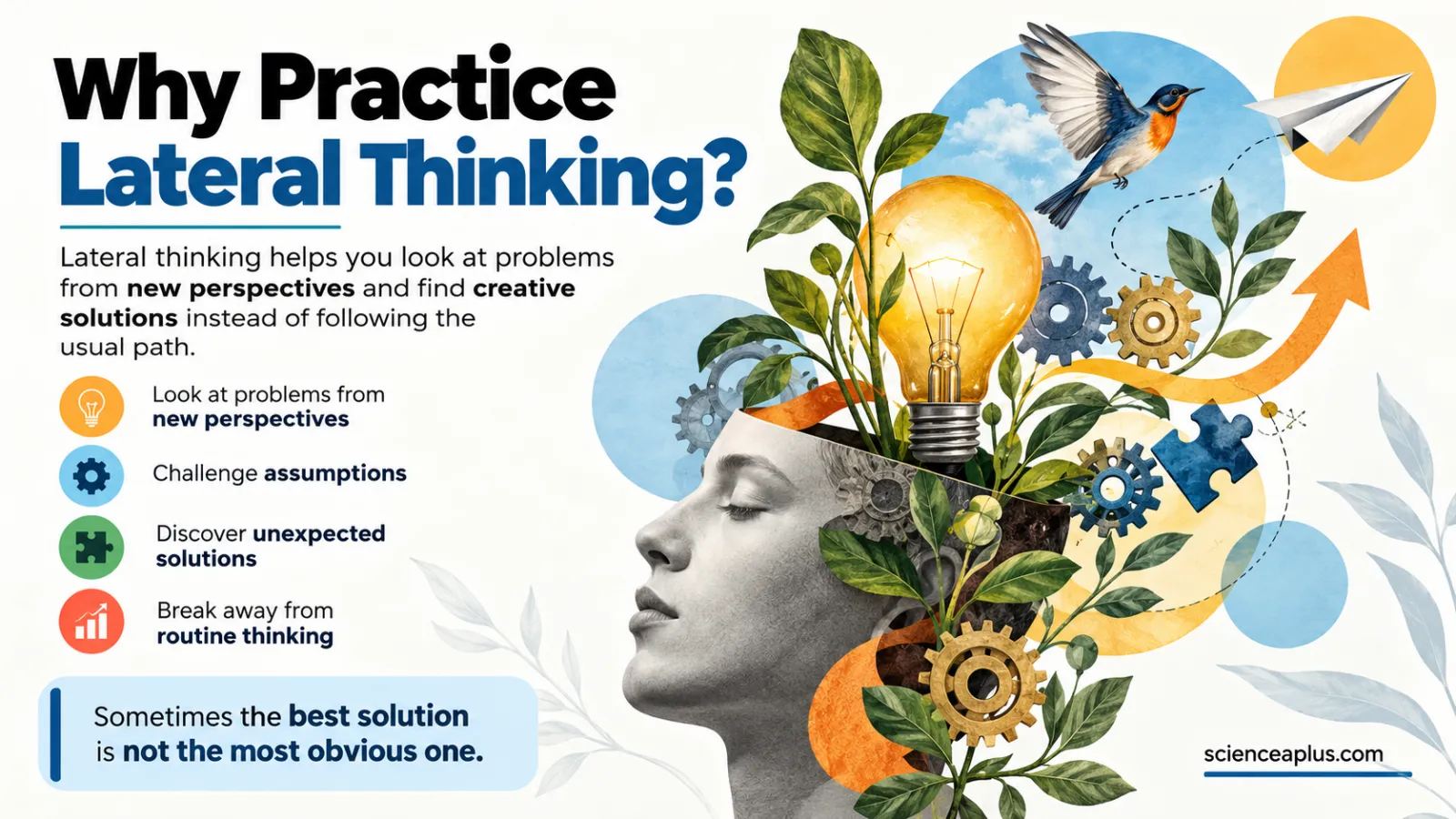
If you only ever think in straight lines, you tend to repeat the answers you already know. The infographic at the top of this page gives four reasons to practise, and each one is worth a closer look.
- Look at problems from new perspectives. A different viewpoint can turn a dead end into a doorway.
- Challenge assumptions. Many problems stay unsolved because everyone is quietly agreeing on something that is not actually true.
- Discover unexpected solutions. The best answer is often not the most obvious one.
- Break away from routine thinking. Habits save time, but they also shut out options.
Problem-solving is widely valued by employers, and new problems are, by definition, ones you have never seen before. That is a lateral skill: you cannot look up the method for a problem that has no method yet. It also matters for exams. Questions that begin "Suggest why…" or "Suggest how the experiment could be improved" reward students who can think of an idea that was not on the revision card.
Being curious helps enormously, because lateral thinking starts with a question nobody asked. If that sounds like you, our post on why critical thinking is important explains how questioning and evaluating ideas fit together with creative thinking.
It is worth saying what lateral thinking is not. It is not random guessing, and it is not the same as being artistic. A lateral idea still has to be tested and judged, and that judging is vertical thinking. The creative leap gets you to the idea; logic then decides whether it works. Next we will look at two famous puzzles that show how powerful, and how difficult, that leap can be.
The nine-dot puzzle: the original "outside the box" problem
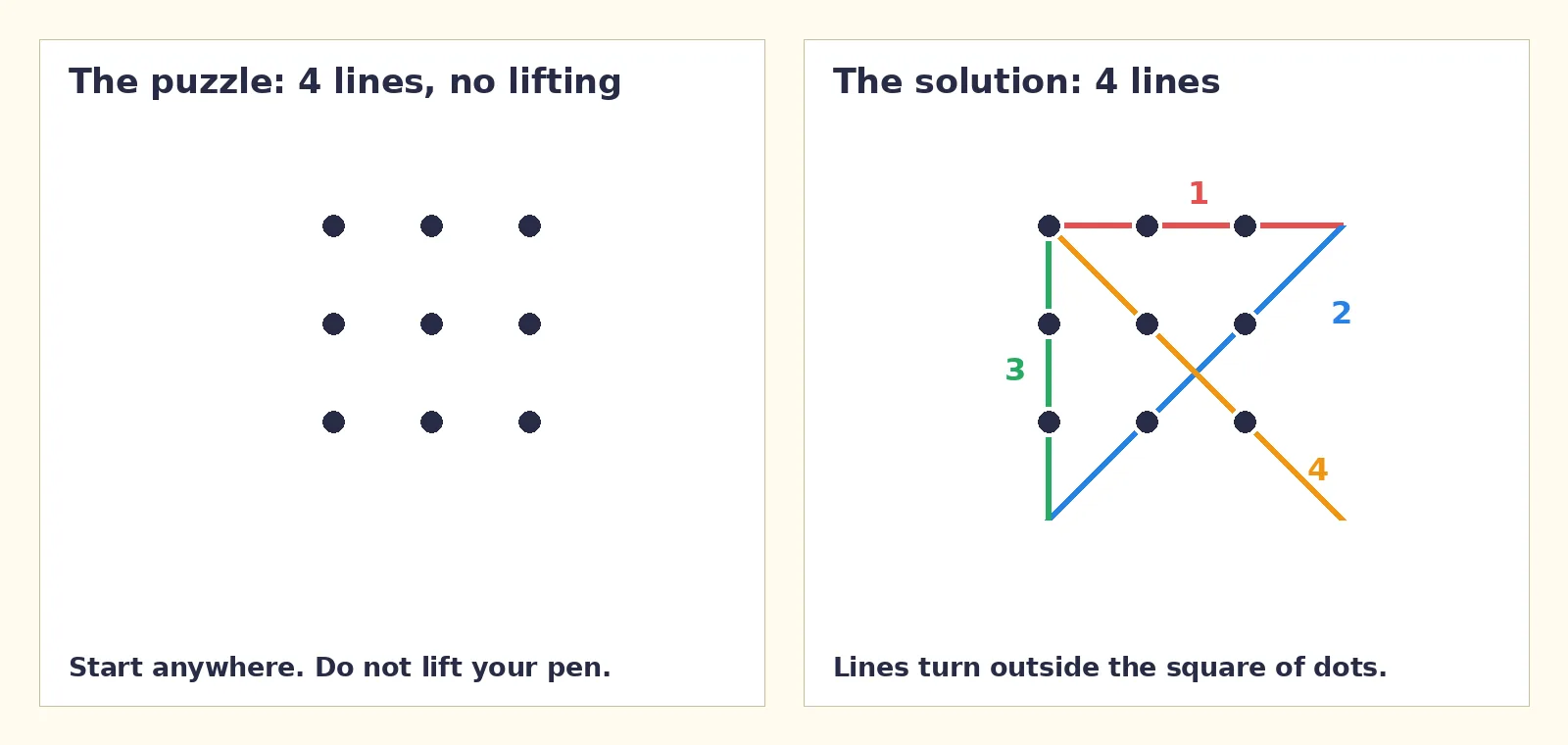
Draw a grid of nine dots, three rows of three. Your task is to join all nine dots using only four straight lines, without lifting your pen from the paper and without going back over a line. Give it a proper try before you read on.
Can you join all nine dots with four straight lines without lifting your pen? (3 marks)
Yes. Start at a corner dot and draw a line along the top row, carrying on past the last dot. Turn and draw a diagonal line down-left through two dots to below the bottom-left corner. Draw a vertical line up the left-hand column to the top-left dot, then finish with a diagonal line through the middle dot to the bottom-right corner. Two of the turning points lie outside the square of dots.
Most people fail at first, and the reason is interesting. Nothing in the instructions says the lines must stay inside the square. Your mind quietly adds that rule by itself, because the dots look like a box. The solution only appears when you notice the invented rule and drop it.
Where does the puzzle come from?
Versions appeared as early as 1907, including Sam Loyd’s “Columbus egg” puzzle in The Strand Magazine and a nine-dot version in A. Cyril Pearson’s puzzle book. Loyd’s Cyclopedia of Puzzles (1914, published after his death) is the best-known early source. Loyd linked it to the story of Columbus and the egg, in which a problem looks impossible until someone breaks an unspoken rule. The idea behind the puzzle is probably older than Loyd's book. The expression "thinking outside the box" later became a popular way of describing the solution strategy.
The puzzle also has cheeky alternative answers, which is a good sign that you are thinking laterally:
- Three lines. Real dots have a size. If you slant three lines very slightly, a single wide pen stroke can cover a whole row of dots.
- One line. Roll the paper into a tube so the dots line up in a spiral, or fold the paper so the dots sit on top of each other, and one line will do. Strictly the puzzle never said you could not.
This result matters. It shows that lateral thinking is not a trick that appears when someone says "be creative". The result suggests that a hint alone is not enough, which is one argument for practice; the study itself did not test training.
The Duncker candle problem and functional fixedness
Karl Duncker described the problem in his 1935 German monograph; it reached English readers in 1945 as On Problem-Solving. It is a problem that psychology students still meet today (the cork-wall version is the later, Glucksberg-era setup). You sit at a table next to a cork wall. On the table are a candle, a book of matches and a small box full of drawing pins (thumb tacks). Your job is to fix the candle to the wall so that it burns without dripping wax onto the table.

How can you fix the candle to the wall so the wax does not drip on the table? (2 marks)
Tip the drawing pins out of the box, pin the empty box to the wall to make a small shelf, then stand the candle in it. The box is used as a platform instead of as a container.
Many people struggle because they see the box as "the thing that holds the pins". That is called functional fixedness: being stuck on the usual job of an object so that you cannot see another job it could do. Once the pins are on the table, outside the box, the box looks like a shelf and the solution jumps out.
What did the experiments show?
In 1962 the psychologist Sam Glucksberg compared two versions of the task. In one, the pins were inside the box. In the other, the box was empty and the pins lay beside it. The empty-box group solved the problem more often and faster. The label "container" had simply never been attached to the box.
Glucksberg also offered cash prizes for speed to some volunteers. You might expect money to sharpen the mind, but in the harder pins-inside version the people offered a prize were slower. Pressure can make you cling harder to the obvious idea.
How to break free from fixed thinking
Functional fixedness and the invented box around the nine dots are two examples of the same thing: a fixed idea. The second infographic in this article shows how lateral thinking helps you question assumptions and explore alternative perspectives.

Here are some practical ways to loosen a fixed idea. They are not magic, but each one gives you a different handle on the problem.
- Describe the problem without jargon. "Keep the candle off the table" is more open than "use the pins".
- List every object and ask what else it could do. A box can be a shelf, a hat, a ruler or a boat.
- Take something away. What if you were not allowed to use the most obvious tool?
- Say the problem to someone else. A listener who does not share your assumptions will often ask the question that cracks it.
Scientists do this all the time. A strange result in an experiment is only useful if someone is willing to ask whether the equipment, the method or the theory is the thing that is wrong. Our guide to the scientific method shows where those questions fit into an investigation.
Generate more creative solutions
The third panel of our infographic series is about quantity. Lateral thinking encourages you to look beyond the obvious and produce several ideas, to combine different concepts and to try unusual approaches. The reason is simple: your first idea is usually the same as everybody else's first idea.

Try this with a real classroom problem, such as how to stop a paper bridge from sagging under a load. A straight-line thinker might add more paper. A lateral thinker lists several routes first: fold it into a tube, add a curve, change where the weight sits, use a different shape, share the load across more supports. Only after the list exists do they pick one and test it.
That order matters. If you judge each idea the second it appears, the odd ones die before they have a chance to turn into something good. Make the list first, then use your logic to decide.
Creative ideas also come from what is already in your head. Mixing two unrelated ideas, such as a bird's wing and a plane, or a burr's hooks and a fastener, can produce a new one. The more you know, the more raw material you have to mix. That is one reason curiosity about everything pays off, and why we wrote about curiosity and imagination skills for students.
Now that you have seen why fixed ideas trap us, let us look at the actual techniques you can use to escape them.
Lateral thinking techniques you can practise
De Bono did not just describe lateral thinking; he offered tools for doing it on purpose. Here are the best known. Each one is a way of forcing your mind off its usual track.
1. Random entry
Pick a word or object at random, for example by opening a dictionary and stabbing a finger at the page, and then force a link between that word and your problem. Suppose the problem is "make homework less boring" and your random word is "lighthouse". A lighthouse warns of danger and guides ships. You might build a homework planner that flags the tasks that are about to become urgent, or turn a revision session into a guided route with checkpoints. The word has nothing to do with homework, and that is the point: it drags you somewhere your normal thinking would never go.
2. Provocation (PO)
De Bono used the short word "PO" to mark a deliberately outrageous statement, such as "PO: the car has square wheels" or "PO: the school has no timetable". You do not claim it is true. You ask what it makes you notice. Square wheels might lead you to think about suspension that absorbs bumps; no timetable might lead you to a flexible system where students choose when to study each subject. A provocation is a stepping stone, not a destination.
3. Reversal
Turn the problem upside down. Instead of "How do I get better marks?", ask "What would guarantee that I get worse marks?" The answers (never reviewing, staying up all night, ignoring feedback) become a list of things to avoid, and a few of the reversed answers point to real improvements. Reversal is also one of the prompts in SCAMPER, below.
4. Challenge
Ask "Why is it done this way?" about something everyone takes for granted. This is not rude; it is how you find out which rules are real and which are just habits. Sometimes there is a good reason. Sometimes nobody remembers one, and the habit can be changed.
5. Alternatives
Deliberately look for more than one answer even when you already have a good one. This is the "rule of three" from earlier in this article. Having alternatives also protects you against your first idea being wrong.
SCAMPER: seven questions for any idea
SCAMPER is a checklist that gives your imagination seven prompts to work through. It was put together by the American educator Bob Eberle and described in his 1971 book SCAMPER: Games for Imagination Development. Eberle built it on an earlier checklist by the advertising executive Alex Osborn, from his 1953 book Applied Imagination. Each letter is a question you ask about an existing object or idea.
| Letter | Question | Example: a school bag |
|---|---|---|
| Substitute | What could I swap for something else? | Replace zips with magnetic clasps |
| Combine | What could I join together? | Bag plus a built-in lunch box |
| Adapt | What else is like this that I could copy from? | Borrow a hiker's chest strap to spread the weight |
| Modify | What could I make bigger, smaller or different? | A slimmer bag for the days with fewer books |
| Put to another use | Who else could use it, or for what? | A bag that unfolds into a seat |
| Eliminate | What could I remove? | Remove the outer pockets nobody uses |
| Reverse | What if I turned it around or rearranged it? | Heaviest books against the back, not the front |

SCAMPER is useful because you do not have to wait for inspiration. You go down the list and let each letter pull an idea out of you. It also works for improving a science practical: Substitute a cheaper material, Eliminate a step that adds error, Reverse the order in which you add the reagents (when it is safe to do so and your teacher agrees).
Divergent thinking: what psychologists measure
Psychologists have their own name for the "many ideas" half of creativity: divergent thinking. The American psychologist J. P. Guilford drew attention to it in his 1950 speech to the American Psychological Association, when he called for far more scientific research on creativity. He argued that creativity is not the same as intelligence and that divergent thinking is central to it. Its partner is convergent thinking, where you narrow many options down to the best one. This pairing is very close to de Bono's lateral and vertical thinking, although they come from different traditions.
The classic test is the Alternate Uses Task, often attributed to Guilford. You are given an everyday object, such as a brick or a paper clip, and a time limit. You list as many unusual uses as you can. Answers are scored in four ways:
- Fluency: how many ideas you produce.
- Flexibility: how many different categories those ideas fall into.
- Originality: how unusual your ideas are compared with other people's.
- Elaboration: how much detail you add to each idea.
"A paper weight, a bookmark, a hook" is fluent but not very flexible, because all three are small office jobs. "A bookmark, a tiny fishing hook, an earring, a lock pick" jumps across categories and scores higher on flexibility. The test is a neat way to see where your thinking gets stuck.
Give four uses for a paper clip that fall into four different categories. (4 marks)
Any four sensible answers from different categories earn the marks, for example: holding papers together (stationery); resetting a device through a tiny hole (tool); straightened into a fishing hook (outdoors); bent into a zip-pull or a decorative charm (craft/jewellery).
The Six Thinking Hats
De Bono's 1985 book Six Thinking Hats turned his ideas into a meeting method. The group imagines six hats, and everyone uses the same hat at the same time:
| Hat | Mode of thinking |
|---|---|
| White | Facts and information |
| Red | Feelings and hunches |
| Black | Caution and risks |
| Yellow | Benefits and positives |
| Green | New ideas and alternatives |
| Blue | Organising the discussion |
A team that has to decide whether to hold a school science fair outdoors could work through it like this. White hat: how many stalls, what is the forecast? Red hat: how does everyone feel about it? Black hat: what if it rains? Yellow hat: fresh air, more space. Green hat: could we use a marquee? Blue hat: who decides, and when?
The technique is popular in teams and classrooms because it stops people from criticising ideas the moment they are said. Some teams report that it improves how they work together, though rigorous evidence is limited. We explore teamwork in growth mindset in teamwork for GCSE students.
Three more lateral puzzles to try
Puzzles are the gym for this skill. Cover the answer, give it two minutes, then reveal it.
A man pushes his car to a hotel, then tells the owner he is bankrupt. Why? (1 mark)
He is playing Monopoly. He pushed his piece, the little car, to a square with a hotel on it and cannot afford the rent.
Two coins add up to 30p. One of them is not a 10p coin. What are the coins? (1 mark)
A 20p and a 10p. Only one coin is not a 10p (the 20p), so the other can be one.
How can you make four equal triangles from six matches, all the same length, without breaking them? (2 marks)
Stop thinking flat. Build a three-dimensional pyramid (a tetrahedron): three matches form a triangle on the table, and the other three rise to meet at a point above the middle. That gives four triangular faces.
If you got any of those, you probably did what lateral thinkers do: you changed the question. "Car" became a game piece, "not a 10p" became "not both", and "on the table" became "in the air". The next section shows how that skill carries over to real choices and to dealing with change.
Make better decisions
Decisions are where lateral thinking pays off in everyday life. When you choose a subject, plan revision or decide how to spend a Saturday, you normally pick from the options that first come to mind. Lateral thinking widens that list before you choose.

The fourth panel of our infographic series says that lateral thinking helps you see what others may miss, identify hidden assumptions and consider different consequences before choosing a solution. A simple routine puts that into practice:
- Write the decision as a question. "Which revision method should I use?" is better than "I need to revise."
- List at least three options, including one that feels silly.
- Challenge one assumption behind each option. Do I really need a quiet room? Must it be a full hour?
- Imagine the consequences a week and a year from now.
- Then switch to logic and choose, using evidence where you can.
Our guide on how to improve critical thinking for your job covers how analysis and creativity combine at work.
Adapt to change
Plans fail. The practical you prepared does not work, the exam question is not the one you revised, or the job you wanted no longer exists. Practising looking sideways may help you cope, because you have rehearsed the move of asking "What else could I do?".

The fifth panel puts it this way: the infographic suggests that lateral thinkers respond better to unexpected challenges and find opportunities in uncertainty. That is a claim rather than a proven result, but it describes of how many scientific discoveries happen. A result that does not fit the prediction is not a failure if someone is willing to ask what it might mean instead.
Limits: what the evidence does and does not show
An honest article about thinking skills has to say where the evidence is weak. Here is what we can say with fair confidence, and what we cannot.
- Fixed ideas are real. Experiments on the candle problem and the nine-dot problem show that people get stuck on assumptions they added themselves. That is solid, well-tested psychology.
- Divergent thinking can be measured. Tests such as the Alternate Uses Task are widely used in creativity research.
- De Bono's training programmes are less proven. Critics point out that his methods have been little tested in rigorous studies, and that it is not clear the six hats match six separate processes in the brain. His techniques are popular and many people find them useful, but "popular" is not the same as "proved to improve your marks".
- A hint alone was not enough. In the 1981 nine-dot experiment, telling people to go outside the square did not make most of them solve it, so do not expect one tip to do the job.
So treat lateral thinking as a useful set of habits for generating options, not a guaranteed route to good grades. Used alongside subject knowledge and careful reasoning, it can help you in the places where the textbook method runs out. If you want to see how reasoning and recall support each other, see how to practise and remember what you study.
Make lateral thinking a habit
Because it is a skill, the way to improve is small, regular practice. The last infographic in the series lists five habits you can start this week.
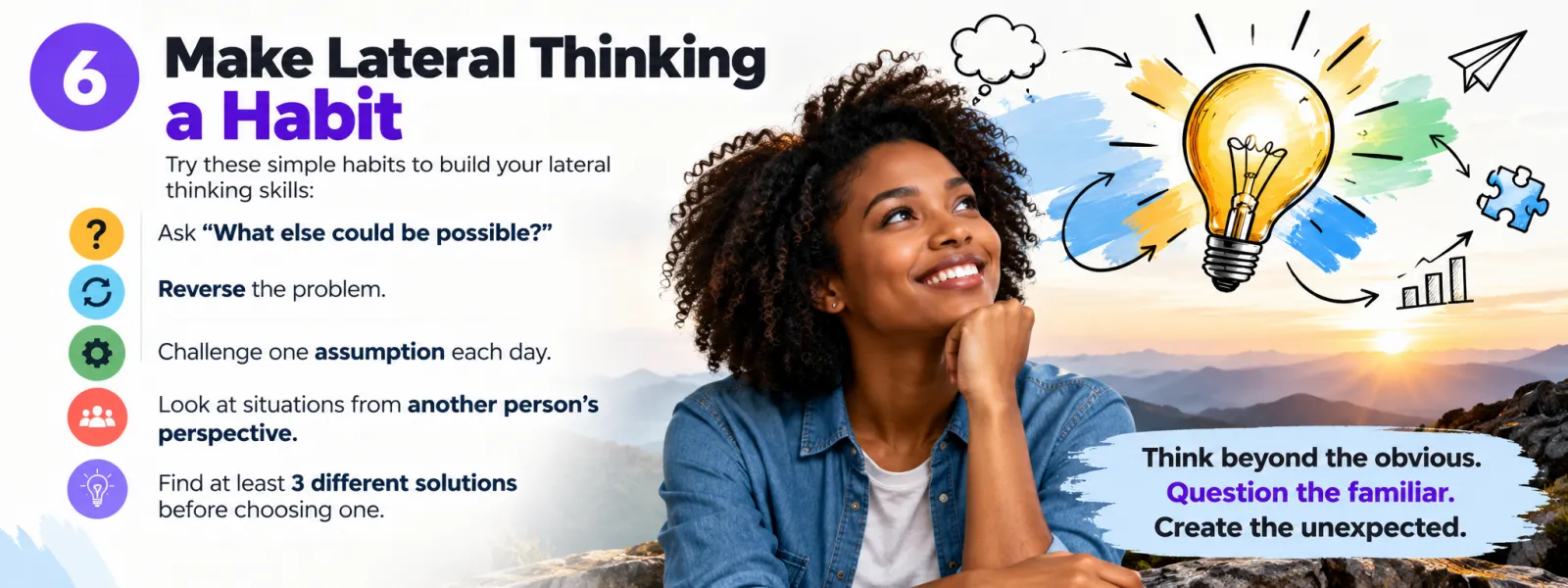
- Ask “What else could be possible?” about one problem today
- Reverse a problem: how could I make it worse?
- Challenge one assumption you made this week
- Look at a situation from another person’s point of view
- Find at least three solutions before choosing one
- Try one lateral puzzle from this article on a friend
Pair the habits with some science. The next time you read about an experiment, ask what the researchers assumed and what else could explain the result. Our article on why critical thinking is important for science students shows how to turn that questioning into marks.
Test yourself
Frequently asked questions about lateral thinking
What is lateral thinking in simple words?
Lateral thinking is solving a problem by looking at it from a different angle instead of following the obvious steps. You question assumptions, try unusual ideas and consider alternatives. The term was introduced by Edward de Bono in 1967 and is often described as thinking sideways.
Who invented lateral thinking?
The Maltese doctor and psychologist Edward de Bono coined the term "lateral thinking" in 1967. He later wrote many books on thinking skills, including Six Thinking Hats in 1985. Other psychologists, such as Karl Duncker and J. P. Guilford, studied related ideas such as problem-solving and divergent thinking.
What is the difference between vertical and lateral thinking?
Vertical thinking is logical and step-by-step, with each step needing to be correct. Lateral thinking moves sideways to produce many possible ideas, including unusual or deliberately "wrong" ones, to find new routes. Most real problems need both: lateral thinking for ideas and vertical thinking to test them.
What are examples of lateral thinking techniques?
Common techniques are random entry (linking a random word to your problem), provocation or PO (making an outrageous statement to spark ideas), reversal (turning the problem upside down), challenging assumptions and SCAMPER. Brainstorming several alternatives before choosing is another simple method.
What is the nine-dot puzzle?
The nine-dot puzzle asks you to join a 3×3 grid of dots with four straight lines without lifting your pen. It can only be solved by drawing lines beyond the square of dots. Sam Loyd published versions of it in the early 1900s (1907, and in his 1914 Cyclopedia of Puzzles), and it inspired the phrase "thinking outside the box".
What is the candle problem?
The candle problem is a puzzle described by psychologist Karl Duncker in 1935 (English translation 1945). You must fix a candle to a wall using a box of drawing pins and matches. The solution is to pin the empty box to the wall as a shelf. It demonstrates functional fixedness.
Can you learn lateral thinking?
Probably: you can build the habits behind it, such as questioning assumptions, listing alternatives and looking at problems from other viewpoints. One classic experiment (Weisberg and Alba, 1981) found that simply being told where to look was not enough to solve the nine-dot puzzle, though that study did not test training. Evidence on creativity training is mixed, but practising techniques such as SCAMPER can help some people generate more ideas.
What does SCAMPER stand for?
SCAMPER stands for Substitute, Combine, Adapt, Modify, Put to another use, Eliminate and Reverse. Bob Eberle described it in a 1971 book, building on a checklist by Alex Osborn. You ask each question about an existing idea or product to generate improvements.
Is lateral thinking scientifically proven?
Parts of it are supported, such as research on fixed assumptions and on measuring divergent thinking. De Bono's own training methods, however, have had little rigorous testing, according to critics. They are popular and many people find them helpful, but strong evidence that they improve results is limited.
Why is lateral thinking important for students?
It helps you tackle questions that have no ready-made method, such as suggesting improvements to an experiment or explaining an unexpected result. It also helps with decisions, teamwork and adapting when plans fail. It works best alongside solid subject knowledge and careful logical reasoning.