The future of commercial spaceflight depends on one thing above all: how cheaply and how often private companies can reach orbit. As of October 2026, reusable rockets have made launches far more frequent, new space stations are being planned to replace the International Space Station, and the Moon is being treated as a destination for customers as well as astronauts. Some of this already exists, some is planned, and some is still speculation. This guide keeps those three apart.
A new space age: the commercial space industry today
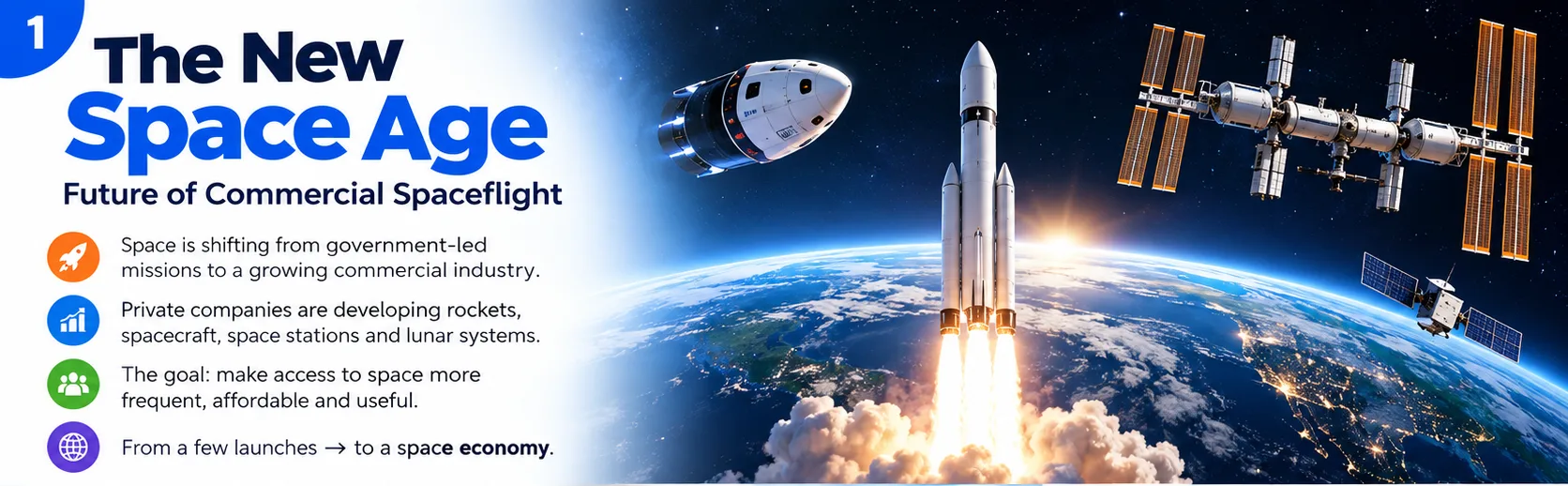
For most of the twentieth century, spaceflight was run by governments. Rockets were built for national agencies, and the customer was the state. Today the commercial space industry includes companies that build rockets, operate satellites, fly paying passengers and sell services to space agencies such as NASA. The agency often acts as one customer among many rather than as the owner of the whole system.
This article looks forward rather than back. If you want the timeline of how we got here, and the companies involved, our guide to private space flight covers the history in detail.
What has changed is the economics. The satellite business, covering communications, navigation and Earth observation, is the largest part of the space economy. The Space Foundation estimated the global space economy at about US$686 billion in 2025, up from US$613 billion in 2024. Passenger flights make the headlines, but satellites bring in most of the money.
It helps to sort every claim about the future into three boxes:
- Exists now: flying hardware and paying customers, such as routinely reused Falcon 9 boosters.
- Planned: funded or contracted projects with target dates, such as the retirement of the ISS around 2030. Dates in this industry often move.
- Speculative: ideas that have been proposed but not developed, such as rocket travel between cities on Earth.
Reusable rockets: the key to cheaper access to space
Traditional rockets were thrown away after one flight. Imagine flying a jumbo jet across the Atlantic and scrapping it on arrival. Ticket prices would be astronomical. Reusable rockets change that sum by recovering the most expensive hardware and flying it again.
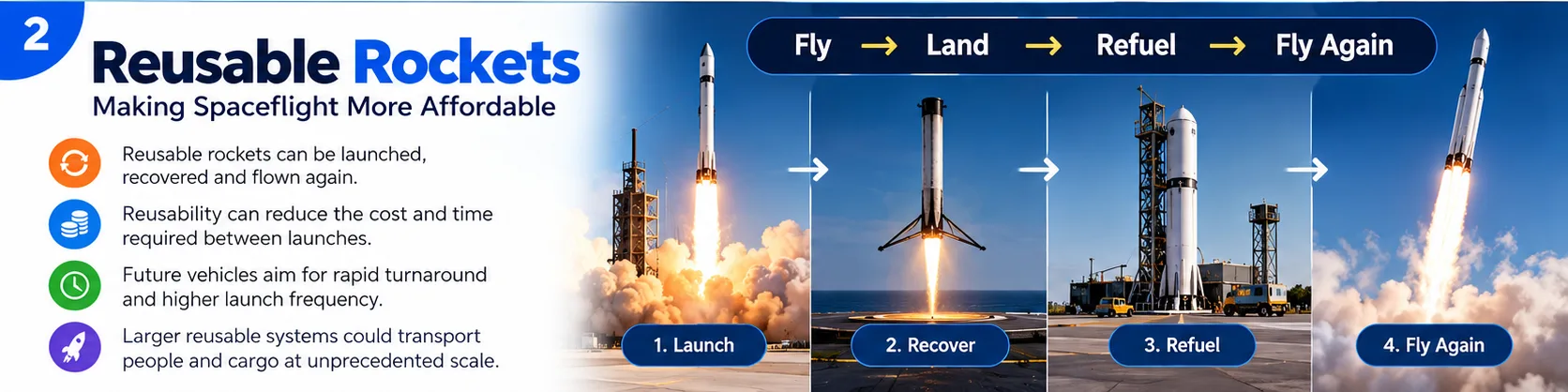
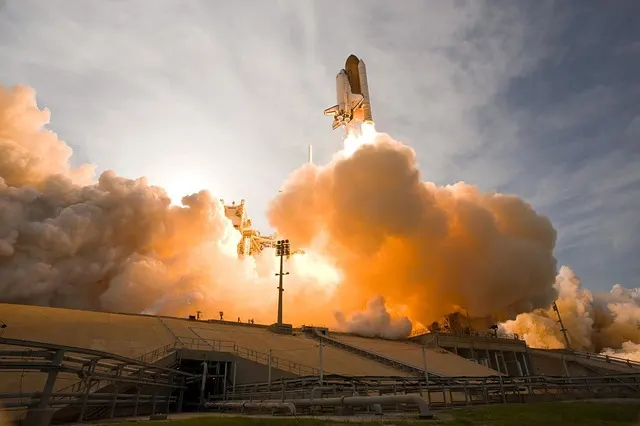
The best-known example is the Falcon 9. Its first-stage boosters fly back and land, then are refurbished and launched again. This is now routine rather than experimental. By August 2026 a single booster had flown 37 times, a record for a rocket stage.
The physics is the same as for any rocket. The engines push exhaust gas downwards, and the rocket is pushed upwards in reaction. Landing a booster means firing the engines again to slow it down, a controlled use of the same principle explained in Newton’s laws of motion.
Fully reusable systems, where the upper stage is recovered too, are the next step. SpaceX’s Starship is the leading example, and as of October 2026 it reached orbit for the first time on 28 September 2026, but it is still in test flights and is not yet in regular service. Until a system carries customers on repeated flights, treat promises about its prices with caution.
How much cheaper has it become?
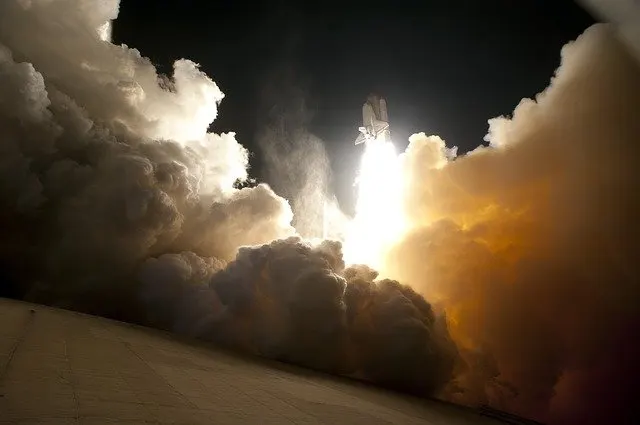
Launch costs to low Earth orbit have fallen by more than ten times since the Space Shuttle era. The Shuttle cost tens of thousands of US dollars for every kilogram sent to orbit. Falcon 9 costs a few thousand dollars per kilogram. These are rough, rounded figures, and exact prices depend on the mission, the customer and the contract.
A drop of that size matters. Satellites can be built and launched in larger numbers, research payloads become easier to afford, and new business ideas become worth trying. Use the calculator below to compare the two eras for a payload of your choice.
Notice that “roughly ten times cheaper” is not the same as “cheap”. A few thousand dollars per kilogram still means that a person with their luggage costs a very large sum to launch before any seat, training or safety margin is added.
Life after the ISS: commercial space stations
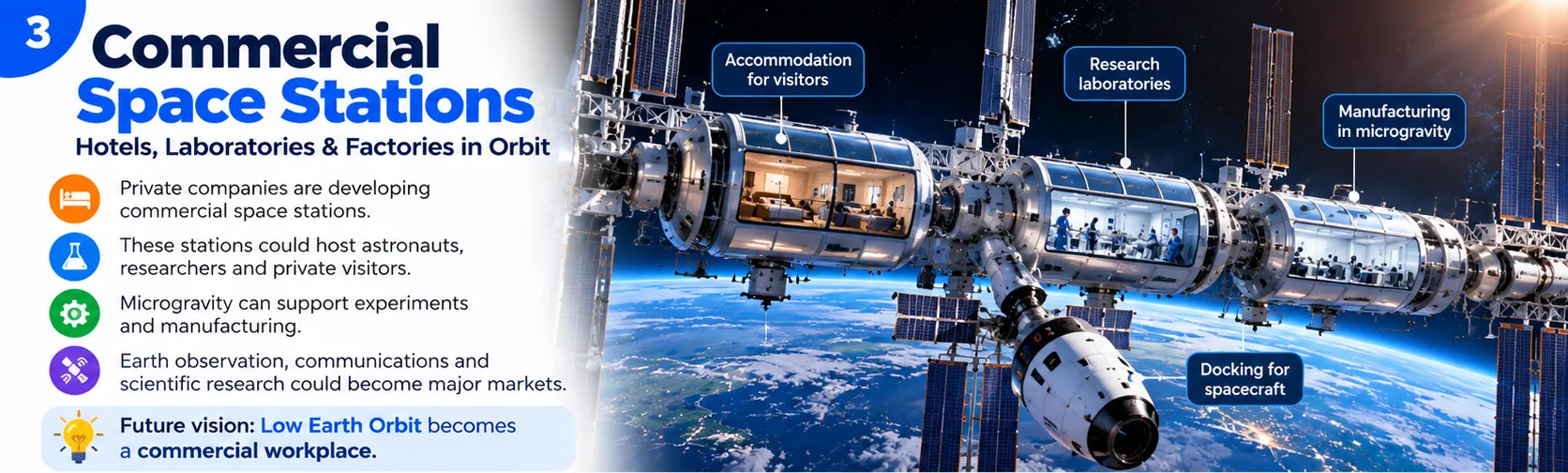
The International Space Station (ISS) has hosted crews continuously for decades, but it is not permanent. As of October 2026, the plan is to retire it and bring it down in a controlled deorbit around 2030–2031. In June 2024, NASA contracted SpaceX to build the US Deorbit Vehicle that is meant to guide it safely back.
That raises an obvious question: what replaces the ISS? The answer being tried is commercial space stations, owned and operated by companies, with NASA as one customer among others. This is a central part of the wider commercial space industry.
What exists and what is only proposed
It helps to keep two lists apart. Today, the ISS is the only crewed station in this story that is actually flying. Everything below is a proposal or a plan, and NASA’s own plans for its Commercial LEO Destinations programme are still changing.
- Axiom Space has proposed a commercial station. It has already flown private crews to the ISS (2022–25), but the station itself is a plan.
- Vast has planned its Haven-1 station for 2027. That date is a target, not a promise.
- Starlab is a joint venture involving Voyager and Airbus.
- Orbital Reef is proposed by Blue Origin and Sierra Space.
Why a “hotel in space” is not the whole story
Will there be hotels in space? Some proposals imagine visitors as well as astronauts, but a station would first have to earn its keep. Possible customers include space agencies, research teams, companies testing materials in microgravity and private visitors. Which of these will pay enough to support a station is still an open question, and that is exactly why NASA’s approach has been to ask several companies to propose designs rather than to bet on one.
For students, the useful idea is the shift in who owns the infrastructure. In the ISS era, governments built and ran the station. In the proposed model, governments buy services from a commercial operator, much as they already buy launches.
Space tourism: where it stands and where it’s going
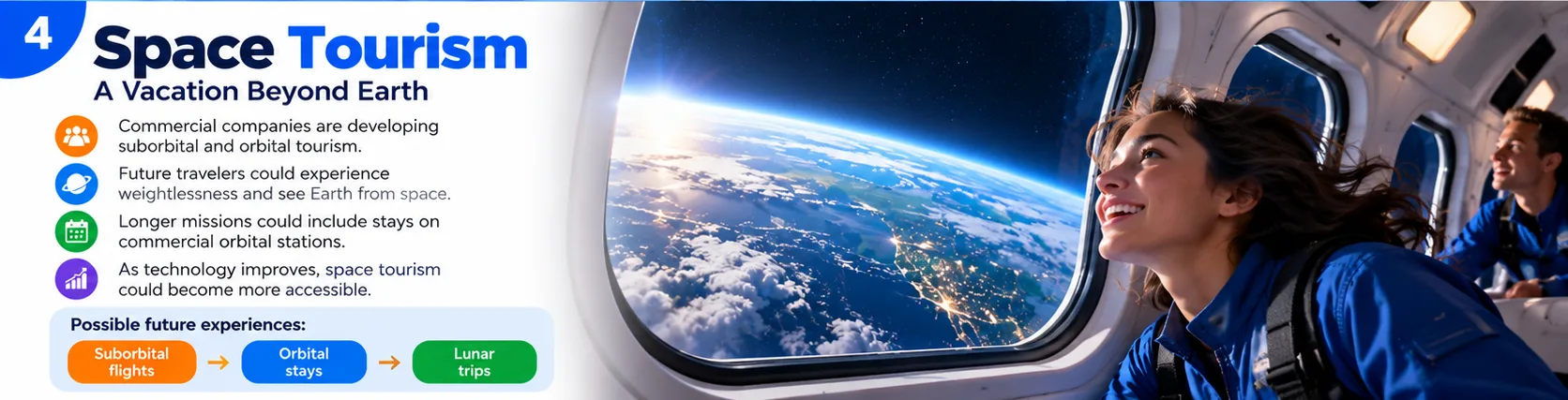
The space tourism future is easy to hype and easy to dismiss, so it is worth sticking to what has actually happened. There are two very different kinds of trip. A suborbital flight rises to the edge of space and returns within minutes. An orbital flight goes fast enough to circle the Earth and stay up for days or longer.
Both have flown with paying or private crews. Neither is cheap. Seats on Axiom missions have reportedly cost tens of millions of US dollars, and suborbital tickets have reportedly been in the hundreds of thousands. In October 2026, price remains the main barrier for almost everyone.
Status of space tourism, October 2026
| Type | Example | Status Oct 2026 |
|---|---|---|
| Suborbital | Virgin Galactic | Flights paused since 2024; its Delta-class spaceplane is targeted for 2027 (a target, not a promise) |
| Suborbital | Blue Origin New Shepard | Paused since January 2026 for at least two years |
| Orbital, free-flying | Inspiration4 (2021) | Completed; a private crew |
| Orbital, free-flying | Polaris Dawn (2024) | Completed; included the first commercial spacewalk |
| Orbital, to the ISS | Axiom missions (2022–25) | Completed; private crews visited the station |
| Orbital, to a commercial station | Haven-1 and others | Planned only; no commercial station is flying yet |
Two things stand out. First, both of the main suborbital programmes are currently on pause, so the short “edge of space” trip is not available to book right now. Second, the completed orbital flights all happened because a launch company, a spacecraft and a customer came together for a single mission.
Will space travel become affordable?
Reusable rockets have lowered the cost of reaching orbit, but the ticket price for a person depends on more than the launch. Life support, training, safety checks and the cost of developing a spacecraft all add up. No company has shown that these will fall far enough for ordinary holidays, and nobody can honestly promise a date. A fair summary is that tourism is real but exclusive, and its future depends on cheaper launches, reliable vehicles and enough paying customers.
Point-to-point rocket travel on Earth (speculative)
One of the most eye-catching ideas is using rockets to cross the planet. Instead of a long-haul flight, a passenger would leave from one city, travel above the atmosphere and land at another. SpaceX has proposed this idea, but it has not been developed. This section is therefore speculation, and it is important to say so plainly.
The hurdles are large:
- Noise. Rocket launches and landings are very loud, which makes a spaceport near a big city hard to imagine.
- Safety. Carrying many passengers on a rocket flight many times a day would need a far better safety record than spaceflight has today.
- Cost. Even with reusable rockets, the fare would have to compete with conventional aircraft.
Even so, the idea is useful to think about. It shows how a technology developed for one purpose, in this case cheaper access to orbit, might one day be applied to something else entirely. Whether it ever makes sense will depend on engineering, regulation and public acceptance as much as on rocket performance.
In short, the next step for the future of commercial spaceflight in low Earth orbit looks like replacing a government-run station with company-run ones, while tourism stays small and expensive. Taking rockets to everyday transport is a long shot.
The Moon becomes a destination
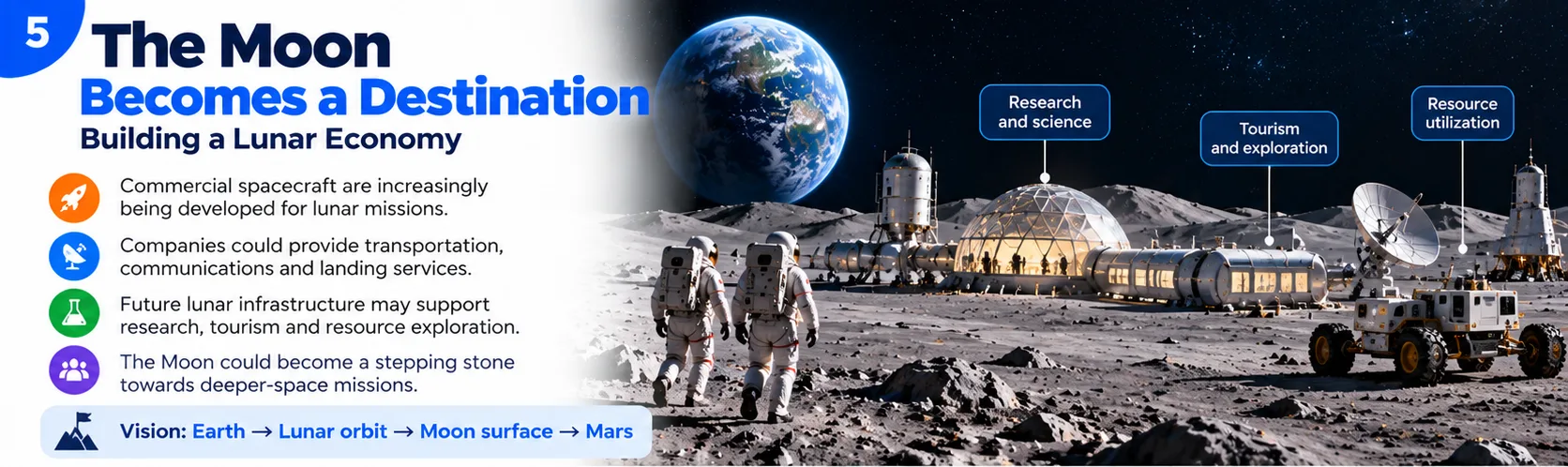
For half a century the Moon was a place that only governments visited. That is changing, and the change is a big part of the future of commercial spaceflight. Public agencies still set the goals, but private companies are now building the landers, carrying the instruments and, in some cases, owning the hardware. The early lunar economy is really a customer-and-supplier relationship between NASA and the commercial space industry.
This section separates three things: what has already happened, what is officially planned, and what is still only an idea. Dates below are as of October 2026 and NASA’s plans have changed more than once.
Artemis: where things stand
NASA’s Artemis programme is the framework for returning people to the Moon. Artemis II, a crewed flight around the Moon, flew in April 2026. Under NASA’s 2026 plan, Artemis III (planned for 2027) is now an Earth-orbit test of commercial landers, and the first crewed landing is planned for Artemis IV, around 2028.
Notice the word commercial. NASA is buying lander services from companies rather than designing every spacecraft itself. If a lander is not ready, the landing date moves, so treat every date here as a planned target, not a promise.
CLPS: commercial robots go first
Before astronauts return, robotic missions are testing the way. NASA’s Commercial Lunar Payload Services (CLPS) programme pays companies to deliver science and technology payloads to the lunar surface. Two results so far show how hard this is.
- Intuitive Machines IM-1 (February 2024): the first commercial soft landing on the Moon, although the lander tipped over on touchdown.
- Firefly Blue Ghost (March 2025): landed upright.
Landing on another world is difficult, and a tipped lander that still returns data is a partial success rather than a failure. The pattern is the same one reusable rockets followed on Earth: attempt, learn, improve.
Why the south pole matters
Carrying water from Earth is extremely expensive, so any ice on the Moon is valuable. Split water into hydrogen and oxygen and you have the two ingredients of rocket propellant. A base near the pole could, in principle, supply crews and refuel spacecraft. That is a long-term idea, and nobody has yet mined lunar ice at scale.
Mining and manufacturing in space
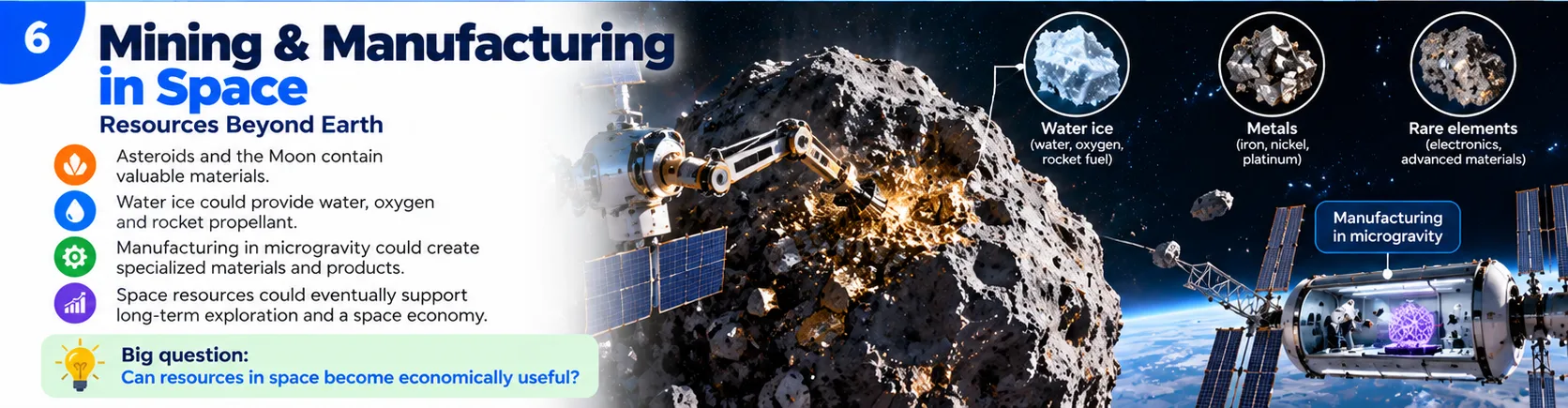
Few topics in the commercial space industry attract more headlines than space mining. It is worth being direct: no commercial mining has happened yet. What exists today is small-scale science, technology demonstrations and a lot of planning.
Using resources where you find them
The core idea is in-situ resource utilisation (ISRU): making use of local materials instead of hauling everything from Earth. Water ice could provide drinking water, oxygen to breathe and hydrogen plus oxygen for propellant. This is the main reason the Moon’s poles attract so much interest.
A real demonstration of ISRU has already flown. NASA’s MOXIE instrument on the Perseverance rover made oxygen from the carbon dioxide in Mars’s atmosphere between 2021 and 2023, about 122 g in total. It is a tiny amount, but it proved the chemistry works on another planet.
What about asteroids?
Asteroids have been sampled, but only in grams. Japan’s Hayabusa2 returned material from the asteroid Ryugu in 2020, and NASA’s OSIRIS-REx returned material from Bennu in 2023. Both were science missions, not mining. To learn how scientists study space rocks that reach us naturally, see our guide to meteorites and the universe.
So the answer to “can we mine asteroids?” is not yet. The step from returning grams to profitably returning tonnes is enormous, and no company has demonstrated it.
Who owns what is dug up?
Law is a real obstacle. The Outer Space Treaty of 1967 bans national appropriation, meaning no country can claim the Moon or an asteroid as its territory. But some countries have decided that this does not stop companies owning resources they extract. The United States passed the Commercial Space Launch Competitiveness Act in 2015, and Luxembourg adopted a similar law in 2017.
The Artemis Accords, started in 2020, include principles on resource use and now have dozens of countries as signatories. Not every country agrees with this approach, so international law in this area is still unsettled.
Making things in orbit
Manufacturing in space is a nearer-term idea than mining. In microgravity, liquids do not settle or sink in the usual way, which may allow some materials to form with fewer flaws. Research on the International Space Station has looked at protein crystals and optical fibres. ZBLAN, a type of optical fibre, is a frequently cited candidate.
One company has already brought products home. Varda Space Industries returned capsules carrying pharmaceutical crystals grown in orbit, the first in February 2024. Whether this can become a sustainable business is still an open question, and it is part of the wider space economy that is still taking shape.
Taken together, the Moon, resources and orbital factories show how the space economy could widen beyond satellites. Each step depends on cheaper launches, reliable landers and clear rules. The next part looks at the economy as a whole, and at the risks that come with it.
The space economy of tomorrow
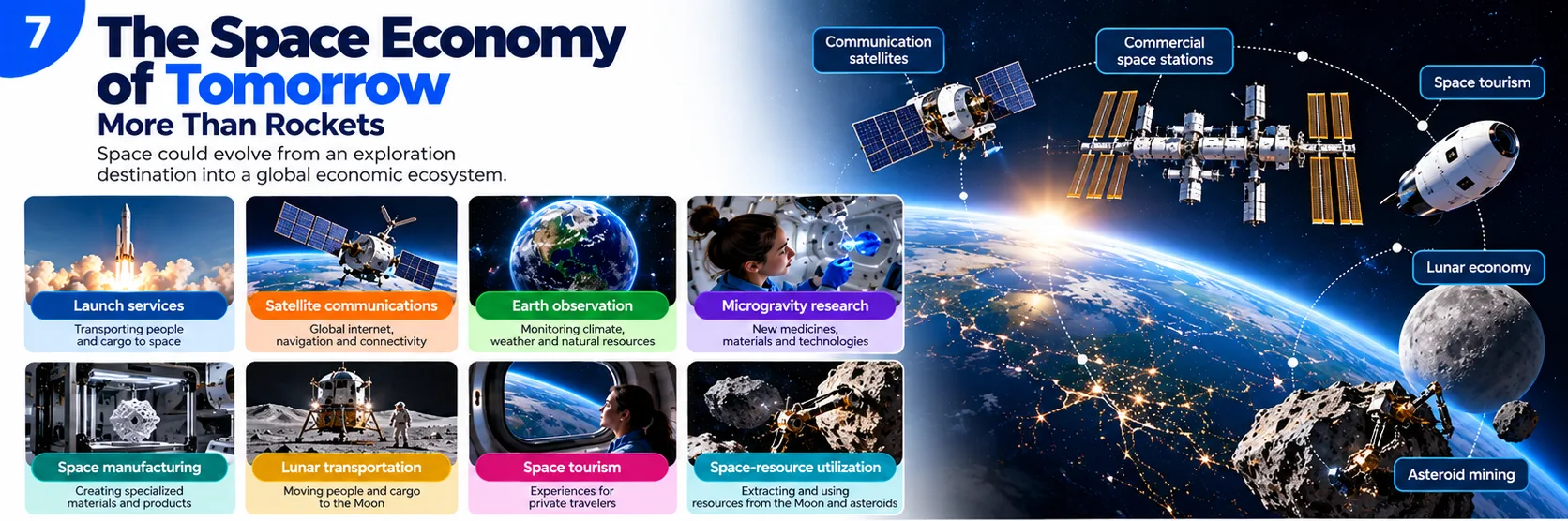
When people picture the space economy, they usually imagine rockets and astronauts. In reality, most of the money is made by satellites that never leave orbit. Communications, navigation and Earth observation make up the biggest part of the industry. Your phone’s map app, a weather forecast and a farmer’s crop-monitoring service all depend on them.
The Space Foundation put the global space economy at about US$686 billion in 2025, and it is still growing. Megaconstellations such as Starlink and Amazon Leo, which use large numbers of small satellites working together, are expanding fast. That is why the commercial space industry is far larger than the handful of launch and tourism companies in the headlines.
Cheaper launches matter here too. If getting a satellite into orbit costs more than ten times less than in the Shuttle era, more companies, universities and countries can afford to build one. For the story of how those companies appeared in the first place, see our history of private space flight, which we will not repeat here.
Solar power from orbit: experimental
One long-studied idea is space-based solar power. Panels in orbit would collect sunlight without clouds or night, then beam the energy to Earth. In 2023, Caltech demonstrated wireless power transfer in space. This is a genuine step, but it remains experimental. Nobody has yet shown it can deliver useful amounts of electricity to the ground at a sensible price. To compare it with the technology we already use, read about how solar energy is used today.
Risks and responsibilities
A bigger industry brings bigger problems. The main risks of commercial spaceflight fall into a few groups, and each one needs rules rather than just good intentions.
Space debris
More satellites and more launches mean more objects in orbit, and dead satellites and fragments can collide with working ones. Cleaning up is hard, so prevention matters. Our article on how to solve the problem of space junk explains the options in detail.
Safety and regulation
Spaceflight is dangerous, and commercial flights still carry risk. In the US, the FAA licenses launches. In the UK, licensing involves the UK Space Agency and the CAA. International law has gaps, especially around who is responsible when something goes wrong far from Earth. Past accidents are a reminder of why careful testing matters, and you can read about them in failures in space travel.
Emissions and the night sky
Rocket launches release gases and black carbon (soot) high in the atmosphere. Research into their effects is ongoing, so scientists cannot yet say exactly how large the impact will be. Astronomers have also reported that bright satellites can streak across telescope images. Both issues are being studied and debated, not settled.
Who gets access?
Seats on private missions cost very large sums. Without careful policy, the benefits of space could go mostly to wealthy people and wealthy countries. That is a question of fairness, not just engineering.
What will spaceflight look like?
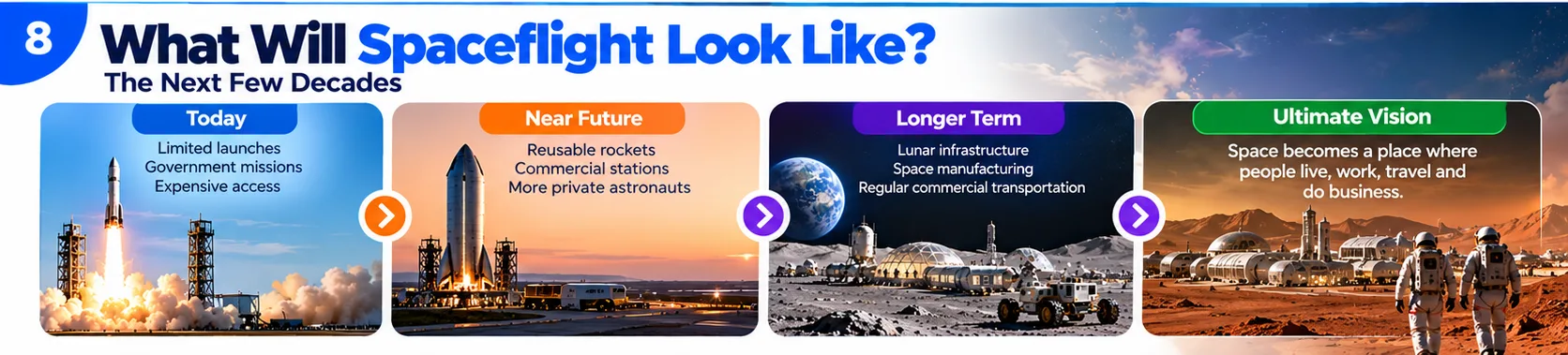
Nobody knows what space travel will be like in 2050. What we can do is separate what is true today from what is planned and what is only a possibility. All dates below are as of October 2026.
Today
- Falcon 9 boosters land and fly again routinely, with a record of 37 flights for one booster by August 2026.
- Private crews have flown to orbit, and Polaris Dawn (2024) carried out the first commercial spacewalk.
- Satellite services dominate the industry’s income.
Planned or in testing (next few years)
- Fully reusable rockets such as SpaceX Starship are still in test flights (Starship first reached orbit in September 2026), not yet in regular service.
- The ISS is due to be retired and deorbited around 2030, with commercial stations proposed to follow. Vast’s Haven-1 is planned for 2027.
- Under NASA’s 2026 plan, Artemis III (planned for 2027) tests commercial landers in Earth orbit, and the first crewed landing is planned for Artemis IV (around 2028).
Speculative (longer term)
- Speculation: hotels in orbit, regular lunar bases, mining of space resources and rocket travel between cities. Each faces major technical, legal or cost hurdles, and none has a firm date.
Whether space travel becomes affordable for ordinary people depends mostly on reuse. Launch costs have fallen, but prices for seats remain very high. Anyone promising a date for cheap holidays in orbit is guessing.
The wider picture also includes the science that draws people to space in the first place. For the bigger context, explore rockets, telescopes, satellites and the ISS, or find out how scientists search for life elsewhere in astrobiology: what you need to know.
Why do reusable rockets lower the cost of spaceflight? (3 marks)
Most of the cost of a launch is the rocket hardware itself. If the first stage lands and is flown again, the same hardware is paid for once but used many times, so the cost per flight falls. Falcon 9 launch costs are a few thousand dollars per kilogram to low Earth orbit, more than ten times cheaper than in the Shuttle era. Refurbishment and fuel still cost money, so launches are not free.
Careers in the space industry
You do not need to be an astronaut to work in space. The industry needs engineers, software developers, data scientists, lawyers, policy experts and doctors. The UK space sector employs tens of thousands of people. Satellite data analysis, spacecraft design and space law are all growing areas, so GCSE and A-level maths, physics and computing are a solid starting point.
Test yourself
Key points
- Satellite services are the biggest part of the roughly US$686 billion space economy (2025).
- Reusable rockets have made launches more than ten times cheaper, but prices for passengers remain very high.
- Space-based solar power is experimental; Caltech demonstrated wireless power transfer in space in 2023.
- Debris, safety, launch emissions, bright satellites and unequal access are real challenges that need regulation.
- Always separate what exists now, what is planned and what is speculation.
- The space sector offers careers well beyond astronauts, from engineering to law.
Frequently asked questions about the future of commercial spaceflight
What will space travel be like in 2050?
Nobody can say for certain. Likely developments include more reusable rockets, commercial space stations replacing the ISS and more Moon missions. Tourism, orbital hotels and rocket travel between cities are possibilities rather than promises, and each faces cost, safety and regulatory obstacles that could change the timeline.
Will space travel become affordable?
Launch costs have fallen more than tenfold since the Space Shuttle era, mainly through reusable rockets. However, passenger prices remain very high, with seats on orbital missions reportedly costing tens of millions of dollars. Prices may fall further, but no reliable date exists for ordinary people to afford it.
How will reusable rockets change spaceflight?
Reusable rockets lower the cost of each launch because the same hardware flies many times. Falcon 9 boosters land and refly routinely, with one booster reaching 37 flights by August 2026. Fully reusable systems such as Starship are still in testing, so their full effect is not yet known.
Will there be hotels in space?
Commercial space stations are proposed by companies including Axiom Space, Vast, Starlab and Orbital Reef, and Vast’s Haven-1 is planned for 2027. These are research and visitor stations, not luxury hotels. NASA’s plans are still changing, so timings and designs may shift.
What replaces the ISS?
The ISS is planned to end operations in 2030, followed by a controlled deorbit around 2030–2031. NASA’s Commercial LEO Destinations programme aims to support privately run stations in its place. Proposals include Axiom Space, Vast, Starlab and Orbital Reef, though nothing is final and NASA’s approach continues to evolve.
Can we mine asteroids?
Not yet. Hayabusa2 and OSIRIS-REx returned only grams of asteroid material, and no commercial mining has happened. The US (2015) and Luxembourg (2017) allow companies to own resources they extract, while the Outer Space Treaty bans national appropriation of space bodies. The legal and technical questions remain open.
What is in-space manufacturing?
It means making products in orbit, where microgravity changes how materials behave. Research on the ISS has looked at protein crystals and ZBLAN optical fibre. In February 2024, Varda Space Industries returned a capsule carrying pharmaceutical crystals grown in orbit. It is still at an early stage.
What are the risks of commercial spaceflight?
Key risks include crew safety, space debris, launch emissions, bright satellites affecting astronomy, unequal access and gaps in international law. Regulators such as the FAA, the UK Space Agency and the CAA license launches, but rules are still catching up with the industry’s rapid growth.
What jobs are there in the space industry?
Jobs include engineering, software, data science, law and policy, and medicine. The UK space sector employs tens of thousands of people. Many roles involve working with satellite data or building spacecraft, and you do not need to become an astronaut to take part in the industry.