

Why are patience and perseverance important? Because almost nothing worth learning happens quickly. Patience lets you wait calmly while progress is slow; perseverance keeps you working when things get hard. Together they turn a few good days into real, lasting skill, whether you are revising for GCSEs, learning an instrument or training for a sport.
What is patience?
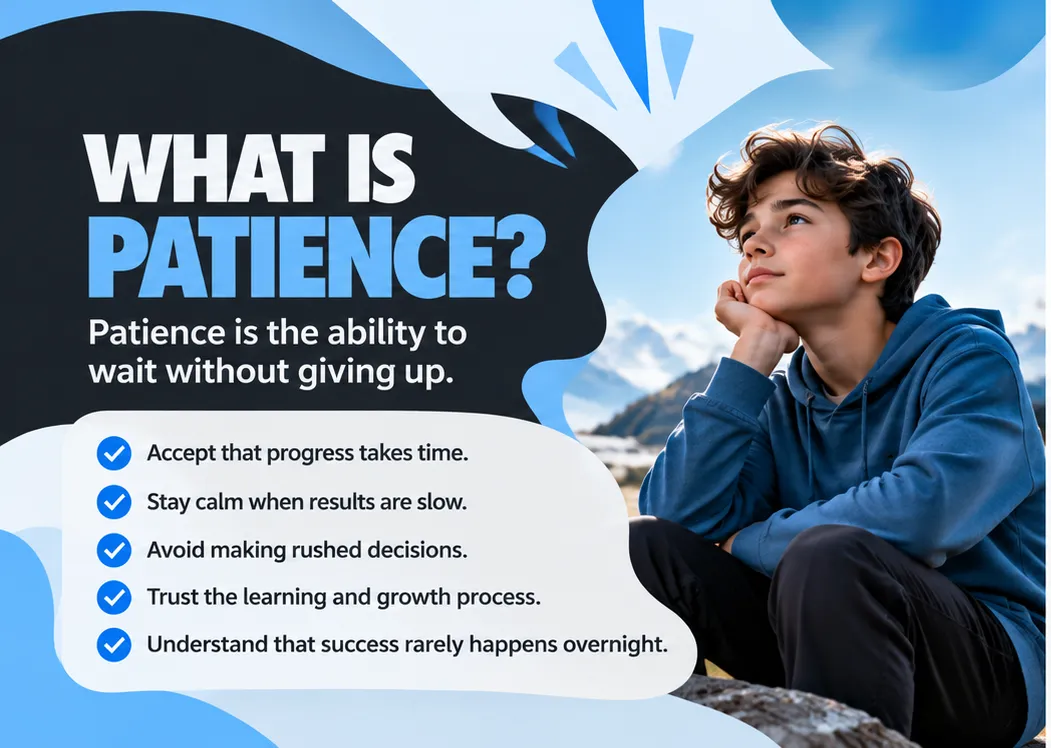
Patience is the ability to wait, or to put up with delay and difficulty, without becoming angry or giving up. It is not the same as doing nothing. A patient student still does the work; they simply accept that understanding a hard topic can take days or weeks, and they do not panic when results are slow.
Patience has three everyday forms. You can be patient with time (waiting for a result), with other people (a friend who is slower to understand) and with yourself (accepting that mistakes are part of learning). The last one is the one most students find hardest.
What is perseverance?
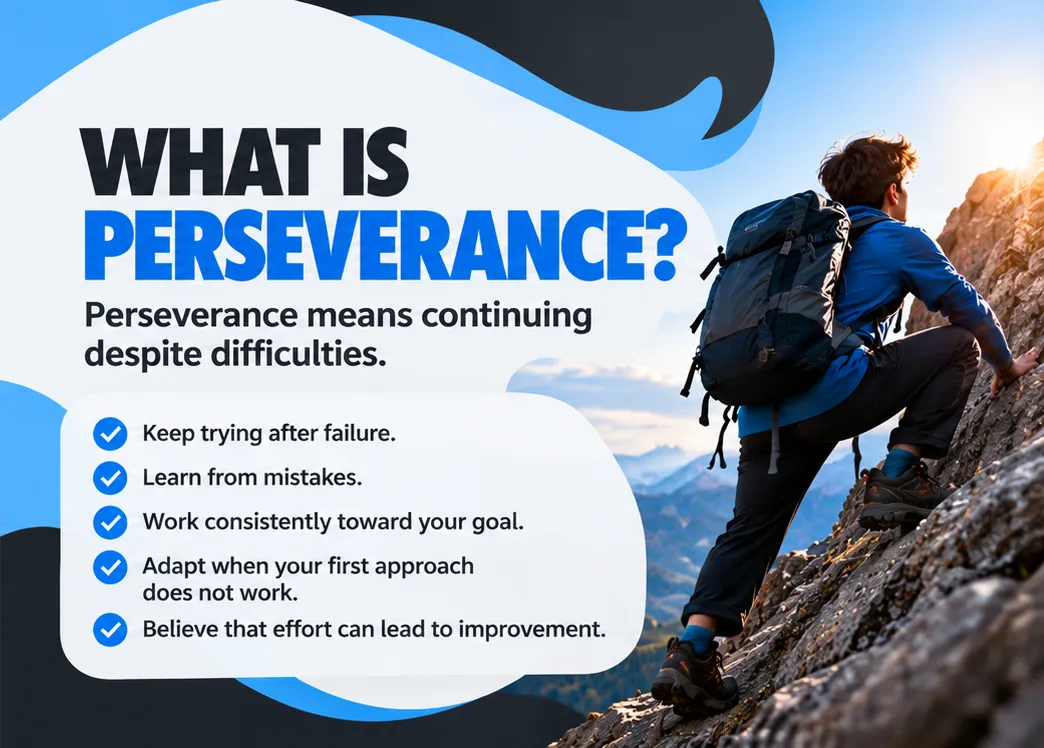
Perseverance means continuing to work towards a goal despite difficulties, setbacks or boredom. If patience is the ability to wait, perseverance is the ability to keep going. A student who fails a maths test, works out which topics went wrong, and tries again the following week is showing perseverance.
Perseverance is more than stubbornness. Stubbornness repeats the same method and hopes for a different outcome. Perseverance adapts: it keeps the goal fixed and changes the approach when something is not working. That distinction matters throughout this article.
Patience vs perseverance: what is the difference?
The two words are often used as a pair, and they do work together, but they describe different skills. The table below shows how they compare.
| Question | Patience | Perseverance |
|---|---|---|
| Core idea | Waiting calmly | Continuing to act |
| Main challenge | Slow results, delays | Difficulty, failure, boredom |
| Typical thought | “This will take time.” | “I’ll try a different way.” |
| Study example | Not panicking when a topic still feels unclear after one lesson | Redoing past-paper questions you got wrong until you can answer them |
| Without it | Rushed decisions, quick frustration | Giving up at the first obstacle |
You need both. Patience without perseverance becomes passive waiting. Perseverance without patience leads to burnout, because you expect results before the work has had time to pay off.

Why patience and perseverance are important

The graphic above lists six benefits. Here is what each one means in practice, and where the evidence is stronger or weaker (later sections look at that carefully).
- Resilience. People who expect setbacks recover from them faster, because a poor mark becomes information rather than a verdict.
- Self-discipline. Each time you carry on with a task you would rather leave, you practise the habit of doing what you planned rather than what you feel like.
- Handling setbacks. Hard topics, lost matches and rejected applications happen to everyone. Perseverance is how you treat them as a stage rather than an ending.
- Gradual skill building. Skills such as essay writing, coding or playing a violin grow in small steps that are invisible day to day.
- Reaching harder goals. Long projects, such as coursework or a degree, only get finished by people who keep returning to them.
- Confidence. Confidence built on having actually got through difficult things is steadier than confidence built on praise.
It also helps to keep goals sensible. Aiming for “top grades in everything by Friday” sets you up to quit; a goal you can really reach keeps you going. Our guide to having realistic goals shows how to size targets so that perseverance has something achievable to work on.
Does failure mean you should stop?
Not by itself. Failure tells you that a particular attempt did not work. It does not tell you that you are unable to succeed. The useful questions are: what exactly went wrong, what can I change, and is the goal still worth it? Sometimes the honest answer to the last question is no, and changing direction is a sensible choice rather than a lack of perseverance. Our article on lessons from failure to success explores how to extract those lessons.
A quick self-check
Try these questions honestly. There are no marks; they simply show where to focus.
When I get a low mark, what do I usually do first?
A perseverant response is to read the feedback, list the specific questions or skills that went wrong, and plan one change before the next test. A less helpful response is to decide “I’m just bad at this subject”.
How long do I usually keep trying before I switch to something else?
If you switch within minutes of feeling stuck, try setting a minimum, such as 20 focused minutes, before you decide a task is too hard. Feeling stuck is normal and usually passes.
Do I change my method when it is not working?
Perseverance is not repeating the same approach harder. If re-reading notes has not helped, try testing yourself from memory, drawing a diagram, or explaining the topic aloud.
The rest of this article looks at what psychology research really says about mindset, waiting for rewards and practice, including the parts that are less impressive than popular posters suggest, and then gives you a practical plan.
Growth mindset: what it is and what the evidence says
The psychologist Carol Dweck popularised the idea of a growth mindset: the belief that your abilities can be developed through effort, good strategies and help from others. The opposite, a fixed mindset, is the belief that talent is mostly set in stone. The idea fits perseverance neatly. If you think ability can grow, then a hard problem is a reason to keep going rather than a sign to stop.

That sounds convincing, and many schools adopted growth-mindset posters and lessons. But good science asks how large the effect really is. Two pieces of research give a balanced picture.
Sisk et al. (2018): a small effect
In 2018, Victoria Sisk and colleagues combined the results of many earlier studies in two meta-analyses. They found that the link between students’ mindset and their achievement was weak. The mindset interventions they analysed, which covered 43 studies and more than 57,000 participants, had only a small overall effect on academic results (about d = 0.08). The effects were somewhat stronger for students from low-income backgrounds and for students at academic risk.
Yeager et al. (2019): helpful in the right setting
A year later, David Yeager and colleagues published a large, carefully designed experiment in the journal Nature. More than 12,000 students starting ninth grade in 65 US high schools in the main analysis completed two online sessions of about 25 minutes each. Lower-achieving students who took the growth-mindset programme gained about 0.10 of a grade point in their core subjects on average, and the share with a D or F average fell by more than 5 percentage points.
The gains were larger, around 0.15 of a grade point, in medium- and lower-performing schools where classmates supported the pursuit of challenging work. The researchers’ conclusion was that school context matters: a mindset message works best when the school gives students real chances to take on challenges.
For a GCSE student, the practical lesson is simple. Believing that you can improve is useful, but only if it leads to action: asking for help, changing your revision method, and returning to the problem. Our article on growth mindset in teamwork for GCSE students shows how this works in group learning.
Delayed gratification: the marshmallow test

Patience is often studied as delayed gratification: choosing a bigger reward later over a smaller reward now. The famous example is the marshmallow test. Walter Mischel and colleagues at Stanford offered young children a choice between one treat straight away or two treats if they waited alone for a while. Early follow-ups suggested that children who waited longer went on to do better at school.
The story spread widely, often as “patient children become successful adults”. A 2018 study challenged that simple version. Tyler Watts, Greg Duncan and Haonan Quan analysed more than 900 children from a large US study. They found that how long a child waited at age four still predicted achievement at age 15, but the link was about half the size reported in the earliest studies. After the researchers took family background, early thinking skills and the home environment into account, most of the link disappeared.
The wider message is more hopeful. Children who used strategies such as looking away or distracting themselves tended to find waiting easier. In other words, patience is partly a set of techniques you can learn, not only a gift you are born with.
Patience tricks that work for students
These ideas follow the same logic as the distraction strategies in the marshmallow research. They reduce the pull of an immediate reward so that the longer-term one is easier to choose.
- Remove the temptation. Leave your phone in another room while you work, rather than relying on willpower.
- Make the future reward concrete. Write down what finishing will give you, such as a free evening or a completed topic.
- Chunk the wait. Work for 25 minutes, then take a five-minute break, so the reward is never far away.
- Protect your energy. It is much harder to stay focused when you are exhausted, so sleep is part of any long-term plan. Our guide to balancing sleep and work for GCSE results covers this.
Test your understanding: patience and mindset
Why might a child take the single marshmallow straight away even though they could get two? (2 marks)
They may not trust that the second reward will really arrive (past experience of broken promises), or they may find waiting harder because of their circumstances. Waiting ability reflects a child’s environment as well as their personal self-control.
Give one reason the Watts et al. study is stronger evidence than the earliest marshmallow studies. (1 mark)
It used a much larger and more varied sample (over 900 children) and could control for family background and other factors that might explain the link.
Deliberate practice: perseverance that actually improves you
Perseverance only pays off if the effort is well aimed. Psychologist K. Anders Ericsson used the term deliberate practice for training that is focused, set at the edge of your current ability, and supported by quick feedback. It is quite different from simply repeating something you can already do.


In a well-known 1993 study, Ericsson and colleagues compared violin students at a Berlin music academy. By the age of 18, the best group had accumulated about 7,410 hours of practice, the good group about 5,301 hours and the future music teachers about 3,420 hours. Each group had just ten students, so this is a small study, but the pattern was clear: the top players had spent much more time practising, and mostly practised alone with specific goals.
What deliberate practice looks like for a student
- Pick a specific target. “Learn the cell cycle” is vague; “explain the stages of mitosis from memory in three minutes” is specific.
- Work just beyond your comfort zone. If every question feels easy, you are rehearsing, not improving.
- Get feedback quickly. Check the mark scheme straight away, or ask a teacher or friend to mark one answer.
- Fix the weak spot. Spend the next session on the exact error, not on the topic you already know well.
- Rest and repeat. Short, focused sessions beat long, distracted ones.
This is the same idea behind testing yourself instead of re-reading. Our guide on how to practise and remember what you study gives methods, and the article on how to improve memory for better learning explains why spaced practice works.
Grit: what the research suggests
Psychologist Angela Duckworth gave the name grit to a mix of perseverance and passion for long-term goals. Researchers split grit into two parts: perseverance of effort (working hard through setbacks) and consistency of interest (sticking with the same goals over time). Later analyses found that most of grit’s link with performance comes from the perseverance part, which overlaps heavily with the long-established trait of conscientiousness. Overall, studies find that grit has a modest link with success, so it is useful but not a cure-all.
For you, this means that “working steadily and finishing what you start” is a skill worth building, but no single personality score will decide your results.
Perseverance stories: what is true, and what is a myth
Stories of famous people who refused to give up are everywhere. They can be inspiring, but they are often retold carelessly. Here are three of the best known, with what we can reliably say about each.
Thomas Edison and the “10,000 ways” quote
You will often see this line attached to Edison: “I have not failed. I’ve just found 10,000 ways that won’t work.” It is a popular saying, but the exact wording is not confirmed as something Edison said. The closest early source is the 1910 biography Edison: His Life and Inventions by Frank Dyer and Thomas Martin. It records his assistant Walter Mallory’s account of Edison during the long storage-battery experiments, when Mallory sympathised about the lack of results. Edison replied: “Results! Why, man, I have gotten a lot of results! I know several thousand things that won’t work.”
The real quotation is arguably better than the popular one. It shows Edison treating a failed experiment as information, which is exactly how a perseverant learner treats a wrong answer.

James Dyson and 5,127 prototypes
James Dyson noticed that vacuum cleaners lost suction as their bags filled with dust. He began building a bagless cleaner that separated dust using a cyclone. By his own account he built 5,127 prototypes over about five years, changing small details each time, before he had a version that worked as he wanted. A cyclonic cleaner based on his design went on sale in Japan in 1986, and his first UK bagless machine, the DC01, launched in 1993.
The lesson is not “try the same thing 5,127 times”. Each prototype tested one change, and the results guided the next one. That is perseverance with a method.
J.K. Rowling and the rejections
It is widely reported that the first Harry Potter manuscript was turned down by twelve publishers before Bloomsbury accepted it, and that Harry Potter and the Philosopher’s Stone was published in 1997. The exact details of each rejection vary between retellings, so treat the number as “widely reported” rather than precisely recorded. What is clear is that the book did find a publisher after setbacks, and that its author kept submitting it.
When to keep going and when to change direction
Perseverance without judgement can waste your effort. Use these questions when you hit a wall.
- Is the goal still mine? A goal you chose is easier to persevere for than one imposed on you.
- Is the method the problem? If you have done 20 hours of the same revision method with no improvement, change the method, not the goal.
- Is it hard or harmful? Difficulty is normal. If a goal is damaging your health or sleep, it needs a rethink and a conversation with someone you trust, such as a teacher, parent or your GP.
- Have I asked for help? Many students persevere alone for too long when a five-minute question to a teacher would unblock them.
Edison’s real words suggest what attitude to a failed experiment? (1 mark)
He treated it as useful information: each failure showed him something that did not work, so it moved him closer to what did.
Why is “Dyson built 5,127 prototypes” a good example of perseverance rather than stubbornness? (2 marks)
Each prototype changed one detail and was tested, so he learnt from every attempt and adapted his design while keeping the same goal.
How to build patience and perseverance: a practical plan

The graphic above shows a path: start, persist, learn from setbacks, grow, achieve. Here is how to follow it in real life, as a student or as an adult.
1. Start small and start now
Beginning is the hardest part. Commit to ten minutes. Once you have started, continuing is usually easier, and ten minutes a day adds up to over an hour each week. If putting things off is your main obstacle, read our tips on how to stop procrastinating.
2. Break big goals into steps
A goal such as “get a grade 7 in science” is too big to act on. Break it into weekly targets: finish one topic, complete one past-paper section, ask one question. Ticking off small steps gives you visible progress, which keeps motivation alive during slow periods.
3. Plan for the dip
Motivation usually fades after the first burst of enthusiasm. Decide in advance what you will do on a day you do not feel like working: a shorter session, an easier task, or a friend to study with. If your motivation has disappeared completely, these three tips for when you have no motivation to study can help you restart.
4. Treat mistakes as data
After any mistake ask three questions: What happened? Why? What will I do differently next time? Writing the answers in a notebook turns frustration into a plan. This is the habit shown by the real Edison quotation earlier.
5. Use effort that feels hard but possible
Aim for the zone where a task is difficult but you can see a way forward. This is the heart of deliberate practice, and it is where learning happens fastest.
6. Look after the basics
Sleep, food, exercise and breaks all affect how long you can concentrate. Perseverance is not working until you collapse. It is steady effort you can keep up, and managing pressure along the way matters; see achieving goals with minimum stress.
7. Celebrate progress
Mark milestones. Rewards for effort, such as a walk, a film or time with friends, make it easier to repeat the effort.

Your perseverance checklist
Tick these off as you try them. Your ticks are remembered in this browser.
- I chose one specific goal for this week
- I broke it into steps of 10 to 25 minutes
- I removed one distraction while working
- I tested myself instead of just re-reading
- I wrote down what went wrong after one mistake
- I asked someone for help with a problem
- I took a proper break and slept enough
- I celebrated one piece of progress
Frequently asked questions about patience and perseverance
What is the difference between patience and perseverance?
Patience is the ability to wait calmly without frustration when results are slow. Perseverance is the ability to keep taking action towards a goal despite difficulty or setbacks. Patience is mostly about how you wait; perseverance is about what you keep doing. Most long-term goals need both skills.
Why are patience and perseverance important for students?
Learning is gradual, and hard topics rarely click on the first attempt. Patience stops you panicking when progress is slow, and perseverance keeps you practising until you improve. Together they help students handle setbacks, build study habits and work towards long-term goals such as exams and coursework.
Does growth mindset really improve grades?
Evidence is mixed. A 2019 study of over 12,000 US students found a modest gain of about 0.10 of a grade point for lower-achieving students after two short online sessions. A 2018 meta-analysis found only small average effects. It seems to help some students, mainly in supportive schools.
Does the marshmallow test predict success?
Not very well. A 2018 replication with over 900 children found that waiting time at four was linked to later achievement, but the link was about half as strong as earlier claims and mostly disappeared after accounting for family background, early abilities and home environment.
Did Thomas Edison say he found 10,000 ways that will not work?
That exact wording is not confirmed. The closest early source is the 1910 biography by Dyer and Martin, which quotes Edison to his assistant: “I know several thousand things that won’t work.” The popular 10,000 version appears in later retellings, so use it with caution.
How many prototypes did James Dyson make?
By his own account, James Dyson built 5,127 prototypes of his bagless cyclone vacuum cleaner over about five years. He changed small details between versions and learnt from each test. A cyclonic cleaner based on his design went on sale in Japan in 1986, and his first UK bagless machine, the DC01, launched in 1993.
Is the 10,000-hour rule true?
Not as a fixed rule. In Ericsson’s 1993 violin study, the best group had about 7,410 hours of practice by age 18. What mattered was how people practised: with specific goals and feedback. The hours needed vary by skill, and other factors, such as teaching, also matter.
How can I build perseverance if I give up easily?
Start with small, specific goals and commit to a short session, such as ten minutes. Remove distractions, track your progress and plan for days when motivation dips. After mistakes, ask what went wrong and what to change. Asking a teacher or friend for help also keeps you going.
Can you be too persistent?
Yes. Persisting with a method that clearly is not working, or with a goal that harms your health, wastes effort. Healthy perseverance keeps the goal but adapts the approach, and it accepts that sometimes changing direction is the sensible choice. If a goal is damaging your wellbeing, talk to someone you trust.
How long does it take to build a habit of perseverance?
There is no fixed time. Habits form through repetition, and the time varies between people and tasks. Focus on showing up regularly in small ways rather than waiting for a set number of days. Gradual, consistent effort over weeks and months is what builds lasting study habits.