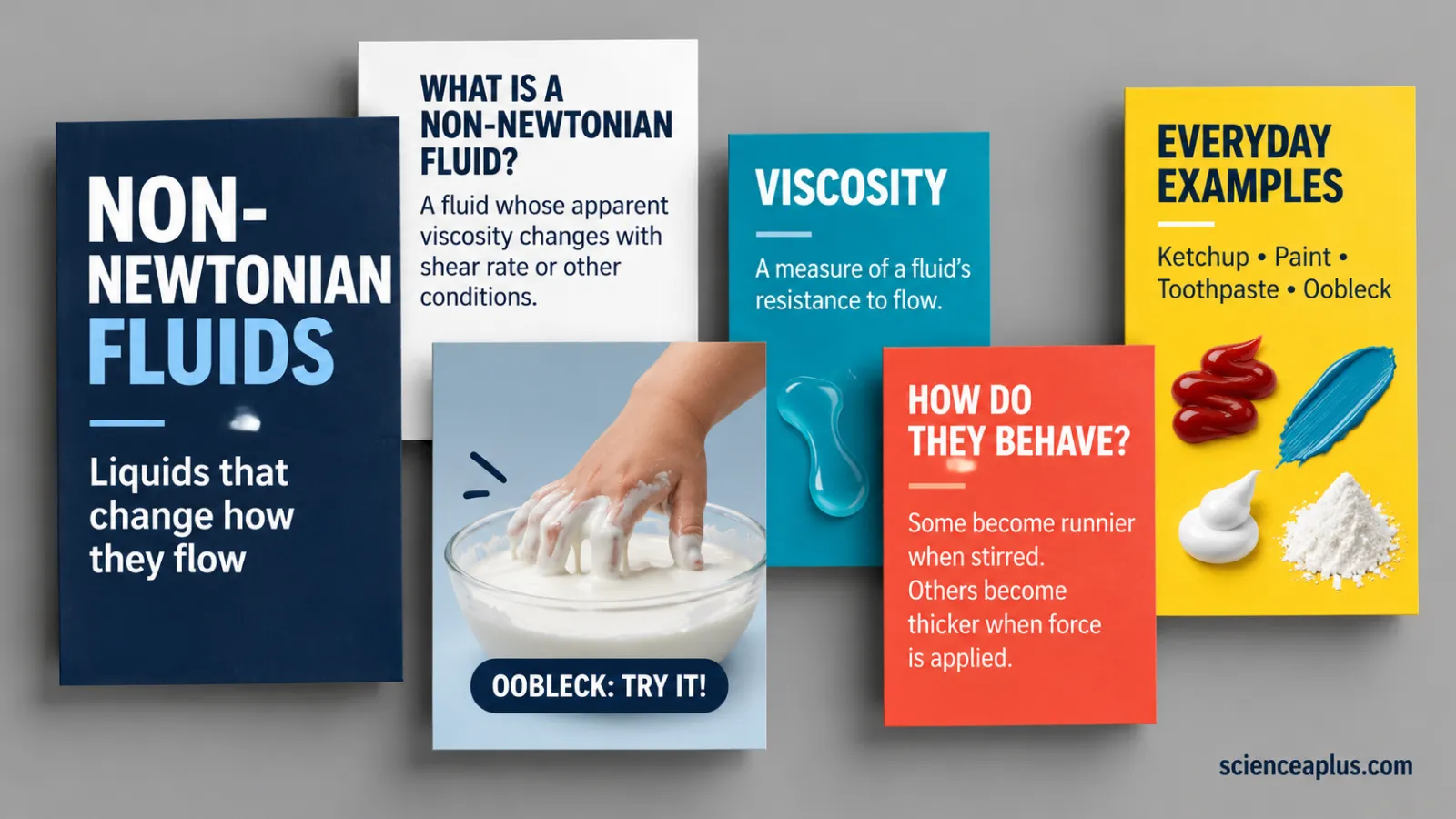
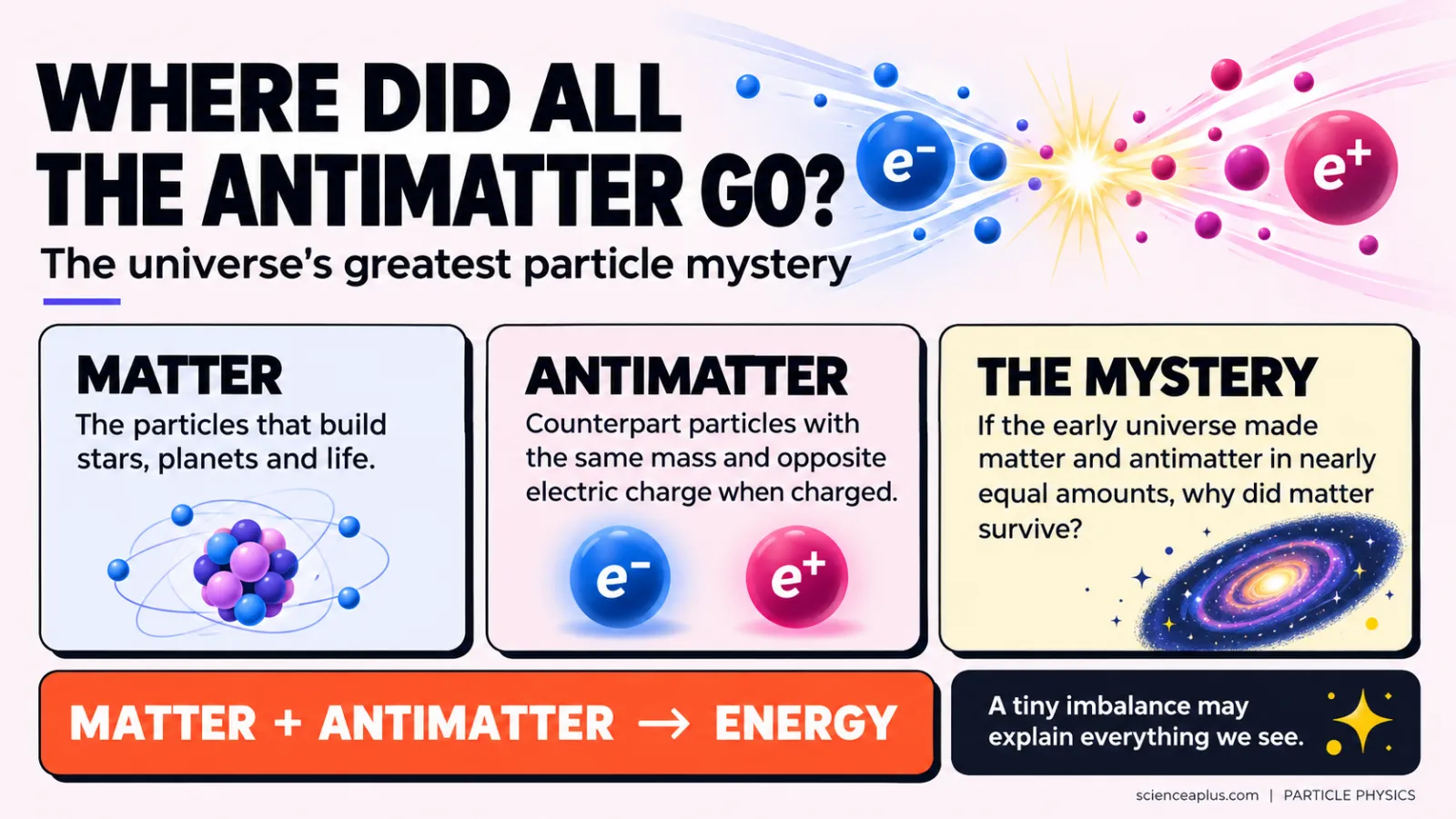
Matter and antimatter are mirror twins. Every particle has an antiparticle with exactly the same mass but the opposite electric charge, and when a particle meets its antiparticle, both vanish in a burst of energy. The Big Bang should have made equal amounts of each, yet today the universe is almost entirely matter. So where did all the antimatter go?
What is matter and what is antimatter?
Ordinary matter is built from atoms, and atoms are built from protons, neutrons and electrons. If you want a refresher on how those pieces fit together, our guide to atomic structure and sub-atomic particles covers the basics.
Antimatter is made of antiparticles. An antiparticle has the same mass as its partner, but its electric charge (and some other quantum properties) are reversed. The antiparticle of the electron is the positron, written e⁺, while the electron is e⁻. The antiparticle of the proton is the antiproton, with a charge of −1.
Not every particle has a separate twin. The photon, the particle of light, is its own antiparticle, so there is no such thing as an "antiphoton". The neutron has no overall charge, but it still has a distinct antineutron because it is made of antiquarks instead of quarks.
| Particle | Charge | Antiparticle | Charge | Mass compared with the particle |
|---|---|---|---|---|
| Electron (e⁻) | −1 | Positron (e⁺) | +1 | Identical |
| Proton | +1 | Antiproton | −1 | Identical |
| Neutron | 0 | Antineutron | 0 | Identical |
| Photon | 0 | Itself | 0 | Not applicable: it is its own antiparticle |
Antiparticles can join together just as ordinary particles do. Antihydrogen is one antiproton plus one positron, the mirror image of hydrogen, the simplest atom. Scientists have made antihydrogen atoms in the laboratory, as the timeline below shows.
Who discovered antimatter? A short timeline
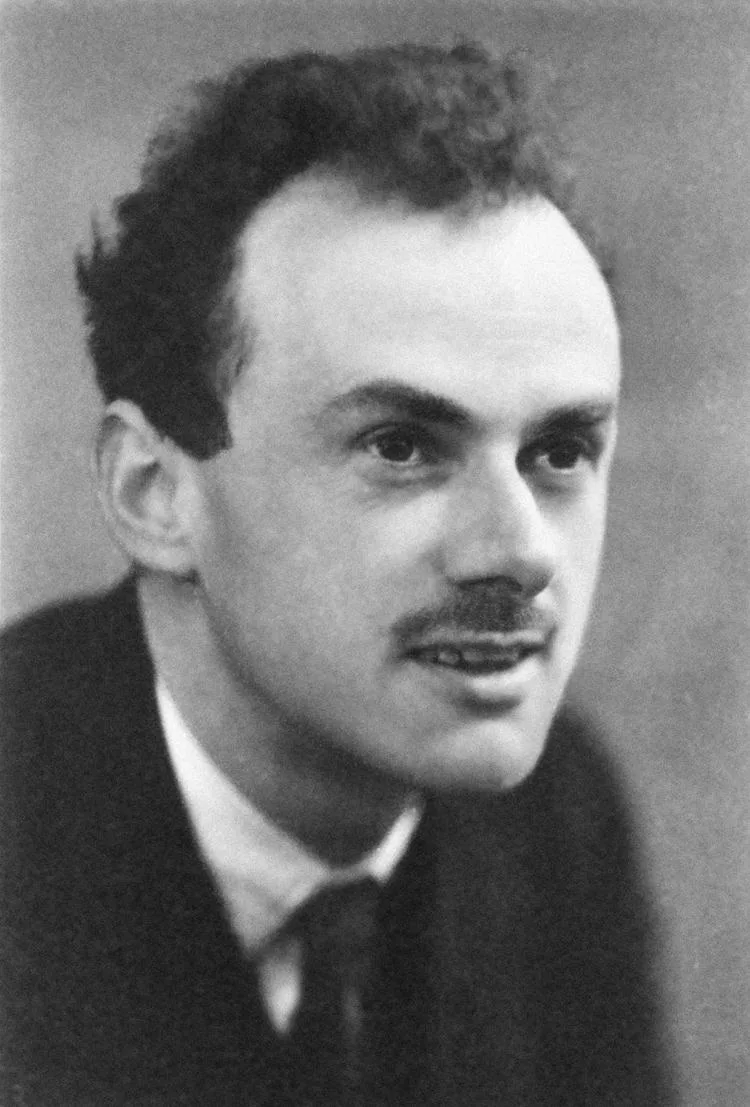
Antimatter began as a prediction on paper and was found in experiments only a few years later. Here are the key moments.
- 1928: Paul Dirac wrote an equation for the electron that combined quantum theory with Einstein's special relativity. It had extra solutions that seemed puzzling at first.
- 1931: Dirac's equation led to the prediction of an "anti-electron" with the electron's mass and the opposite charge.
- 1932: Carl Anderson found the positron in cosmic-ray tracks in a cloud chamber.
- 1933 and 1936: Dirac shared the 1933 Nobel Prize in Physics with Erwin Schrödinger, and Anderson shared the 1936 prize with Victor Hess "for his discovery of the positron".
- 1955: The antiproton was discovered at the Bevatron in Berkeley, California.
- 1956: The antineutron was discovered at the same machine.
- 1995: The first antihydrogen atoms were made at CERN.
- 2010 and 2011: The ALPHA experiment trapped antihydrogen, first briefly and then for 1,000 seconds.
1932: the positron appears in a cloud chamber
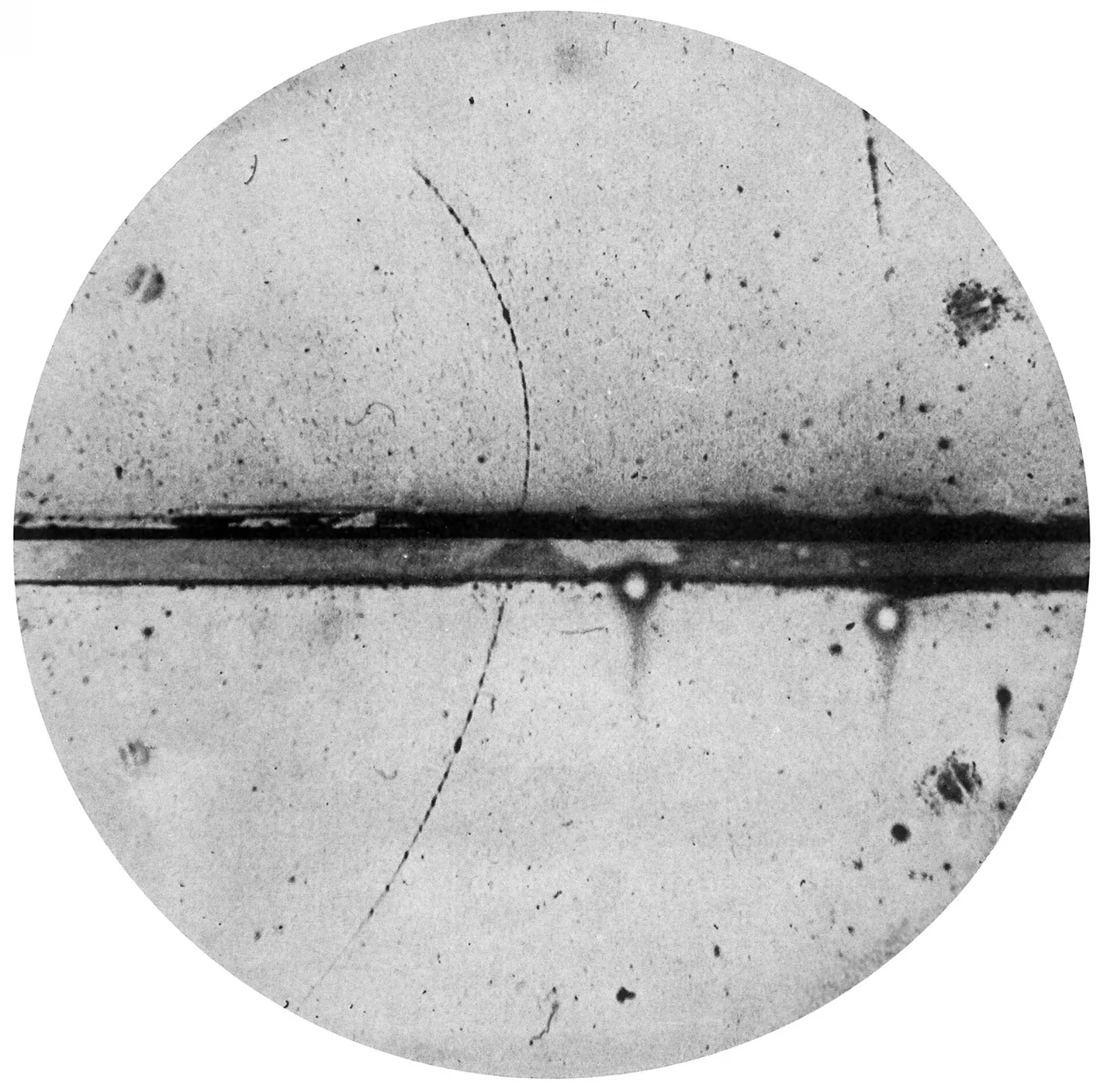
A cloud chamber shows the paths of charged particles as thin trails of droplets. Anderson put a strong magnet around his chamber, so charged particles followed curved paths. He also placed a lead plate across the middle. A particle slows down as it passes through lead, so the more sharply curved half of the track shows which way the particle was travelling.
One famous track had the same mass as an electron's but curved in the direction that a positively charged particle would. It was the positron, the first antiparticle ever seen. Anderson received the 1936 Nobel Prize in Physics for the discovery.
1955 and 1956: antiprotons and antineutrons
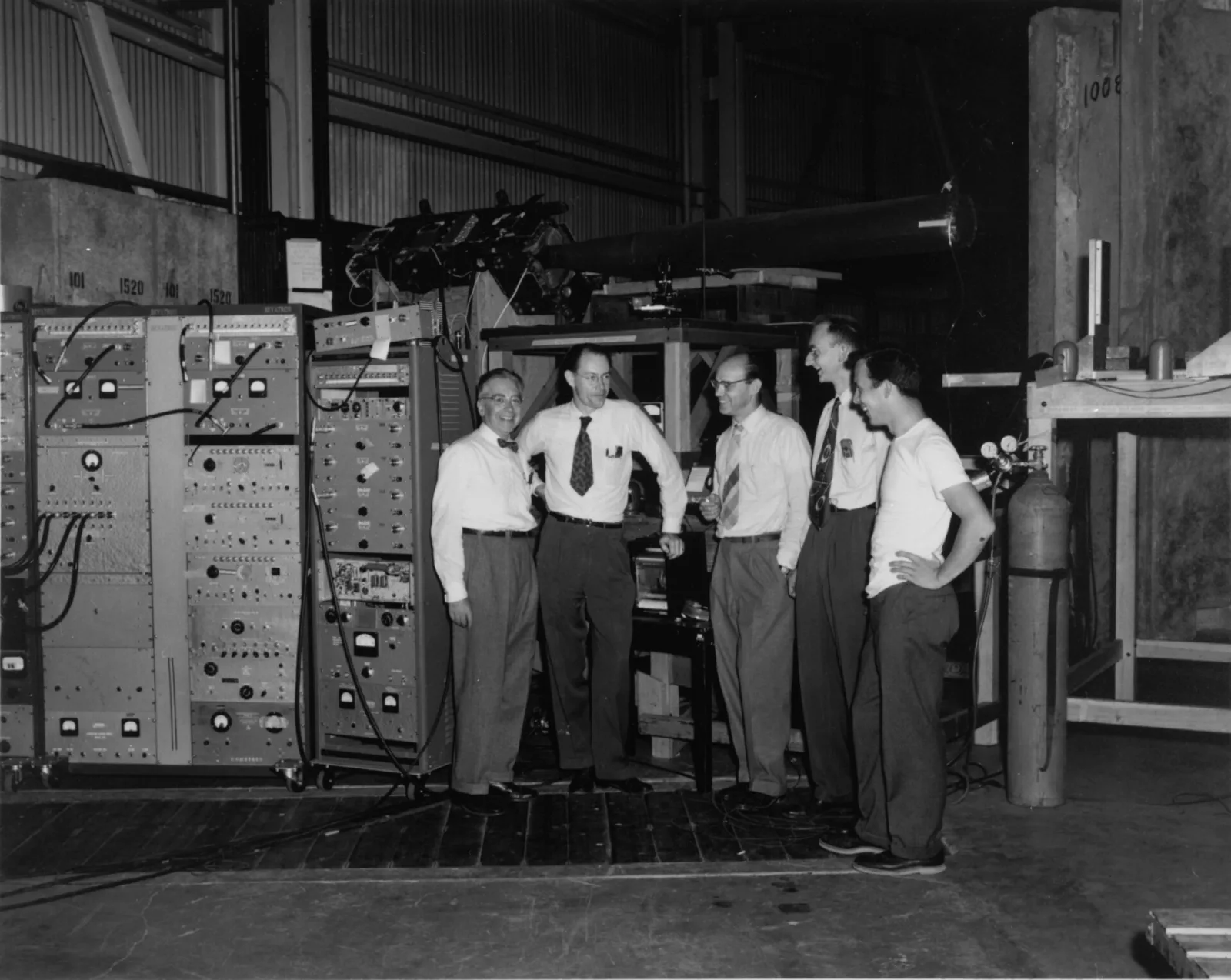
An antiproton is far heavier than a positron, so it takes much more energy to make one. In a proton–proton collision on a fixed target, the incoming proton needs about 5.6 GeV of kinetic energy. The Bevatron at Berkeley was the most powerful accelerator of its day, and it was built for exactly that energy range.
In 1955 Owen Chamberlain, Emilio Segrè and their team fired protons at a copper target and found antiprotons among the debris. The search was demanding: there were typically about 50,000 pions for every antiproton. Segrè and Chamberlain shared the 1959 Nobel Prize in Physics. In 1956 the antineutron was discovered at the Bevatron too, by a team of Cork, Lambertson, Piccioni and Wenzel.
1995 to 2011: the first anti-atoms
In September 1995 a team led by Walter Oelert at CERN's LEAR ring made nine antihydrogen atoms over about three weeks. Each one lasted only about forty billionths of a second before touching ordinary matter and annihilating.
Keeping antihydrogen for longer was the next challenge, because there is no container that antimatter will not destroy by touching it. In 2010 the ALPHA experiment trapped 38 antihydrogen atoms for about 172 milliseconds using magnetic fields. In June 2011 it held antihydrogen for 1,000 seconds, more than 16 minutes. That record belongs to antihydrogen atoms, not to positrons.
The next section explains what actually happens in the moment when matter and antimatter meet, and why that moment releases so much energy.
What happens when matter and antimatter collide?
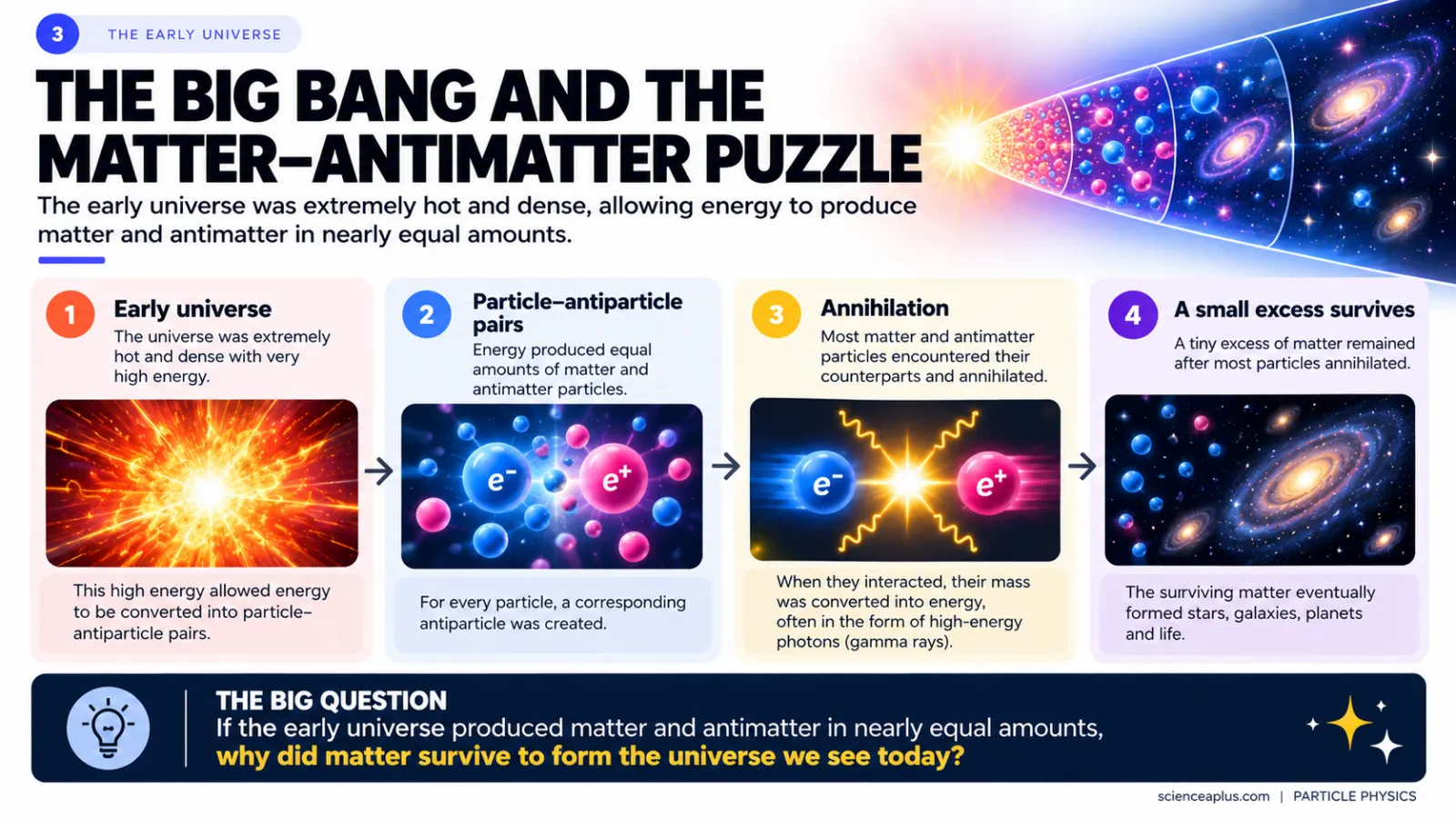
When a particle meets its own antiparticle, the pair is destroyed in an event called annihilation. Nothing is left of the original particles. Their mass is converted into energy, mostly in the form of photons and pions. In the words of CERN, any contact between a particle and its antiparticle "leads to the immediate annihilation of both".
The simplest case is an electron meeting a positron. When they are moving slowly, they turn into two gamma-ray photons that fly off in opposite directions:
e⁻ + e⁺ → γ + γ
Each of those photons carries an energy of 511 keV, which is the rest energy of an electron (or a positron). A proton meeting an antiproton is messier because both are made of smaller particles, and the energy mostly comes out as pions rather than photons.
The reverse process also happens. If enough energy is concentrated in one place, it can create a particle and an antiparticle together. This is called pair production, and it is always a pair: you cannot make a lone electron from energy without also making a positron. In the extremely hot early universe, pair production and annihilation went on constantly.
Einstein's E = mc² and why the energy is so huge
Annihilation is the cleanest example of Einstein's famous equation, E = mc². It comes from Albert Einstein's theory of relativity. Here E is energy in joules, m is mass in kilograms, and c is the speed of light, about 3.00 × 10⁸ m/s. Because c² is a gigantic number, even a tiny mass is equivalent to an enormous amount of energy.
When an amount of antimatter m meets the same mass of ordinary matter, both are destroyed, so the total mass converted is 2m:
E = 2mc²
Take 1 g of antimatter meeting 1 g of matter. That is 2 g, or 0.002 kg, so E = 0.002 × (3.00 × 10⁸)² ≈ 1.8 × 10¹⁴ J. That is about 43 kilotonnes of TNT. It would also be enough to boil roughly 535 million full kettles, assuming each heats 1 litre of water from 20 °C to 100 °C, which takes about 336,000 J.
CERN describes annihilation as about 50 times better than nuclear fusion in terms of the efficiency of converting mass to energy. Turning that into usable energy is another matter, as we shall see later. Try the calculator to see how much energy different amounts would release.
Antimatter in everyday life
Antimatter sounds like science fiction, but small amounts of it are all around us, and some are put to work in hospitals.
PET scans: antimatter in medicine
A PET (positron emission tomography) scan uses antimatter directly. A tracer, often a glucose-like molecule, is labelled with a positron-emitting isotope and injected into the patient. Each positron that is emitted meets an electron almost at once and annihilates, producing two 511 keV gamma rays in opposite directions. A ring of detectors picks up the pairs and builds a map of where the tracer has collected.
It is a different technique from an MRI scan, which uses strong magnets and radio waves rather than annihilation. Both give doctors views inside the body.
Bananas and thunderstorms
Bananas are slightly radioactive because they contain potassium-40, a rare isotope of potassium. Very occasionally a potassium-40 nucleus decays by emitting a positron. By one estimate, an average banana emits a positron about once every 75 minutes. Each positron soon meets an electron and annihilates.
Nature also makes antimatter on a grander scale. NASA's Fermi space telescope detected beams of positrons coming from thunderstorms, an announcement made in January 2011 about an event over Zambia on 14 December 2009. Fermi saw the telltale 511,000 eV (511 keV) signal of annihilation.
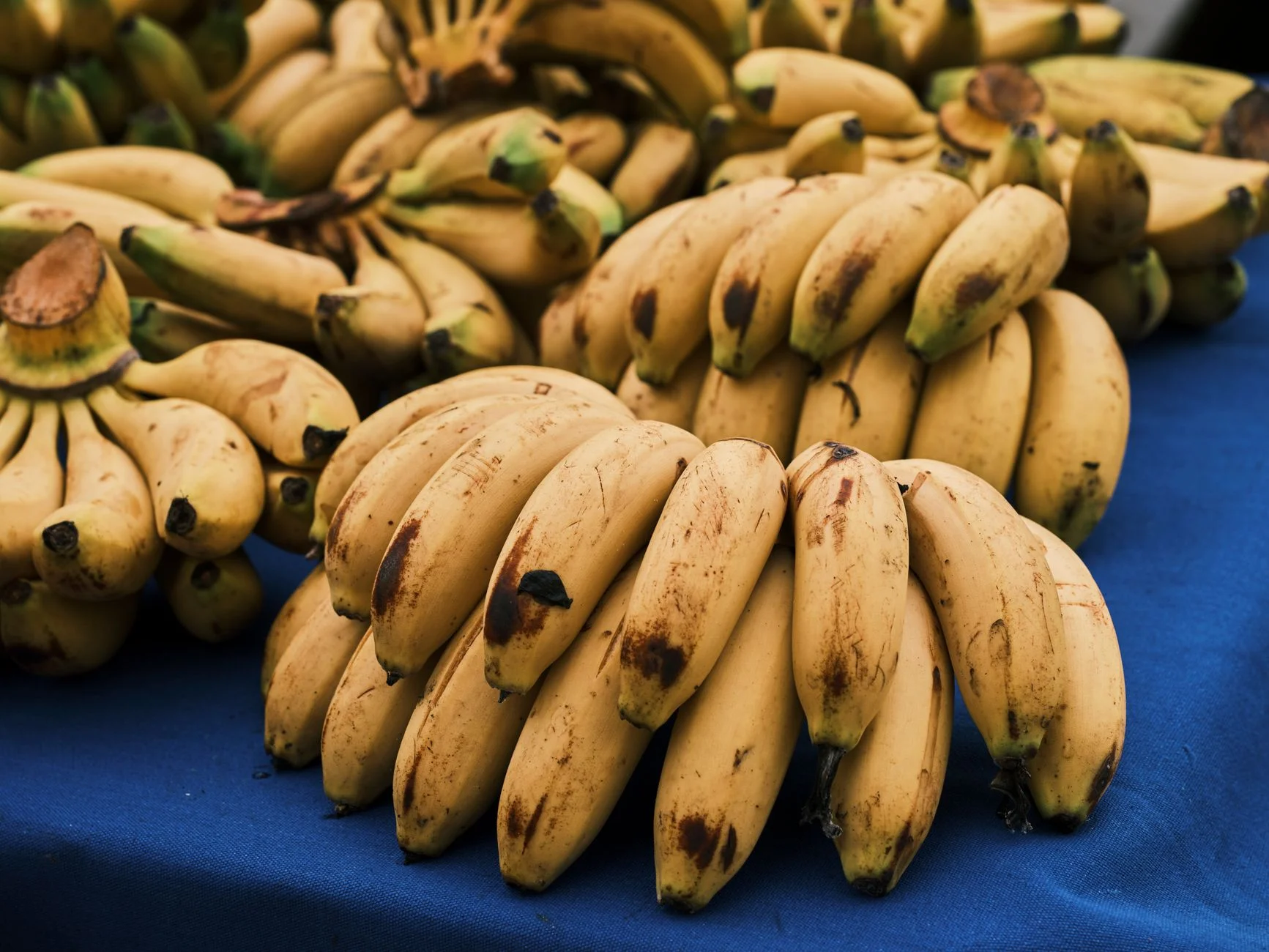
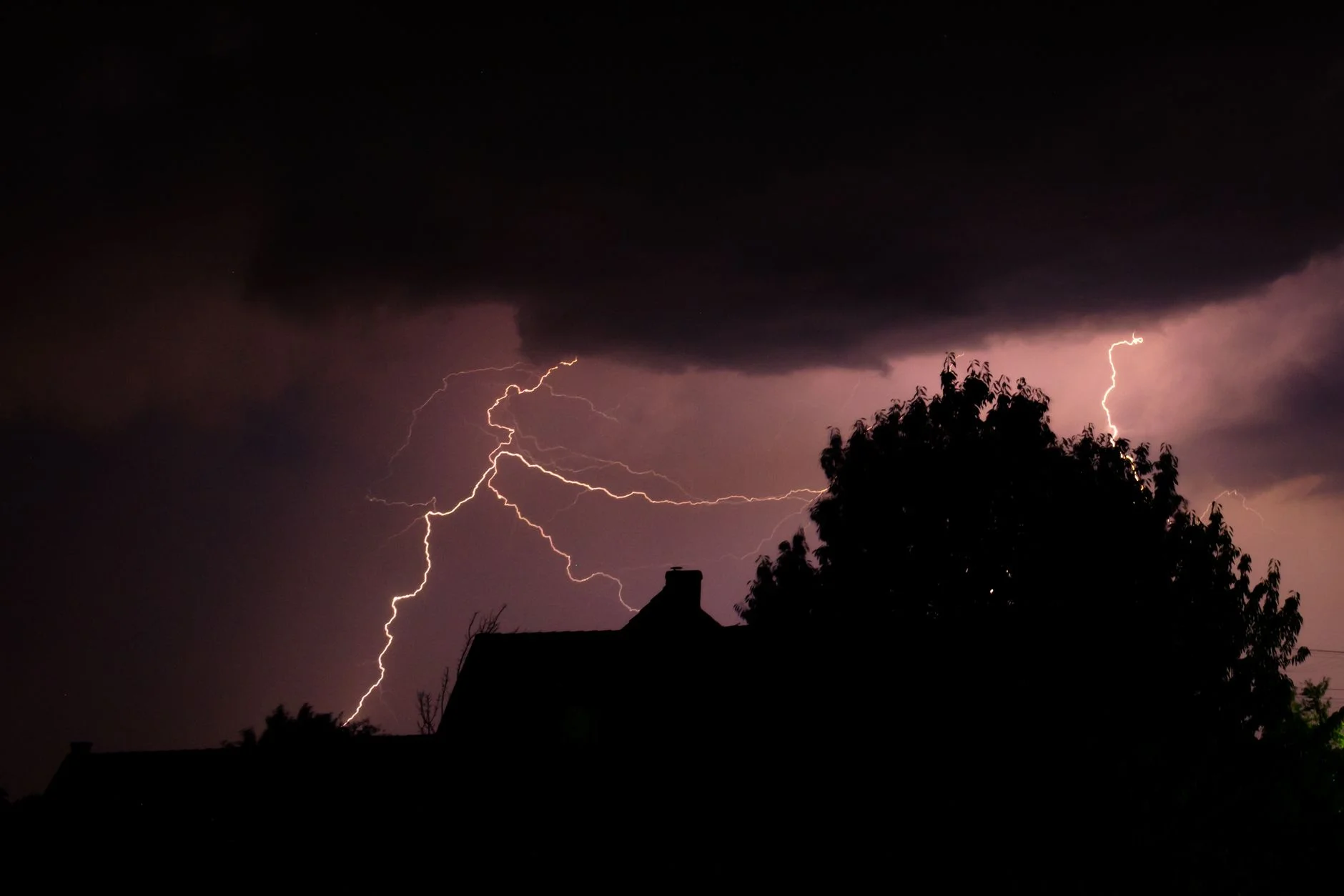
The amounts involved in these examples are minuscule. The real puzzle, as the next sections show, is that the early universe should have been full of the stuff but is not.
Mass and energy in the wider picture
Annihilation is one of many ways that mass and energy swap places. If you want to see how it fits in with the other forms of energy you meet at school, read our guide to the different kinds of energy and their uses.
Test yourself: reveal the model answers
A positron and an electron annihilate at rest. Why are two photons produced rather than one? (2 marks)
Momentum must be conserved. The total momentum before the collision is about zero, so the two photons must travel in opposite directions with equal and opposite momentum. A single photon would carry momentum away and break the conservation law.
Calculate the energy released when 2 g of antimatter annihilates with 2 g of matter. (3 marks)
The total mass converted is 2 g + 2 g = 4 g = 0.004 kg. Using E = mc², E = 0.004 × (3.00 × 10⁸)² = 3.6 × 10¹⁴ J.
State one similarity and one difference between an electron and a positron. (2 marks)
Similarity: they have exactly the same mass. Difference: their electric charges are opposite, with the electron at −1 and the positron at +1.
The matter–antimatter asymmetry: the Big Bang's missing half
Here is the puzzle. The laws of physics treat matter and antimatter almost identically, and pair production makes them in equal numbers. So the hot, dense early universe should have contained equal amounts of each. As the universe expanded and cooled, particles and antiparticles should have met and annihilated until nothing but radiation remained. There would be no stars, no planets and no people.
That is clearly not what happened. The universe today is made almost entirely of matter, and physicists call this imbalance the matter–antimatter asymmetry (or baryon asymmetry, because it concerns baryons such as protons and neutrons).
Just one extra particle per billion
The imbalance needed to explain the universe was tiny. According to CERN, a surplus of "approximately one extra particle per billion antiparticles" survived the mutual annihilation. Everything we can see, from the Sun to the Milky Way, is made of that leftover.
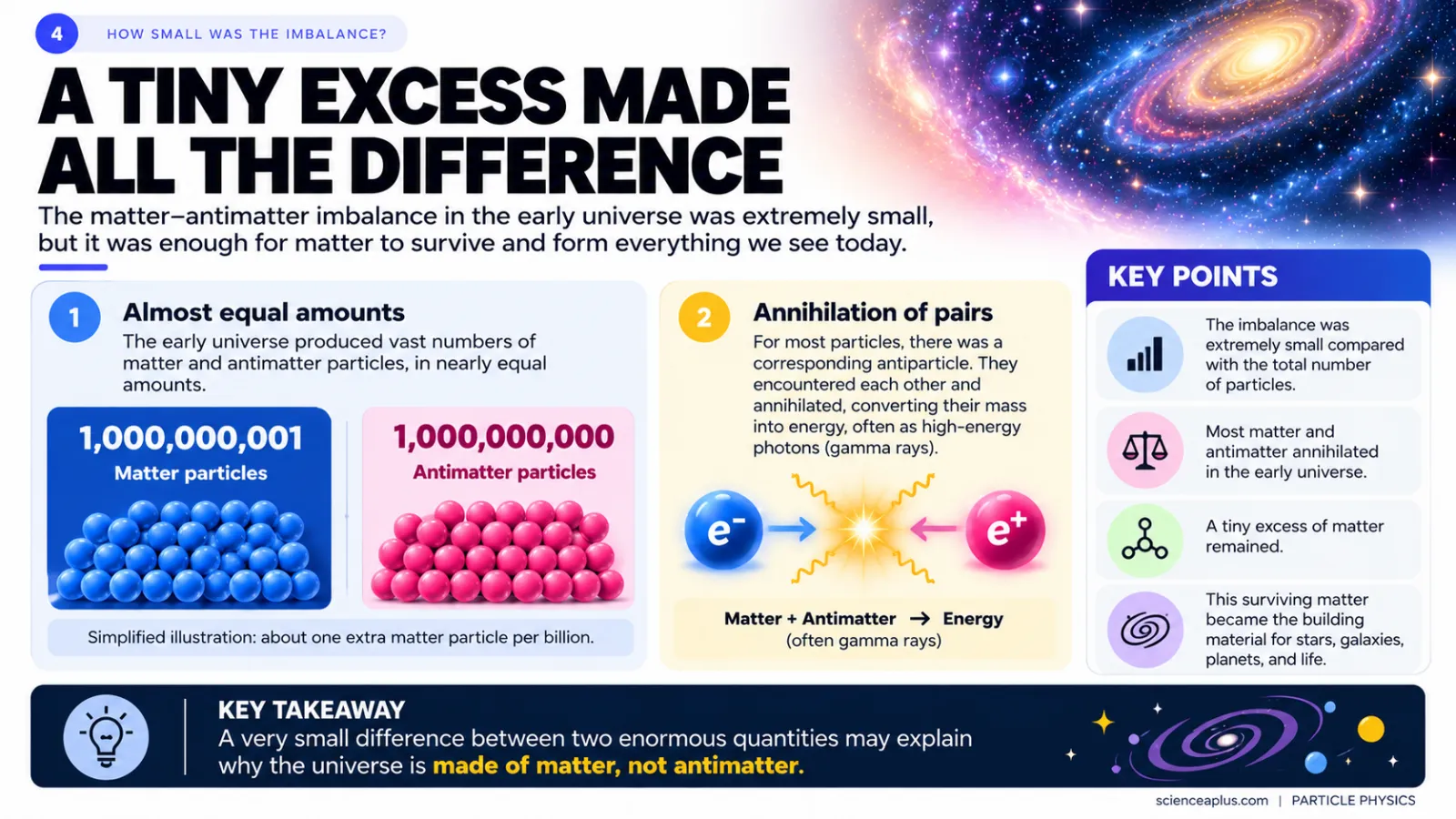
We can even measure it. Data from the Planck satellite's map of the cosmic microwave background gives a baryon-to-photon ratio of about 6.1 × 10⁻¹⁰. In plain terms, there is roughly one proton or neutron for every 1.6 billion photons. Those photons are the "ash" of the great annihilation: the light left over from the moment when almost all of the matter and antimatter destroyed each other. The surviving matter later clumped together to form the stars and galaxies described in our article on beautiful cosmology.

Could there be antimatter galaxies out there?
One way to solve the puzzle would be if the missing antimatter were hiding in separate regions of the universe, such as whole antimatter galaxies. But this does not work. Where a region of matter bordered a region of antimatter, annihilation would glow with gamma rays that telescopes could detect. The AMS experiment on the International Space Station has searched for antimatter arriving from space, and no evidence of antigalaxies has been found.
The disappearing antimatter is just one of several unsolved puzzles about the cosmos, alongside questions such as what dark energy is.
Sakharov's three conditions for a matter-dominated universe
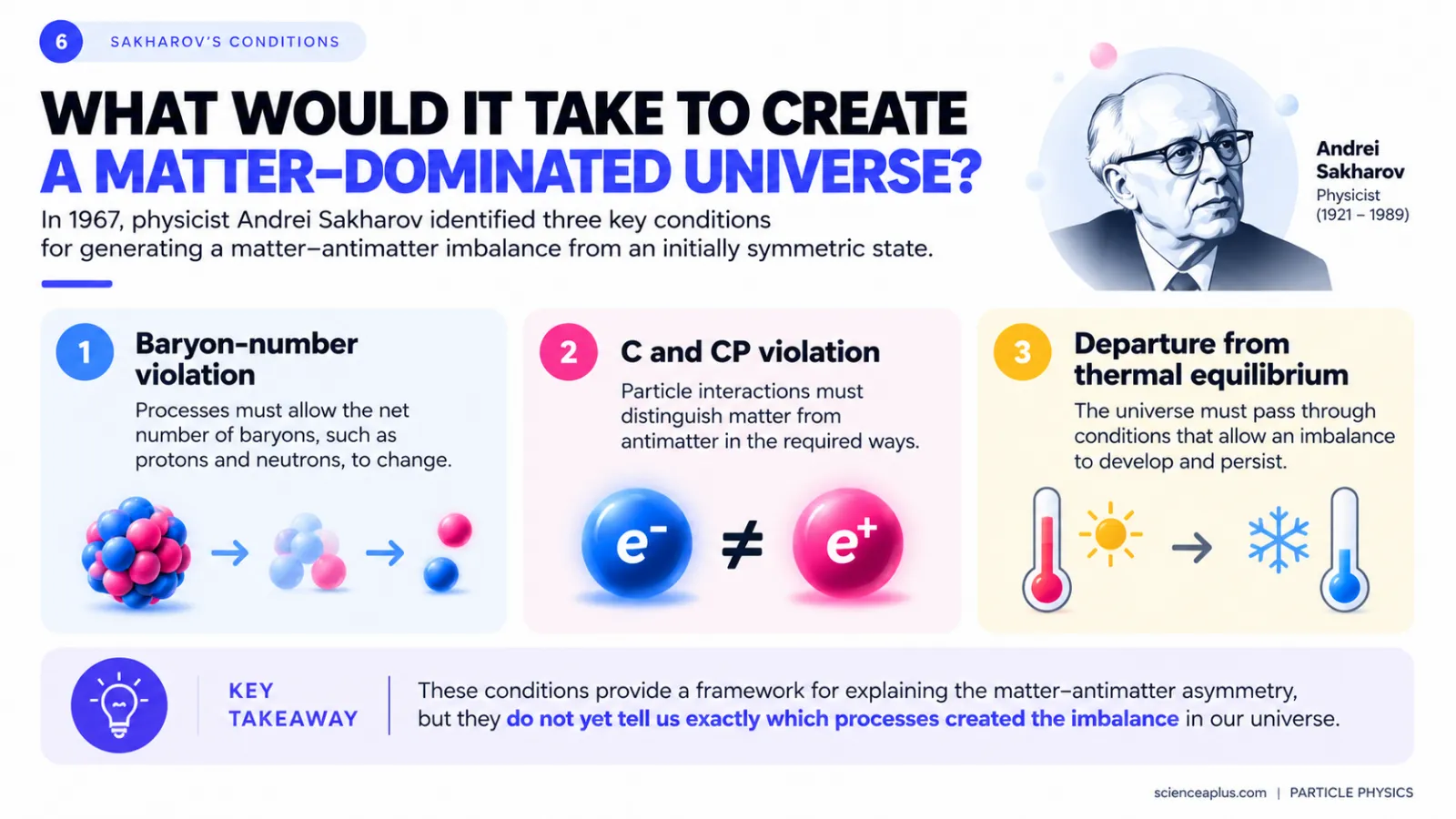
In 1967 the physicist Andrei Sakharov (1921–1989) worked out what must be true for a symmetric universe to end up with more matter than antimatter. His three conditions are still the starting point for every theory of the asymmetry.
- Baryon-number violation. Baryons are particles such as protons and neutrons. Normally the total number of baryons minus antibaryons never changes. To start from equal amounts and end up with a surplus, there must be some process that can change that number. Think of a bank account that is balanced at zero: to end up with a positive balance, some transaction must be able to add to it.
- C and CP violation. Nature must treat particles and antiparticles slightly differently. If the laws were perfectly symmetrical, any process that made extra matter would be matched by an equal process that made extra antimatter, and the surplus would cancel out. The next section explains what C and CP mean.
- Departure from thermal equilibrium. In perfect equilibrium, reactions run forwards and backwards at the same rate and undo any imbalance. The early universe had to be changing fast enough, by expanding and cooling, so that the reactions could not simply reverse the surplus.
All three conditions are needed together. Missing even one would leave the universe with an even balance, or no matter at all.
CP violation: nature's tiny bias
Physicists use two ideas to describe symmetry. C (charge conjugation) means swapping every particle for its antiparticle. P (parity) means looking at the mirror image of a process. CP means doing both at once. If the laws of physics were completely CP-symmetric, a process and its CP mirror image would happen at exactly the same rate.
In 1964, James Cronin, Val Fitch and their colleagues at Brookhaven found that the decays of neutral kaons did not quite obey it. This is called CP violation, and it was a huge surprise. Cronin and Fitch received the 1980 Nobel Prize in Physics.
Why the Standard Model is not enough
Here is the catch. The amount of CP violation predicted by the Standard Model of particle physics is, in CERN's words, "many orders of magnitude too small" to explain the observed asymmetry. That means something else must be going on. Physicists are hunting for new sources of CP violation, which would be a sign of new physics beyond the Standard Model, the kind of physics that researchers hope will fit into a future theory of everything.
Neutrino experiments such as T2K approach the problem from another side. They compare how neutrinos and antineutrinos change from one type to another as they travel, to see whether the two behave differently.
Describe one piece of evidence that the universe contains much more matter than antimatter. (2 marks)
No antimatter galaxies have been found: annihilation at the boundary between matter and antimatter regions would produce gamma rays, and none consistent with that has been seen. Also, the very small number of matter particles compared with photons (about one for every 1.6 billion) shows that almost everything annihilated, leaving only a tiny surplus.
State Sakharov's three conditions for creating a matter–antimatter imbalance. (3 marks)
1. Baryon-number violation. 2. C and CP violation. 3. A departure from thermal equilibrium.
How do scientists make and trap antimatter?
Antimatter does not sit around waiting to be collected, so scientists have to make it. At CERN, near Geneva, the Antimatter Factory (the Antiproton Decelerator together with a ring called ELENA) delivers approximately 400 million antiprotons per hour. The ALPHA experiment combines antiprotons with positrons to make antihydrogen at a rate of up to 3,000 atoms per hour. Even running non-stop for a year, that would give only about 30 million antihydrogen atoms.
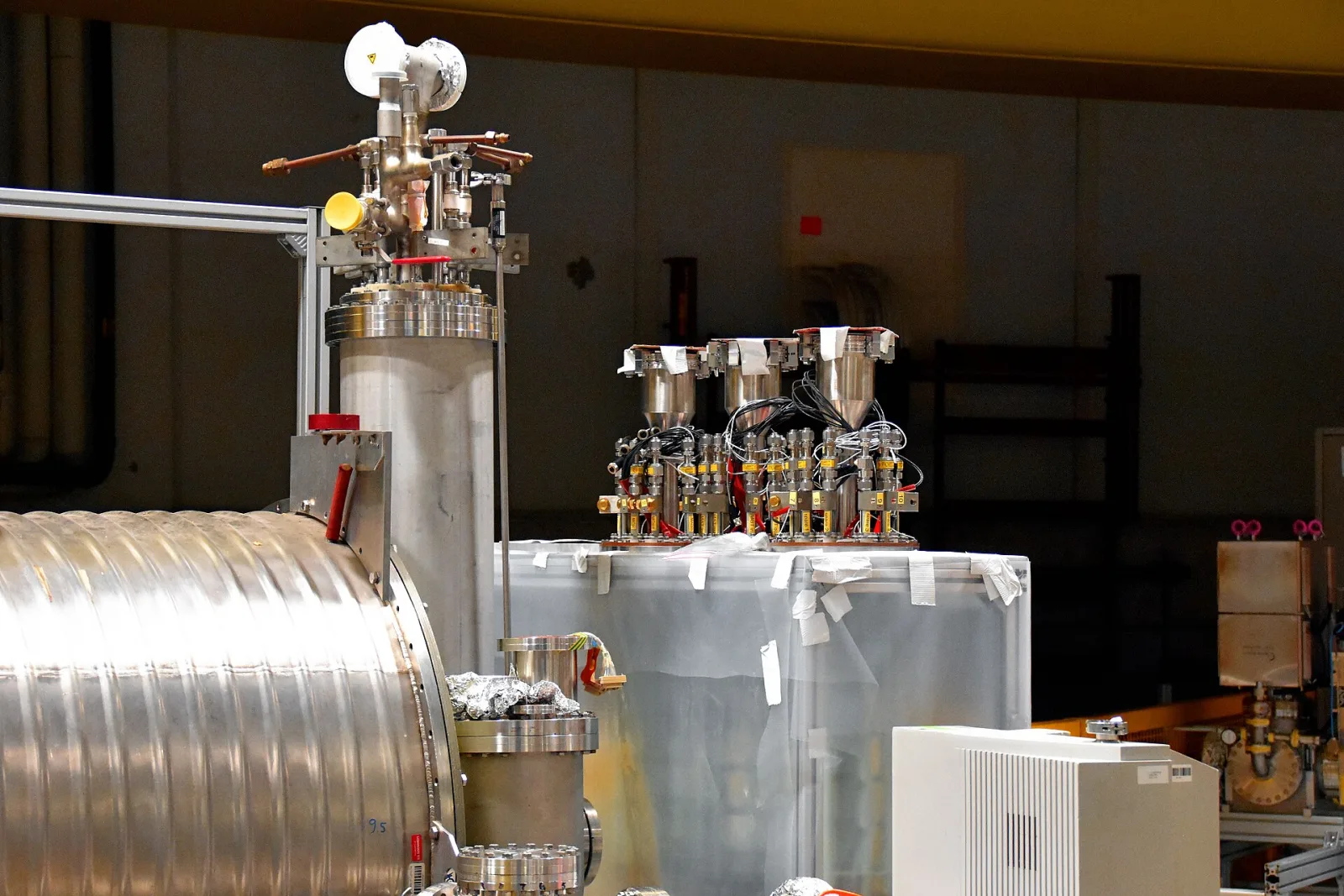
Storing antimatter is just as tricky. It cannot touch the walls of any container, because the walls are made of matter. Instead, charged antiparticles are held in a vacuum by magnetic and electric fields inside a device called a Penning trap, and antihydrogen is held by strong magnetic fields. The same kinds of powerful magnets that physicists use elsewhere are essential here.
Does antimatter fall up or down?
Because antimatter is so strange, some people wondered whether gravity might push it upwards. Physicists wanted to test this directly rather than assume.
The ALPHA-g experiment did exactly that. Its results, published in the journal Nature on 27 September 2023, came from a vertical trap. Groups of about 100 antihydrogen atoms were released at a time, and the experiment recorded whether they drifted up or down when the magnetic field was switched off. They fell towards the Earth just as ordinary matter does, within the precision of the experiment (about 20% of the strength of gravity, g).
So antimatter does not fall up. The result is not yet precise enough to say whether gravity acts on antimatter with exactly the same strength as on matter. That is the target of future, more precise measurements.
New results: LHCb 2025 and antimatter on the road
A new kind of CP violation
In March 2025 the LHCb experiment at CERN announced the first observation of CP violation in baryons. Until then, it had been seen only in mesons, which are particles made of a quark and an antiquark. The LHCb team studied a baryon called the Λb (lambda-b) decaying into a proton, a kaon and two oppositely charged pions, and compared it with the decay of its antiparticle. Using more than 80,000 decays from LHC data taken between 2011 and 2018, they found a difference of 2.45%, with an uncertainty of about 0.47%. The result has a significance of 5.2 standard deviations, high enough to count as a discovery. It was published in Nature in July 2025.
This does not by itself explain the asymmetry, because the Standard Model's CP violation is still far too small. But each new measurement helps physicists test their theories and look for signs of new physics.
Antimatter on a lorry
Higher-precision measurements need quieter laboratories than the accelerator site, so the BASE-STEP project built a portable trap for antiprotons. In a test run in autumn 2024 (reported in Nature in May 2025), the team drove a trapped cloud of protons around CERN on a lorry, and the trap ran without external power for four hours.
CERN announced in March 2026 that, in a world first, the BASE team had transported antimatter: a cloud of 92 antiprotons in a portable cryogenic Penning trap. The trap, with a superconducting magnet, liquid-helium cooling, a power reserve and a vacuum chamber, weighed about 1,000 kg and was narrow enough to fit through ordinary laboratory doors. The lorry drove around the CERN site for about 30 minutes at up to 42 km/h, after which the experiment continued. The aim is to deliver antiprotons to quieter laboratories, such as Heinrich Heine University Düsseldorf, a journey that would take at least 8 hours.
In another advance, the ALPHA team cooled positrons with laser-cooled beryllium ions and raised the antihydrogen production rate by a factor of eight, producing over 15,000 antihydrogen atoms in a matter of hours.
What we still don't know
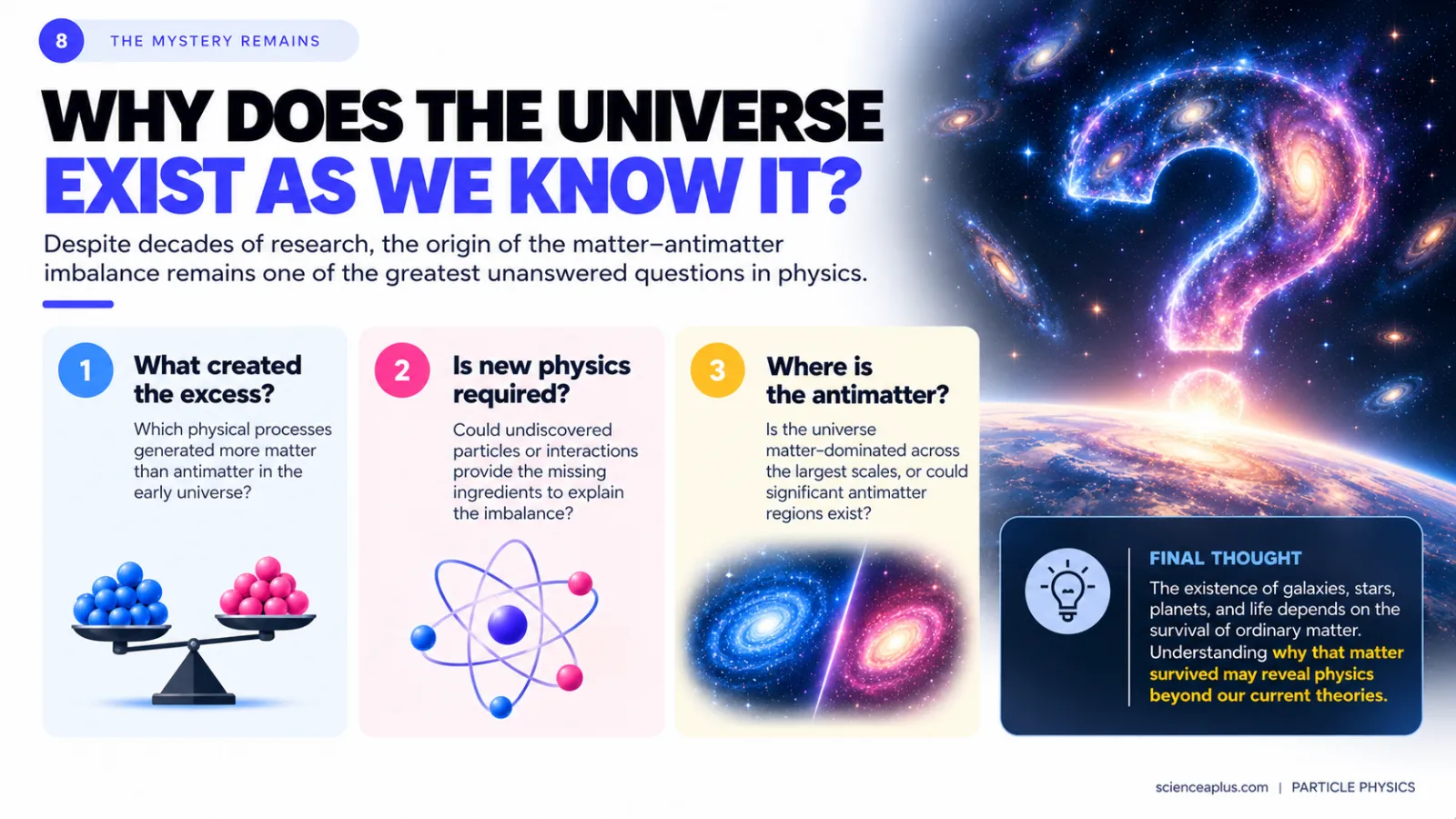
Three big questions remain open. What process created the tiny excess of matter, and when? Is new physics needed beyond the Standard Model to explain it? And if the universe began with equal amounts, where did all the antimatter go? Each experiment above chips away at part of the answer.
Flip cards: matter or antimatter?
Frequently asked questions about matter and antimatter
What is antimatter?
Antimatter is made of antiparticles, which have the same mass as ordinary particles but opposite electric charge. The positron is the electron's antiparticle and the antiproton is the proton's. When a particle meets its antiparticle, both are annihilated and their mass is converted into energy, mostly photons and pions.
Who discovered antimatter?
Paul Dirac predicted the anti-electron in 1931 from his relativistic equation. Carl Anderson then discovered the positron in cosmic-ray tracks in 1932 and won the 1936 Nobel Prize in Physics. The antiproton followed in 1955 and the antineutron in 1956, both at the Bevatron in Berkeley.
What happens when matter and antimatter collide?
They annihilate: both particles disappear and their mass is converted into energy. An electron and a positron moving slowly produce two gamma-ray photons of 511 keV each, flying in opposite directions. A proton and an antiproton mostly produce pions. The process is the reverse of pair production, where energy makes a particle and antiparticle.
How much energy does antimatter release?
When antimatter meets the same mass of matter, the energy released is E = 2mc². One gram of antimatter meeting one gram of matter releases about 1.8 × 10¹⁴ joules, around 43 kilotonnes of TNT. That is why scientists find annihilation so interesting.
Why is there more matter than antimatter in the universe?
Nobody knows for certain. The Big Bang should have made equal amounts, yet roughly one extra matter particle per billion antiparticles survived annihilation, and that surplus became everything we see. Physicists think a small difference in how nature treats matter and antimatter, called CP violation, played a part. New physics is likely needed.
What are the Sakharov conditions?
In 1967 Andrei Sakharov listed three conditions for creating more matter than antimatter from an even start. First, baryon number must be able to change. Second, C and CP symmetry must be violated, so nature treats particles and antiparticles differently. Third, the early universe must have departed from thermal equilibrium, as it did while expanding and cooling.
Does antimatter fall up or down?
Antimatter falls down. In 2023 the ALPHA-g experiment at CERN released groups of about 100 antihydrogen atoms in a vertical trap, and they fell towards the Earth like ordinary matter, within the precision of the experiment. It is not yet precise enough to show whether gravity acts on antimatter with exactly the same strength.
Does antimatter exist naturally on Earth?
Yes, in tiny amounts. Bananas contain potassium-40, which occasionally decays by emitting a positron, by one estimate about once every 75 minutes for an average banana. NASA's Fermi telescope also detected beams of positrons from thunderstorms. Positrons are used in medical PET scans too. Each positron is destroyed quickly by meeting an electron.
Can antimatter be transported or used as fuel?
It can be transported in tiny amounts: in March 2026 CERN announced that 92 antiprotons were driven around its site in a portable trap on a lorry. As fuel it is impractical. CERN says all the antimatter it has ever made could light a single bulb for a few minutes.