For most of the twentieth century, going to space was something only governments did. Today, private spaceflight is a normal part of the launch schedule: companies build rockets, fly astronauts, deliver cargo and sell satellite internet. As of 2026, private space companies launch many of the world’s rockets, and the global space economy is estimated at hundreds of billions of dollars a year.
This guide explains what commercial spaceflight actually means, how it differs from the old government-led model, and how we got from a US law in 1984 to private crews orbiting Earth. Later sections cover reusable rockets, the main companies, the Moon, satellite constellations and space tourism.
What is private spaceflight?
Private spaceflight means that a company, rather than a national space agency, designs, owns and operates the rockets or spacecraft. The company then sells a service: a ride to orbit for a satellite, a seat for an astronaut, or a few minutes of weightlessness for a paying passenger.
That is different from how things worked for decades. Space was run by governments such as NASA, the Soviet and later Russian programme, and the European Space Agency (ESA). Private firms were involved, but mostly as contractors who built hardware to a government’s design and handed it over. The agency owned the vehicle and ran the mission.
Government model versus commercial model
| Feature | Traditional government model | Commercial model |
|---|---|---|
| Who owns the rocket? | The space agency | The company |
| Who designs it? | The agency sets detailed requirements; contractors build to them | The company designs it, often to meet a performance goal |
| How is it paid for? | Government funds the whole programme | Customers (including agencies) pay for a service, such as a launch or a seat |
| Customers | Mainly the government | Governments, satellite operators, researchers and private individuals |
This is why people use terms such as “commercial” and “private” for this sector. NASA, for example, now often behaves like a customer buying a ticket instead of an owner running every part of the journey. We look at that arrangement in more detail later in this series.
Why does the difference matter?
When a company owns the vehicle, it has a reason to make it cheaper to fly, because it can win more customers. That pressure is one reason reusable rockets became a serious engineering goal. It also means more organisations can reach orbit, from universities launching small satellites to companies building their own space stations.
It also raises new questions about safety, regulation and who benefits, which we return to later. For a wider look at how rockets, telescopes and satellites fit together, see this overview of rockets, telescopes, satellites and the International Space Station.
A short history of private spaceflight
Commercial spaceflight did not appear overnight. It grew through a series of laws, prizes, government contracts and first-of-their-kind flights. Here are the key dates, using the best-established records as of 2026.
- 1984: The United States passes the Commercial Space Launch Act, creating a legal framework for private companies to launch rockets.
- 2001: Dennis Tito becomes the first space tourist, flying on a Russian Soyuz to the International Space Station (ISS). The trip reportedly cost about US$20 million.
- 4 October 2004: SpaceShipOne wins the US$10 million Ansari X Prize by flying to space twice within two weeks. These were suborbital flights, meaning the craft went up and came back down without orbiting Earth.
- 2006: NASA starts Commercial Orbital Transportation Services (COTS), a programme to buy cargo delivery to the ISS from companies instead of owning the vehicles.
- 28 September 2008: SpaceX’s Falcon 1 becomes the first privately developed liquid-fuel rocket to reach orbit.
- 2011: The Space Shuttle retires. For several years afterwards the US relies on Russian Soyuz spacecraft to send astronauts to the ISS.
- May 2012: SpaceX’s Dragon is the first commercial spacecraft to berth with the ISS.
- 23 November 2015: Blue Origin’s suborbital New Shepard rocket lands upright after reaching space.
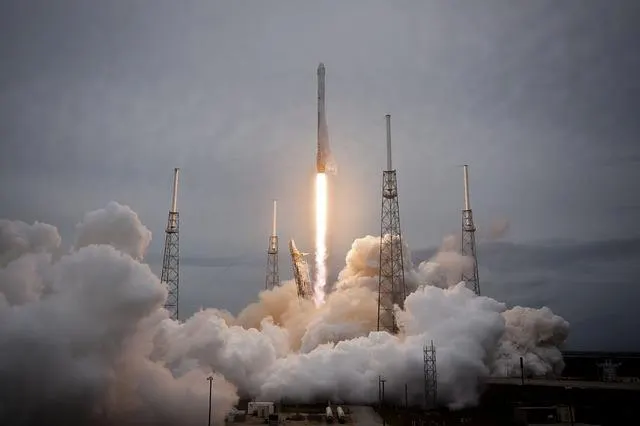
- 21 December 2015: A Falcon 9 first stage makes the first landing of an orbital-class booster.
- 30 May 2020: Crew Dragon Demo-2 carries NASA astronauts to the ISS, the first time a private company has done so. It ends US reliance on Soyuz seats.
- September 2021: Inspiration4 becomes the first all-civilian orbital mission.
- April 2022: Axiom Mission 1 is the first all-private crew to visit the ISS.
- July 2023: China’s LandSpace launches Zhuque-2, the first methane-fuelled rocket to reach orbit. In June 2023, Virgin Galactic had flown its first commercial flight.
- 22 February 2024: Intuitive Machines’ Odysseus (IM-1) becomes the first commercial spacecraft to soft-land on the Moon, although it tipped over on landing.
- September 2024: Polaris Dawn completes the first commercial spacewalk.
- January 2025: Blue Origin’s New Glenn, an orbital rocket, launches for the first time.
- 2 March 2025: Firefly’s Blue Ghost lands fully upright on the Moon.
Reading the timeline
Notice the pattern. The early milestones are mostly about law, prizes and contracts. From about 2008 onwards they are mostly about hardware: reaching orbit, docking, landing and reflying rockets. After 2020 they are about people, as companies began flying astronauts and paying customers.
Not every milestone was a clean success. Odysseus tipped over on the Moon, and Boeing’s Starliner crewed test flight in June 2024 returned to Earth uncrewed in September 2024 after thruster problems. Those setbacks are part of the story too, and we cover them in the section on challenges and risks.
In the next part of this guide, we look at how private companies are changing space exploration in practice, starting with the technology that made launches cheaper: rockets that land and fly again.
How private companies are changing space exploration
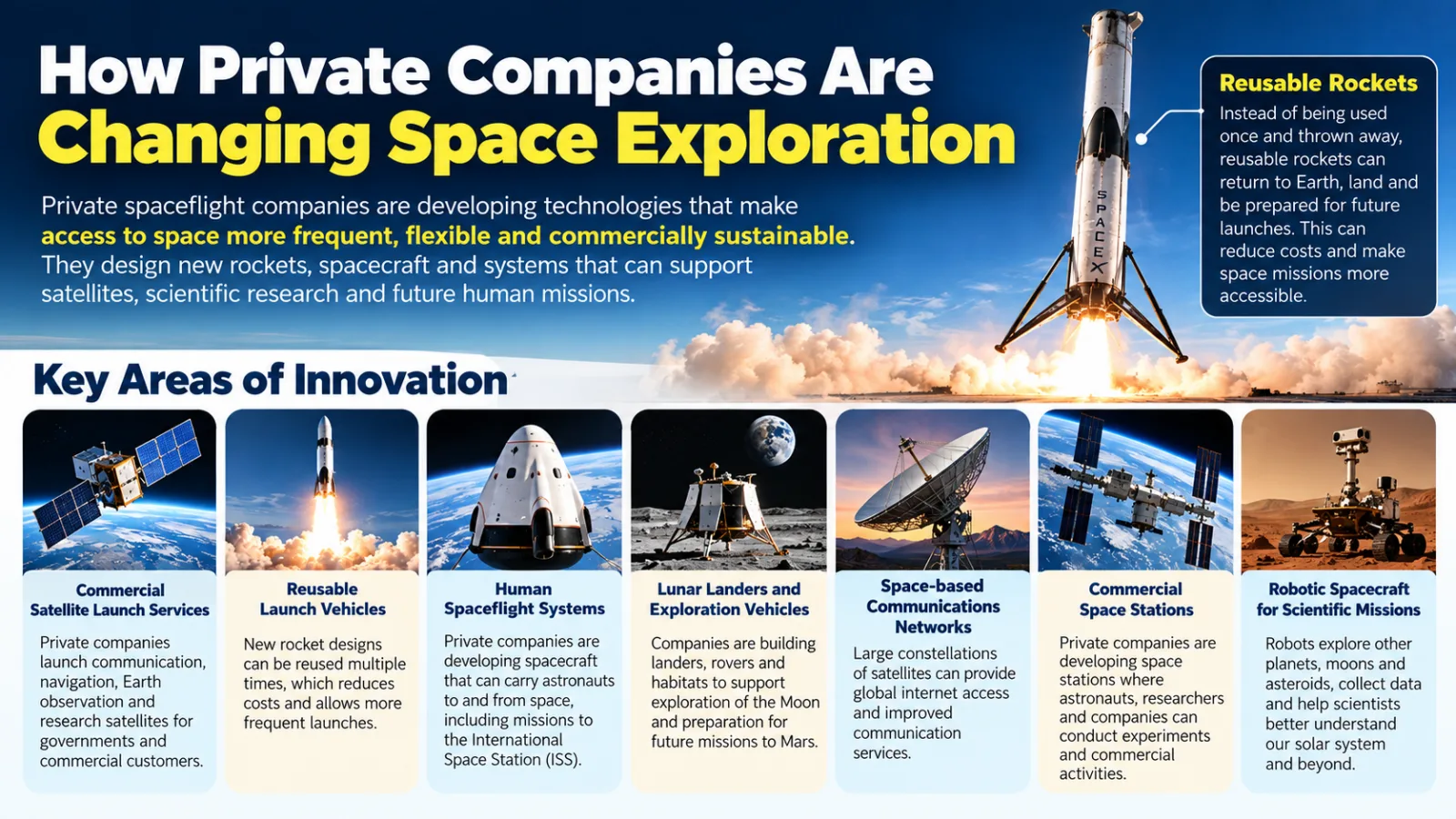
For most of the twentieth century, a rocket launch meant a government launch. Companies built the hardware, but agencies such as NASA decided what to build, owned it and flew it. Private spaceflight turns that around. In the new model, a company designs, owns and operates the rocket, then sells a service: a ride for a satellite, cargo for the space station, or a seat for an astronaut.
That change matters for three reasons. Companies compete on price, they have a strong reason to reuse expensive hardware, and they can test, fail and redesign faster than a large public programme usually can. The sections below look at how each of these has worked in practice, as of October 2026.
Reusable rockets: landing instead of discarding
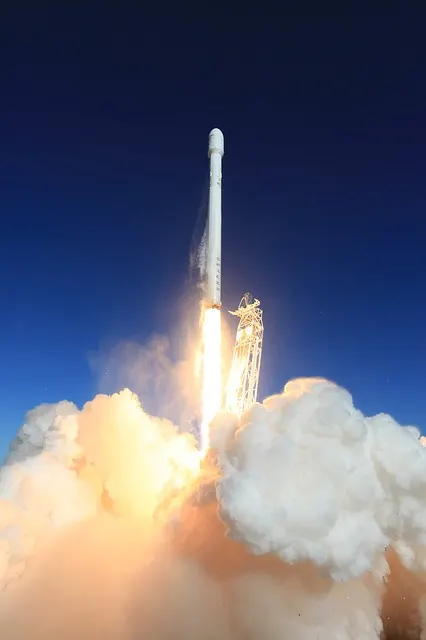
For decades, the first stage of almost every rocket was thrown away after one flight. That is a bit like flying a jumbo jet across the Atlantic and scrapping it on arrival. Reusable rockets change this: the first stage separates, turns around, and lands under control so that it can be inspected and flown again.
The physics is not new. A rocket works because it throws exhaust gas downwards at high speed, and the gas pushes the rocket upwards with an equal and opposite force. To land, the booster restarts some of its engines so that the thrust slows it down. If you want to see the principle behind this, our guide to Newton’s laws of motion walks through action and reaction with everyday examples.
The key dates are worth knowing. Blue Origin’s suborbital New Shepard booster landed first, on 23 November 2015. Then, on 21 December 2015, a SpaceX Falcon 9 made the first landing of an orbital-class booster. Since then, SpaceX has reflown Falcon 9 boosters many times — by mid-2026 a single booster had flown more than 35 times. Landing is now a routine part of the launch.
Cheaper launches
Reusing a booster spreads its cost over many flights. The fuel for a launch is a small part of the bill; the rocket itself is the expensive part. Launch costs to low Earth orbit have therefore fallen sharply. In the Shuttle era, the cost was tens of thousands of dollars for every kilogram sent to orbit. On Falcon 9 it is a few thousand dollars per kilogram, so roughly ten times cheaper. These are rough figures, and the exact price depends on the mission and how it is counted.
Cheaper launches have knock-on effects. Universities can afford small satellites, new companies can offer services from orbit, and large constellations of satellites become practical. The Space Foundation estimated the global space economy at about US$613 billion in 2024, and it has kept growing since, so we are talking about hundreds of billions of dollars a year, much of it from satellite services rather than rockets.
NASA as a customer
The biggest public customer has been NASA itself. In 2006 the agency began the Commercial Orbital Transportation Services (COTS) programme, which paid companies to develop ways of supplying the International Space Station. The idea was to buy a service rather than own the vehicle. In May 2012, SpaceX’s Dragon became the first commercial spacecraft to berth with the ISS.
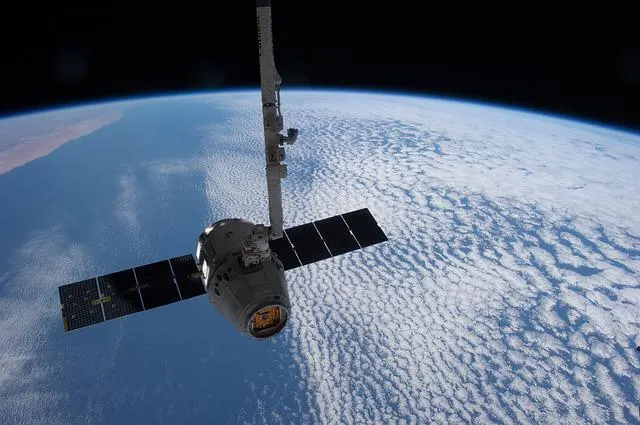
The same thinking was applied to astronauts through the Commercial Crew Program in the 2010s. The Space Shuttle retired in 2011, and for years US astronauts had to travel on Russian Soyuz spacecraft. On 30 May 2020, Crew Dragon Demo-2 became the first flight in which a private company carried NASA astronauts to the ISS, ending that reliance on Soyuz.
The model is still developing. Boeing’s Starliner crewed test flight in June 2024 returned to Earth uncrewed in September 2024 after thruster problems, a reminder that new spacecraft can be hard to get right. The same customer approach now reaches the Moon through Artemis, which uses commercial landers (Starship HLS and Blue Moon), and through Commercial Lunar Payload Services (CLPS).
The main private space companies
Many people ask who the main private space companies are. There is no official ranking, so the table below simply describes some well-known examples and what each is known for as of 2026. It is not a complete list, and inclusion is not an endorsement.
| Company | Founded / Country | Known for |
|---|---|---|
| SpaceX | 2002, United States | Falcon 9 and Falcon Heavy rockets, Dragon spacecraft, Starship test flights, and the Starlink satellite network |
| Blue Origin | 2000, United States | New Shepard suborbital flights (paused since January 2026 for at least two years); the New Glenn orbital rocket, first launched in January 2025 and still in an early flight stage |
| Rocket Lab | 2006, United States / New Zealand | Electron small launcher flown from New Zealand; larger Neutron rocket in development |
| Virgin Galactic | 2004, United States | Suborbital spaceplane; first commercial flight in June 2023; flights paused since 2024 while its new Delta-class vehicle is built; commercial service is targeted for 2027 |
| Axiom Space | 2016, United States | Private astronaut missions to the ISS and planned commercial space station modules |
| Boeing | United States (long-established aerospace company) | Starliner crew capsule, whose first crewed test flight in June 2024 returned uncrewed |
| Northrop Grumman | United States (long-established aerospace company) | Cygnus cargo spacecraft for the ISS |
| Sierra Space | United States | Dream Chaser spaceplane for cargo (first flight planned as a free-flying demonstration) |
| Skyroot Aerospace | India | Vikram-S, a suborbital rocket launched in 2022, and Vikram-1, which reached orbit in July 2026 |
| LandSpace | China | Zhuque-2, the first methane-fuelled rocket to reach orbit, in July 2023 |
Notice how different these businesses are. Some sell rides for small satellites, some fly crew, some supply the ISS, and some focus on short suborbital trips. Companies outside the United States, such as Skyroot and LandSpace, show that commercial spaceflight is now a global industry rather than a single-country story. Part of the reason is the long record behind it: the Commercial Space Launch Act in the US dates back to 1984, so the legal groundwork came long before today’s rockets.
From Earth orbit to the Moon and Mars
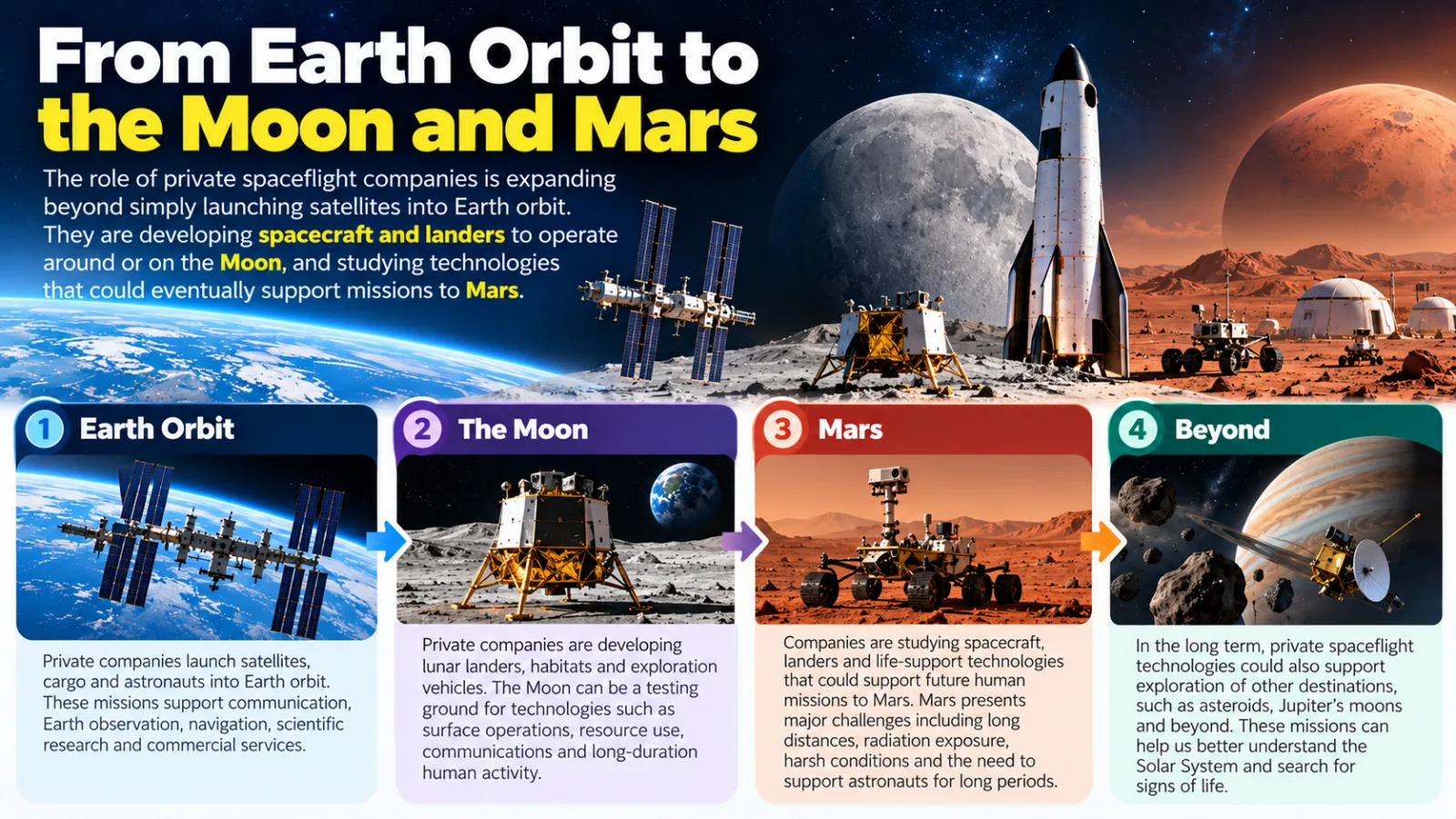
For decades, private space companies mostly built hardware for government agencies. Today they also launch their own satellites, fly astronauts and design vehicles to land on other worlds. This section follows commercial spaceflight outwards: from satellites circling the Earth, to stations in low Earth orbit, to the Moon and, eventually, Mars.
Satellite constellations: Starlink and others
A satellite constellation is a large group of satellites working together, usually to deliver internet access. Because the satellites orbit low, signals travel a shorter distance, which cuts delay. The trade-off is that you need a lot of them to cover the whole planet.
Starlink, run by SpaceX, has thousands of satellites in orbit as of 2025–26, making it by far the largest constellation ever built. Others are following. OneWeb, now part of Eutelsat, operates its own network, and Amazon’s network (formerly Project Kuiper, now called Amazon Leo) began launching in 2025. Reusable rockets are a big reason this is affordable, because each launch can carry many satellites at a lower cost.
Each satellite is powered by sunlight, using large panels that turn light into electricity. If you want to see how that works on the ground, read our guide to solar energy uses.
Constellations also raise real concerns. More objects in orbit means a higher risk of collisions and more space debris. Astronomers have also reported that bright satellite trails can interfere with observations, a form of light pollution. Our article on how we might solve the problem of space junk looks at the clean-up ideas in more detail.
Commercial space stations
The International Space Station (ISS) is planned to retire around 2030. NASA does not want a gap in human presence in low Earth orbit, so it has backed its Commercial LEO Destinations approach. Rather than build and own the next station, NASA would act as one customer among several, buying time and services from companies.
Several private space stations are planned:
- Axiom Space already flies private astronaut missions and plans commercial modules, which could later become a station.
- Vast has planned a small station called Haven-1.
- Starlab is a planned station from a joint venture of companies.
- Orbital Reef is a planned station led by Blue Origin and partners.
As of 2026, these are plans and development projects, and schedules can change. The aim is a market where governments, researchers and private customers all rent space in orbit.
Commercial Moon landers
The Moon is the next testing ground. NASA’s Artemis programme relies on commercial landers: SpaceX’s Starship HLS and Blue Origin’s Blue Moon are both part of the plan for carrying astronauts to the surface. Under NASA’s 2026 plan, Artemis III will test the landers in Earth orbit and the first crewed landing is planned for Artemis IV in 2028. Separately, NASA’s Commercial Lunar Payload Services (CLPS) pays companies to deliver science and technology instruments to the Moon.
Two landings show how hard this is:
- On 22 February 2024, Intuitive Machines’ Odysseus (IM-1) became the first commercial spacecraft to soft-land on the Moon. It tipped over on landing, but it still returned data.
- On 2 March 2025, Firefly’s Blue Ghost landed fully upright.
Soft-landing means arriving at low speed, using rocket thrust to slow down. Without an atmosphere, parachutes are no use, so the engine must do all the work. Even small errors in speed or position can end a mission.
Mars ambitions
Mars is much harder than the Moon. A journey takes months, communication has a delay of several minutes each way, and a landing must slow a heavy spacecraft through a thin atmosphere. SpaceX has said that its Starship vehicle is designed with Mars in mind, and other companies and agencies have their own long-term ideas.
These are plans and ambitions, not scheduled missions. No company has set a firm date that depends on proven technology. Starship is still in its test-flight stage, and many problems, such as life support, radiation and returning home, remain unsolved. Treat any specific Mars date you read online with caution.
Six milestones that changed spaceflight
Each card below names a milestone. Try to recall what happened, then tap to check.
Together, these steps took private companies from competing for a prize to carrying astronauts, running stations and landing on the Moon. The next section looks at who can actually buy a ticket, and what it costs.
Space tourism: who can go and how much?
Space tourism means paying to travel to space for the experience rather than as a professional astronaut. It is the most visible part of commercial spaceflight, but it is still a tiny market. As of 2026, only a small number of private passengers have ever flown.
The first space tourist was Dennis Tito in 2001. He travelled on a Russian Soyuz to the International Space Station (ISS) for a reported US$20 million. For years after that, a seat in orbit was something only the very wealthy could consider.
Suborbital versus orbital trips
There are two very different kinds of trip, and the difference matters when you compare prices and risks.
- Suborbital: the vehicle goes up to about 100 km, the Kármán line used by the FAI, and falls back down. Passengers get a few minutes of weightlessness. The United States uses a lower boundary of 80 km. Blue Origin’s New Shepard and Virgin Galactic’s spaceplane are suborbital vehicles.
- Orbital: the vehicle must reach a sideways speed high enough to circle the Earth. This needs far more energy, so it is much harder and more expensive. Inspiration4 (September 2021) was the first all-civilian orbital mission, and Axiom Mission 1 (April 2022) was the first all-private crew to the ISS.
So how much does it cost to go to space? There is no single price. Suborbital flights cost far less than orbital ones, and a private mission to the ISS costs far more still. What is clear is that falling launch costs, helped by reusable rockets, are the main hope for making trips cheaper over time.
Challenges and risks
Private spaceflight has made space more accessible, but it brings real problems. Four stand out: safety, debris, regulation and environmental impact.
Is private spaceflight safe?
Spaceflight is never risk-free. In 2014 Virgin Galactic’s SpaceShipTwo crashed during a test flight and one pilot was killed. In June 2024, Boeing’s Starliner crewed test flight had thruster problems, and the capsule returned to Earth uncrewed in September 2024. You can read more about what goes wrong, and what engineers learn from it, in our article on failures in space travel.
Space debris and crowded orbits
More launches and more satellites mean more objects in orbit. Starlink alone has thousands of satellites, by far the largest constellation. Debris can damage spacecraft, and satellite trails can interfere with astronomers’ observations.
Regulation and the Outer Space Treaty
The Outer Space Treaty of 1967 says that states are responsible for the activities of their nationals in space, including private companies. In practice, that means each country must authorise and supervise its own companies, which is why national regulators such as the FAA matter.
Environmental impact and inequality
Rocket launches release exhaust into the atmosphere, and the environmental effect of a much higher launch rate is still being studied. There is also a fairness question. Most of the benefits so far go to a few wealthy countries and companies, and access remains very unequal.
Why does reusing a rocket reduce cost? (2 marks)
The first stage is a large, expensive part of the rocket, and it is normally thrown away after one launch. If it lands and flies again, its cost is shared across many flights (1 mark). Only refuelling and refurbishment need to be paid for each time, so the cost per launch falls (1 mark).
The future of commercial space exploration
The global space economy was estimated at about US$613 billion in 2024 and is still growing, so we are talking about hundreds of billions of dollars a year. Several developments will shape what comes next.
- Private space stations: the ISS is planned to retire around 2030. Several companies, including Axiom, Vast (Haven-1 planned for 2027), Starlab and Orbital Reef, have proposed commercial stations; NASA’s plans are still changing.
- Moon missions: Artemis uses commercial landers, including Starship HLS and Blue Moon.
- Bigger rockets: New Glenn first launched in January 2025, and Rocket Lab’s Neutron is in development.
- More countries: companies in India and China are building their own launchers.
For a wider look at where the industry may go, see our guide to the future of commercial space flight. The big question is whether private spaceflight can become cheaper, safer and fairer at the same time.
Test yourself
Key points
- Private spaceflight means companies own and operate rockets and sell services, rather than only building hardware for governments.
- Space tourism is either suborbital (minutes of weightlessness) or orbital (much costlier and harder).
- Dennis Tito became the first space tourist in 2001, reportedly paying US$20 million.
- Main risks: safety, debris, regulation, environmental impact and unequal access.
- Under the Outer Space Treaty, states are responsible for their private companies.
- The future includes private space stations, commercial Moon landers and larger rockets.
Frequently asked questions about private spaceflight
What is private spaceflight?
Private spaceflight is when companies, not only government agencies, build, own and operate rockets and spacecraft. They sell launches, cargo delivery, crew transport or tourist trips. Governments such as NASA are often customers, but the company runs the vehicle.
Who are the main private space companies?
Well-known private space companies include SpaceX, Blue Origin, Rocket Lab, Virgin Galactic, Axiom Space, Boeing, Northrop Grumman and Sierra Space. There are also firms abroad, such as Skyroot in India and LandSpace in China. Each focuses on different things, from launch to space stations.
How much does it cost to go to space?
There is no single price. The first space tourist, Dennis Tito, reportedly paid about US$20 million in 2001. Suborbital flights are cheaper than orbital missions, and costs depend on the company and vehicle. Reusable rockets are expected to help prices fall over time.
What is the difference between suborbital and orbital flight?
A suborbital flight rises to space, about 100 km by the FAI definition, and falls back after a few minutes of weightlessness. An orbital flight reaches the speed needed to keep circling the Earth. Orbital flight needs much more energy, so it is harder and costlier.
Is private spaceflight safe?
It carries real risks, as with all spaceflight. Virgin Galactic’s SpaceShipTwo crashed in 2014 and killed one pilot, and Boeing’s Starliner had thruster problems in 2024. Regulators such as the FAA oversee commercial launches, and engineers use each failure to improve designs.
Who regulates private space companies?
Under the Outer Space Treaty of 1967, each state is responsible for the space activities of its own nationals, including companies. In the United States the FAA licenses commercial launches. Other countries use their own agencies to authorise and supervise operators.
Does private spaceflight add to space debris?
It can. More launches and huge satellite constellations such as Starlink increase the number of objects in orbit, raising collision risk. Astronomers also worry about light pollution from satellites. Operators and regulators are working on ways to limit debris, but it remains a concern.
Who was the first space tourist?
The first space tourist was American businessman Dennis Tito in 2001. He flew on a Russian Soyuz spacecraft to the International Space Station and reportedly paid around US$20 million. Later milestones include Inspiration4 in 2021, the first all-civilian orbital mission.
What is the future of private spaceflight?
Plans include commercial space stations to replace the ISS, which is planned to retire around 2030, and commercial Moon landers for Artemis. Newer rockets such as New Glenn (already flying) and Rocket Lab’s Neutron (not yet flown) are also joining the market. Cost, safety, debris and fair access will decide how fast things grow.