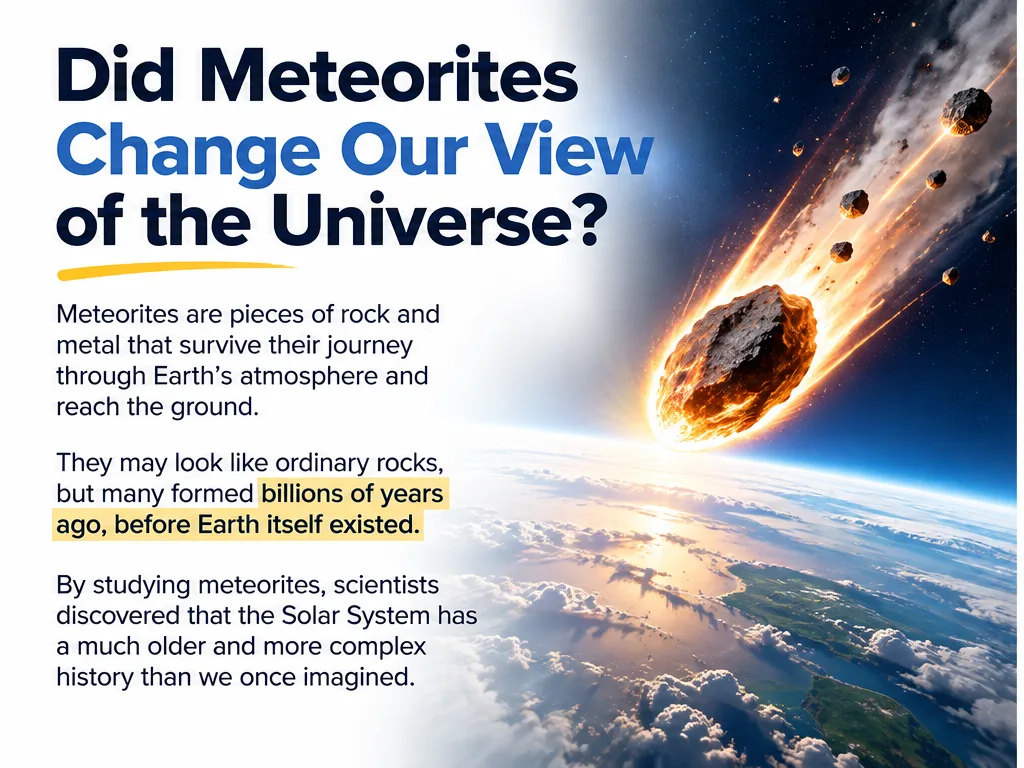
Meteorites are pieces of space rock that survive a fiery fall through the atmosphere and land on Earth. They look like ordinary stones, yet they are some of the most valuable objects a scientist can hold. They are leftovers from the birth of the solar system, and by studying them we learned how old our planet is, what the early solar system was made of, and even where some of life’s ingredients may have come from. So what are meteorites, and why did they change our view of the universe? This guide covers the answer in plain terms, with the key meteorite facts, a little GCSE science, and some surprising stories.
The short version: meteorites are fragments of asteroids, and occasionally of the Moon or Mars. The oldest material inside them is about 4.567 billion years old, which is how we know how old the solar system is.
What is a meteorite?
A meteorite is a piece of rock or metal from space that has reached the ground. That is the whole definition, but the word is often muddled with two close relatives, so it is worth sorting them out. The three names describe the same object at three different moments in its journey.
A small rocky or metallic body travelling through space is a meteoroid. When it hits the atmosphere and burns up, the streak of light we see is a meteor, often called a shooting star. If a piece survives the fall and lands, that piece is a meteorite.
| Name | Where it is | What it is |
|---|---|---|
| Asteroid | In space | A larger rocky or metal body, bigger than about 1 m |
| Meteoroid | In space | A small rocky or metal body, up to about 1 m across |
| Meteor | In the atmosphere | The streak of light made as a meteoroid burns up |
| Meteorite | On the ground | The piece that survives and lands |
This meteor vs meteorite difference is a favourite exam trap. A meteor is a flash of light, not a rock. Most meteors burn up 75–120 km above the ground, so only a tiny fraction of the material ever reaches the surface.
Space material arrives all the time. Many tonnes of dust and small fragments hit Earth every day, though almost all of it is far too small to notice. Most of it is dust that burns up or drifts down unseen. Real meteorite facts are about the rare larger pieces that make it to the surface intact, and those are the ones scientists study.
Ancient visitors from space
Most meteorites come from the asteroid belt, the region of rocky bodies between Mars and Jupiter. These asteroids are leftovers that never grew into a planet. When two of them collide, fragments can be knocked onto paths that cross Earth’s orbit. A small number of meteorites have a different origin: some are pieces of the Moon and some are pieces of Mars, blasted off by large impacts.
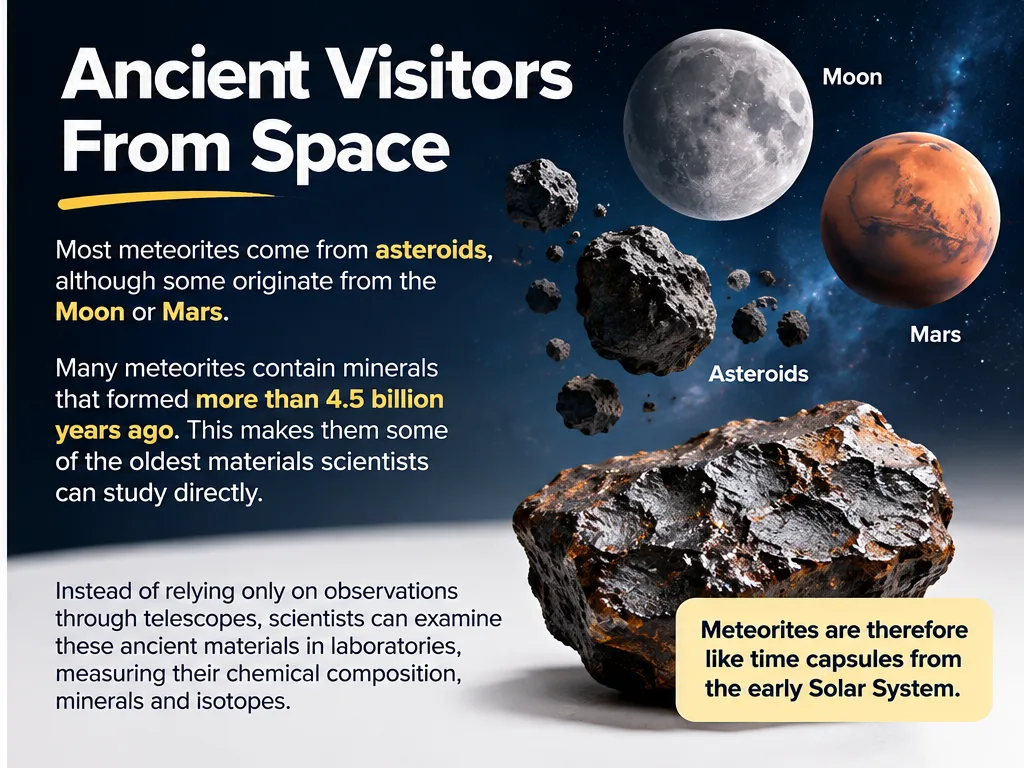
This is what makes meteorites so useful. Earth is geologically busy. Its surface is constantly recycled by volcanoes, erosion and moving plates, so the very oldest rocks from the planet’s early days have been destroyed or changed. Many asteroids, by contrast, have barely altered since the solar system formed. A meteorite from one is like a sample from a time capsule.
The oldest solid material found in meteorites is made of tiny grains called calcium-aluminium-rich inclusions, or CAIs. They are about 4.567–4.568 billion years old, which makes them the oldest solids we know of in the solar system. The age of these grains is the best marker we have for the moment the solar system began to form.
Notice what that means. We cannot drill down to Earth’s original crust, because it is long gone. Instead, we measure the rocks that fell from space and use them to date the planet they landed on. We return to exactly how that works when we look at radioactive decay and half-life later in this article.
When scientists refused to believe stones fell from the sky
It is easy to forget that the idea of rocks falling from space was once treated as nonsense. Until about 1800, most scientists doubted that stones could fall from the sky. People had reported them for centuries, but the reports were put down to superstition, lightning, or rocks thrown up by volcanoes. Space was assumed to be empty, so where could a stone possibly come from?
The first serious challenge came in 1794, when the German physicist Ernst Chladni argued that meteorites really did come from space. Many of his colleagues were not convinced. A strong claim needs strong evidence, and at that point the evidence was mostly witness accounts.
The turning point came on 26 April 1803, when around 3,000 stones fell on the town of L’Aigle in France. This time there were hundreds of witnesses, and the stones themselves were collected. The French scientist Jean-Baptiste Biot investigated the fall, interviewed locals and mapped where the stones landed. His report convinced the scientific world that meteorites are real and come from beyond Earth.
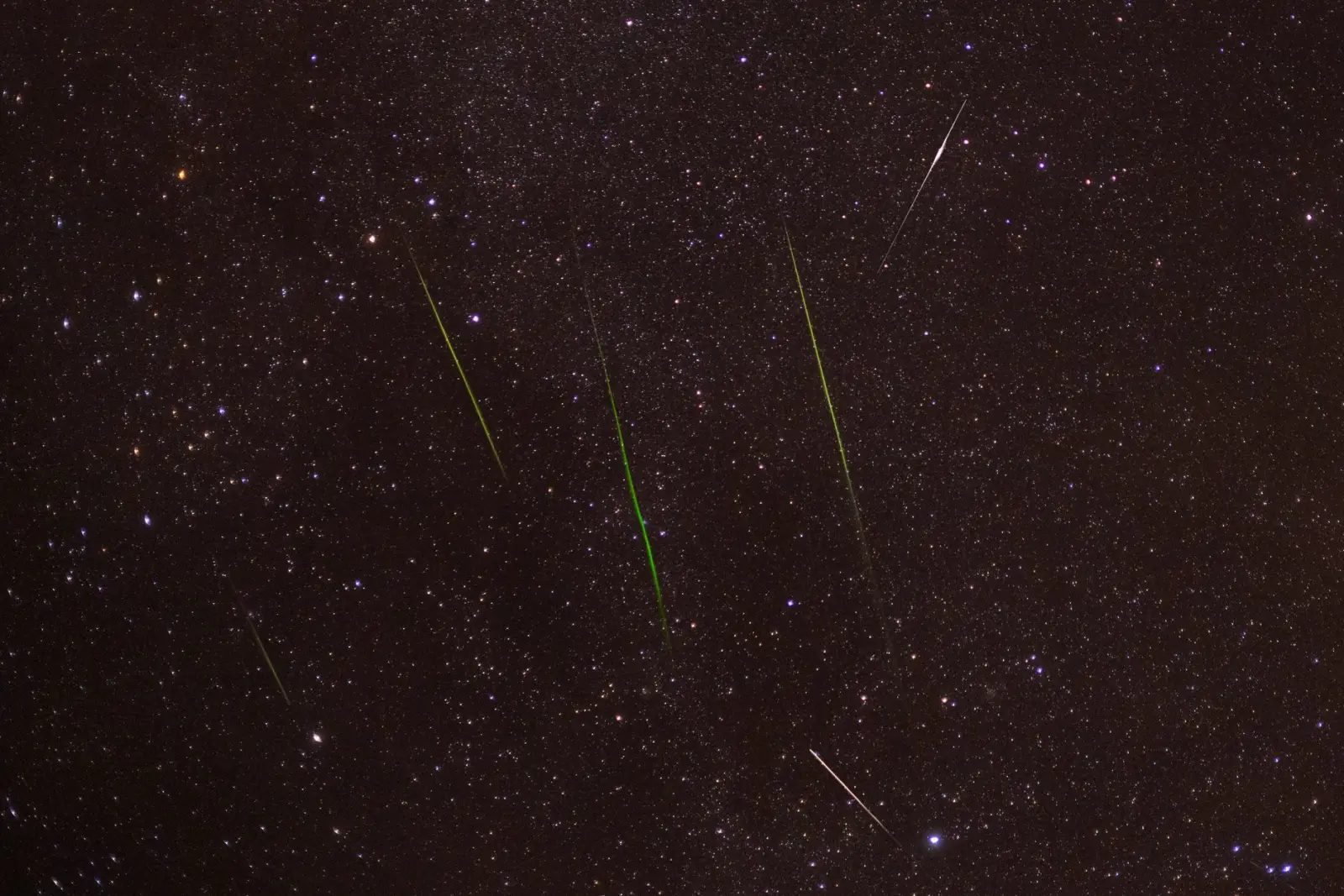
Once meteorites were accepted as real, scientists could analyse them, and the results kept surprising people. Not all shooting stars give us rocks to study, though. Meteor showers, such as the Perseids that peak around 12 August, happen when Earth passes through debris left behind by a comet (or, more rarely, an asteroid). The Perseids come from comet Swift–Tuttle. The Geminids, which peak around 14 December, come from the asteroid 3200 Phaethon. These are mostly streaks of light, whereas meteorites are the rare rocks we can actually pick up.
Types of meteorites
If you were asked "what are meteorites made of?", the honest answer is "it depends which one". Scientists sort meteorites into three main groups, based on how much rock and how much metal they contain. Each group is a snapshot of a different part of a long-vanished small world.
The split below is by falls, meaning meteorites seen to land and then collected. That matters, because iron meteorites are easier to spot lying on the ground, so finds can give a misleading picture.
| Type | Made of | Share of falls | Clue to look for |
|---|---|---|---|
| Stony: chondrites | Silicate rock containing chondrules | ≈ 86 % | Tiny round grains set in a rocky matrix |
| Stony: achondrites | Silicate rock, melted and reshaped | The rest of the stony group (≈ 8 %) | No chondrules; looks more like volcanic rock |
| Iron | Iron–nickel metal | ≈ 5 % | Very heavy; Widmanstätten pattern when cut and etched |
| Stony-iron | Metal and rock mixed together | ≈ 1 % | Pallasites show glassy green olivine crystals in metal |
Altogether, stony meteorites make up about 94 % of falls. Most of these types of meteorites come from the asteroid belt, although a few come from the Moon and Mars.
Iron meteorites are the remains of the metal cores of asteroids that once melted and separated, just as Earth’s iron sank to its core. Cut one open, polish it and dip it in acid, and the Widmanstätten pattern appears: interlocking bands of iron–nickel crystals. They only form when metal cools extremely slowly, over millions of years, deep inside a parent body.
Chondrites: the oldest rocks
Chondrites are the most common meteorites and the most valuable to scientists. They are packed with chondrules: small, round grains that were once molten droplets, floating in the young solar system before they were gathered into rock.
Unlike Earth’s rocks, chondrites have never been melted as a whole. They have not been squashed, recycled or buried by plate tectonics. That makes them time capsules from the birth of the planets.
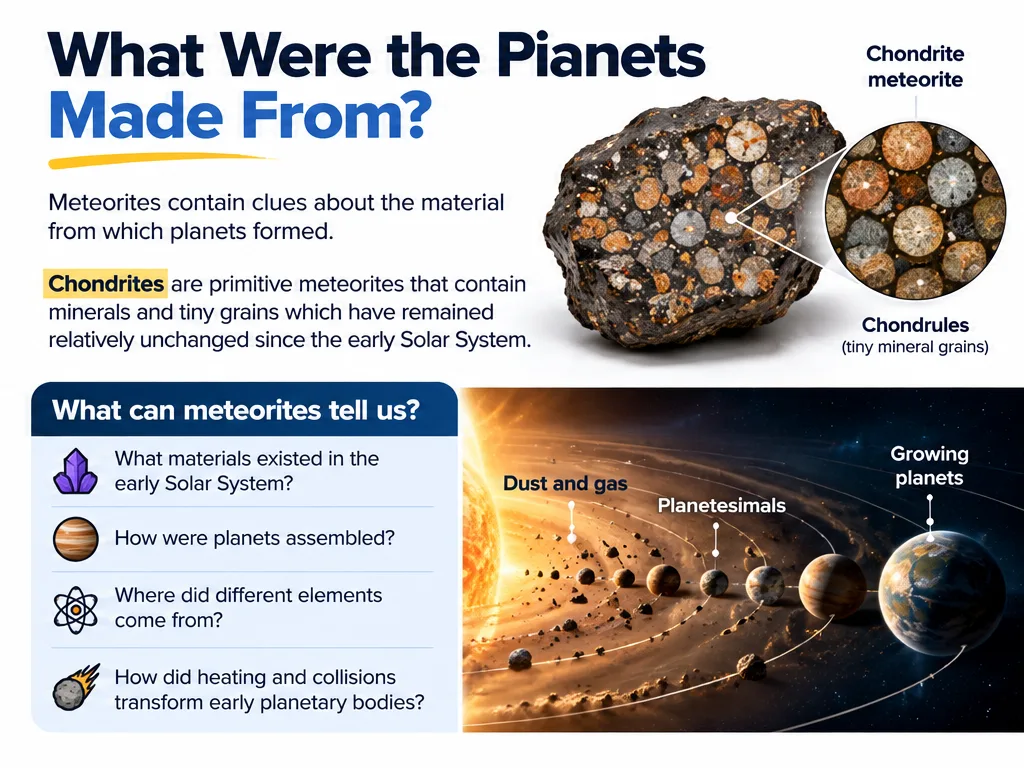
One family, the carbonaceous chondrites, is especially rich in water and organic compounds. We will meet the most famous of them, the Murchison meteorite, later in this series.
How meteorites revealed the age of the solar system
So, how old is the solar system, and how can anyone know? You cannot use Earth’s oldest rocks, because our planet’s surface has been recycled over and over. Meteorites are the better witnesses. They formed early, then sat almost unchanged in space until they fell.
The oldest solids found in meteorites are calcium-aluminium-rich inclusions, or CAIs. They are about 4.567 to 4.568 billion years old. That is the accepted start date for the solar system.
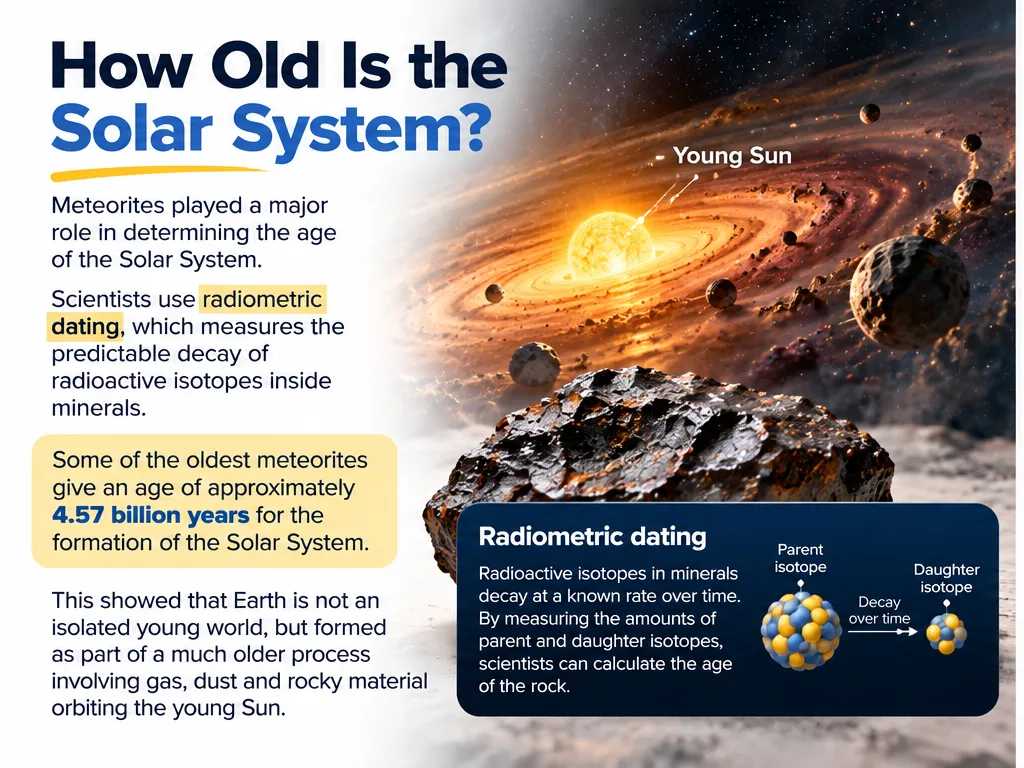
Read that number again, because it is the answer to "how do we know the age of the solar system". The method is called radiometric dating, and it works like a clock built into the rock.
Radiometric dating explained
Some atoms are unstable. A radioactive "parent" isotope decays into a stable "daughter" isotope at a steady, predictable rate that heat, pressure and chemistry cannot change. The time it takes for half of the parent atoms in a sample to decay is its half-life.
After one half-life, 50 % of the parent atoms are left. After two, 25 %. After three, 12.5 %. You can write this as:
fraction left = (½)(time ÷ half-life)
Now measure how much daughter product has built up in a mineral compared with the parent that remains, and you can work out how long the clock has been running. This radiometric dating only works if the mineral formed with no daughter atoms already inside, and if nothing has leaked in or out since.
Different isotopes suit different jobs:
- Uranium-238 to lead-206: half-life 4.47 billion years, ideal for the oldest rocks.
- Uranium-235 to lead-207: half-life about 704 million years, used alongside uranium-238 as a cross-check.
- Aluminium-26: half-life about 717,000 years, so short that it has long since vanished. Its decay products in meteorites show the solar system formed quickly, and may hint at a nearby supernova.
Try it yourself with the calculator below. Pick a half-life and an elapsed time, and see how much of the parent isotope is left. For the full story of how the Sun and planets formed, read our guide to the origin of our solar system.
Clair Patterson and the age of Earth
Until the 1950s nobody had a reliable age for Earth. In 1956 the geochemist Clair Patterson used lead isotopes in meteorites, including pieces of the Canyon Diablo meteorite from Arizona, to settle it. His result was 4.55 ± 0.07 billion years.
His reasoning was neat. Meteorites and Earth formed together from the same material, so lead isotope ratios in meteorites show the starting point. Compare them with ratios in Earth’s lead, and the time gap can be calculated.
Modern measurements give about 4.54 billion years for Earth, so Patterson’s figure was essentially correct. A fallen rock from space gave us the age of our own planet.
Meteorites from Mars and the Moon
Most meteorites come from the asteroid belt, but not all of them. A small number are pieces of other worlds, blasted off by impacts and thrown across space until they landed on Earth. These rocks are some of the cheapest planetary samples we will ever get, because nobody had to build a rocket to fetch them.
Hundreds of Martian meteorites are now known. Scientists can tell they are from Mars because tiny bubbles of gas trapped inside the rock match the composition of the Martian atmosphere, which the Viking landers measured directly. That match is a bit like a fingerprint: no other known source has it.
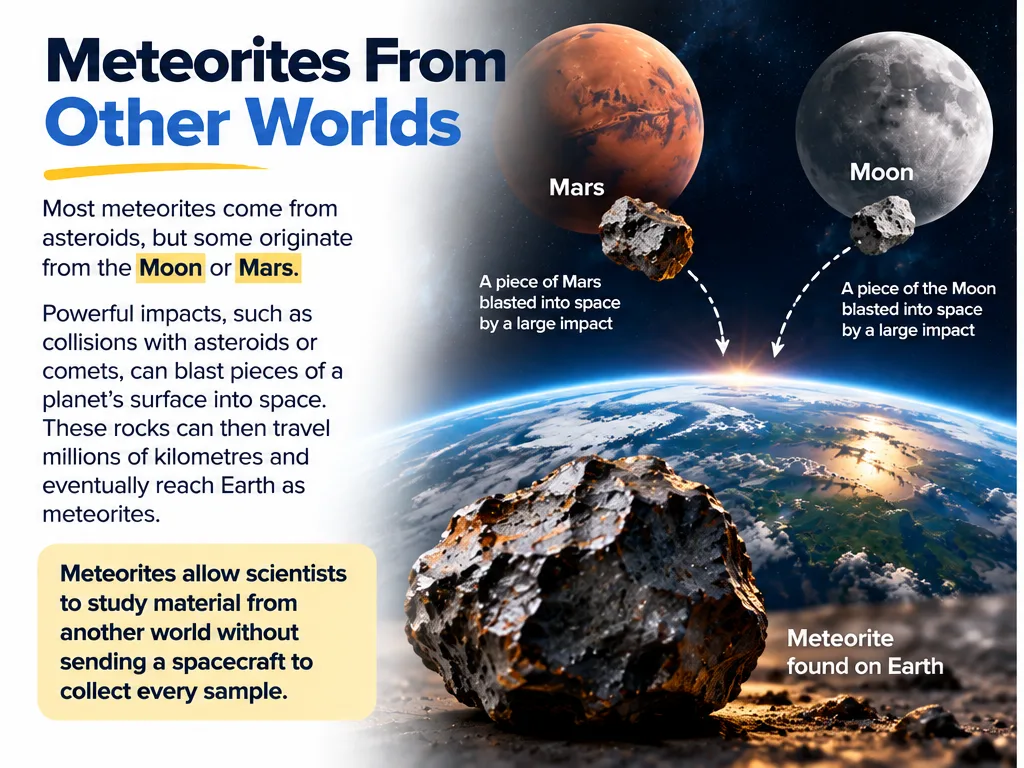
Lunar meteorites exist too. Many of them have been found in Antarctica, where dark rocks stand out on the white ice. We can compare them with the 382 kg of rock and soil brought back by the Apollo missions. Those Apollo samples helped show that the Moon formed after a giant impact early in the history of the solar system.
Why does this matter for what meteorites reveal about the universe? Because it turns planets into laboratories. We can weigh, slice and analyse real pieces of Mars and the Moon in Earth laboratories, and use them to test ideas about how rocky worlds form and change.
Did meteorites bring the ingredients for life?
This is one of the most exciting questions in science, and one of the easiest to get wrong. Some meteorites, especially the carbonaceous chondrites, are rich in water and organic compounds. Organic here means carbon-based, not “made by living things”.
The most famous example is the Murchison meteorite, which fell in Australia in 1969. Scientists have found about 70 different amino acids in it, including some that living things on Earth do not use, along with many thousands of other organic compounds. Later studies, in 2011 and 2022, found nucleobases such as adenine, guanine and uracil in meteorites. Nucleobases are the “letters” used in genetic molecules.
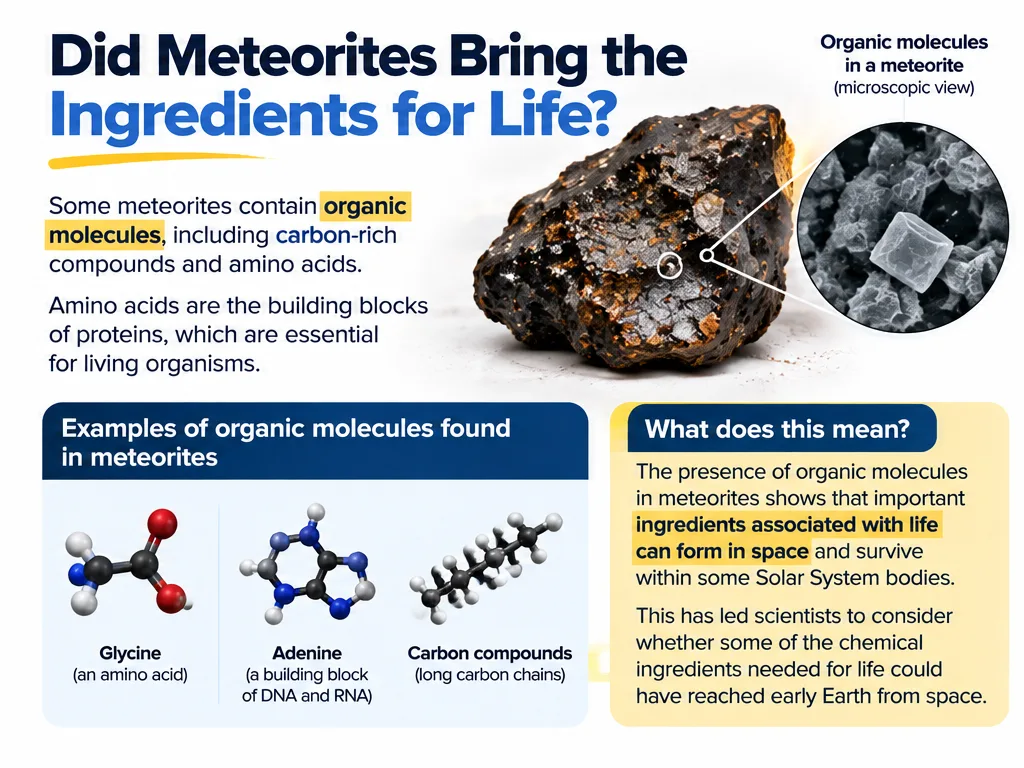
So did these ingredients help start life on Earth? The idea is that the early Earth received organic building blocks from space, which mixed with whatever chemistry was already happening on our planet. It is a serious hypothesis, and it fits the evidence. It is not proof that life came from space.
Researchers who study this field are called astrobiologists. If you want the wider picture, including how scientists search for life beyond Earth, read our guide to astrobiology: what you need to know.
Sample-return missions: bringing asteroids home
Meteorites have a problem as evidence. They fall through our atmosphere, sit on the ground and get contaminated. A sample collected directly from an asteroid and sealed in a capsule is much cleaner. That is why space agencies have started to bring pieces of asteroids home.
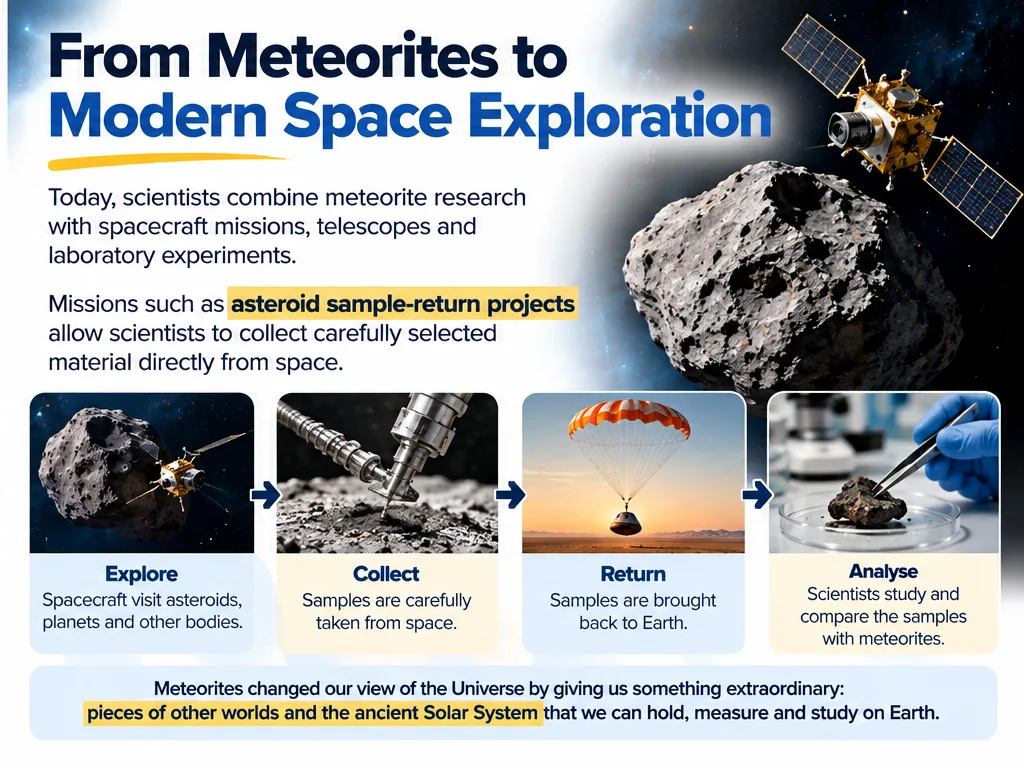
Japan’s Hayabusa2 mission returned samples from the asteroid Ryugu in 2020. They contained amino acids and uracil, one of the nucleobases found in RNA.
NASA’s OSIRIS-REx mission delivered material from the asteroid Bennu on 24 September 2023. The results, reported in January 2025, were striking. The sample held amino acids, including 14 of the 20 used by life on Earth, and all five nucleobases. It also contained salts left behind when water evaporated, which tells us that liquid water once existed on Bennu’s parent body.
Together, Murchison, Ryugu and Bennu give a consistent story: organic compounds are common in primitive asteroids, and some of them were formed in the presence of water. That does not tell us how life began, but it tells us the early Earth was not short of raw materials.
Flip the cards: famous space rocks and what they taught us
Test your memory of six famous objects. Read the front, say the answer out loud, then tap to check.
These stories explain why scientists treat meteorites as time capsules. Some record the age of the solar system, some come from other worlds, and some carry chemistry that may have helped set the stage for life. Next, we look at what happens when a space rock is big enough to change a planet.
Impacts that changed Earth
Most meteorites are small and harmless. A few have been anything but. Impacts have carved craters, shaken cities and, once, helped rewrite the history of life.
The most famous case is the Chicxulub impact, about 66 million years ago. An asteroid roughly 10 km across hit what is now Mexico. Two clues link it to the extinction of the non-avian dinosaurs: a thin layer of iridium in rocks around the world (found by the Alvarez team in 1980) and a buried crater under the Yucatán. For the animals it ended, see our list of all the dinosaurs.
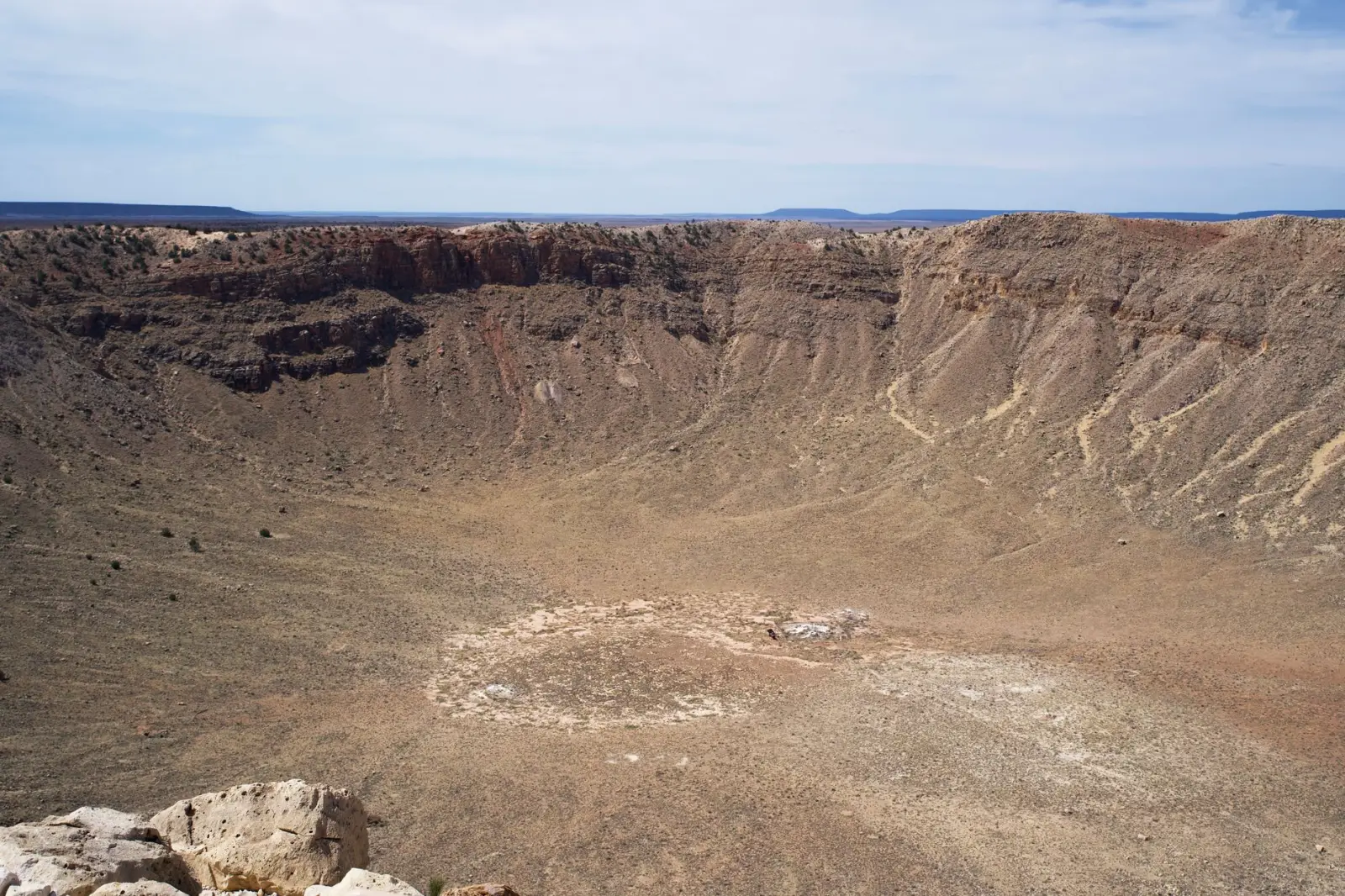
Smaller impacts leave clearer scars. Barringer (Meteor) Crater in Arizona is about 1.2 km wide and roughly 50,000 years old. It was made by an iron meteorite only about 50 m across, which shows how much energy a fast-moving lump of metal carries.
Some objects never reach the ground in one piece. On 15 February 2013 a rock about 20 m wide exploded in the air above Chelyabinsk, Russia. The shock wave injured around 1,500 people, mostly from broken window glass. The 1908 Tunguska event was also an airburst.
Protecting Earth: the DART mission
If we can see a dangerous asteroid early, can we nudge it aside? NASA tested this with the DART mission. On 26 September 2022 the spacecraft crashed into Dimorphos, a small moonlet orbiting a larger asteroid. The impact shortened its orbit by about 32–33 minutes. It was the first real test of deflecting an asteroid.
Debris from our own spacecraft is a separate problem, explored in how to solve the problem of space junk.
How meteorites changed our view of the universe
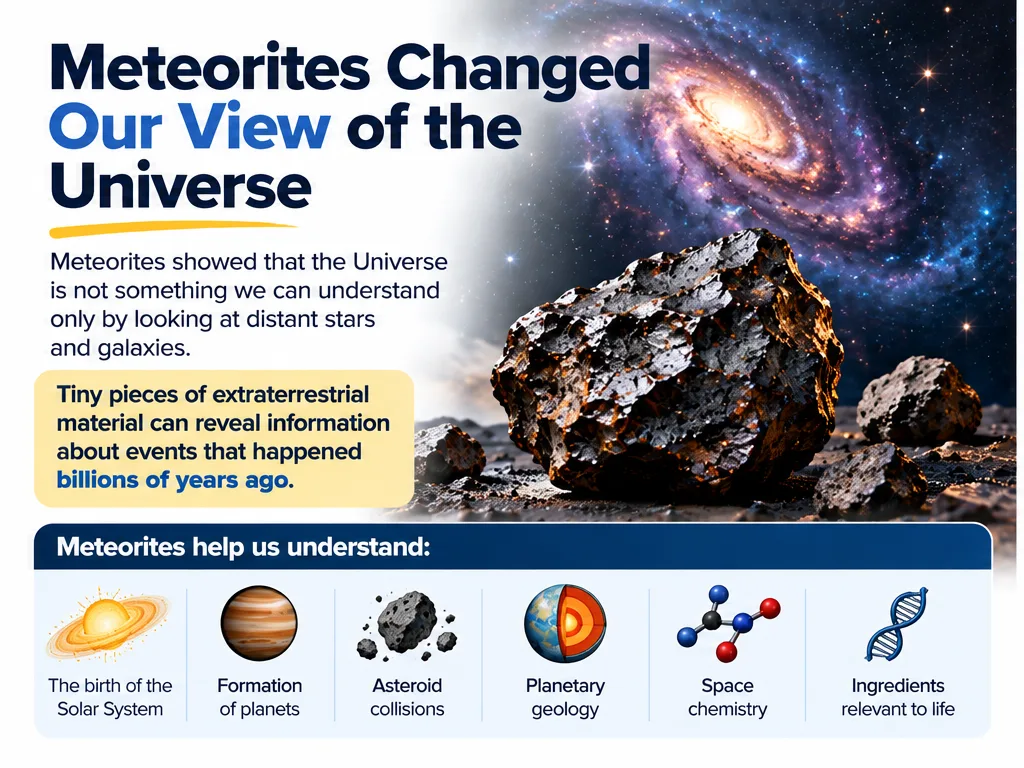
Until about 1800 most scientists doubted that stones fell from the sky. Today meteorites are treated as time capsules. Their oldest grains, the calcium-aluminium-rich inclusions, are about 4.567–4.568 billion years old. That answers the question how old is the solar system with real numbers.
They also show that the early solar system was busy and quick. Short-lived aluminium-26 (half-life about 717,000 years) in meteorites suggests it formed fast. Carbonaceous chondrites carry water and organic compounds, so the building blocks of life were spread through space. Martian and lunar meteorites even let us study other worlds without leaving home.
Each shooting star is part of this story. Meteor showers happen when Earth passes through trails of comet or asteroid debris. The Perseids peak around 12 August, from comet Swift–Tuttle, and the Geminids around 14 December, from asteroid 3200 Phaethon. Showers are named after the constellation they seem to come from, so our guide to how many constellations there are helps you find them. To go further, see exploring the universe with rockets, telescopes and satellites.
How to tell if a rock is a meteorite
Antarctica is the best hunting ground, because dark rocks stand out on white ice. The ANSMET programme has collected tens of thousands of specimens there. At home, most finds are meteorwrongs, usually slag or iron ore. Iron meteorites are not precious metal, so compare with our page on gold, the precious metal if a shiny lump has you excited. Tick off the clues:
- It feels heavy for its size.
- A magnet sticks to it (iron meteorites especially).
- It has a thin, black, glassy fusion crust.
- The surface has thumbprint-like dents called regmaglypts.
- It is not bubbly, because bubbles point to volcanic rock.
- If it is an iron meteorite, an etched slice shows the Widmanstätten pattern.
- If it is a chondrite, the inside shows tiny round chondrules.
Test yourself
Key points
- A meteoroid is in space, a meteor is the light streak, and a meteorite is the piece that lands.
- Calcium-aluminium-rich inclusions in meteorites are about 4.567–4.568 billion years old.
- Chicxulub (about 66 million years ago) is linked to the dinosaur extinction by iridium and a buried crater.
- Chelyabinsk (2013) showed that airbursts can injure people without any crater.
- DART shortened Dimorphos’s orbit by about 32–33 minutes in 2022.
- Heavy, magnetic, fusion-crusted and not bubbly: these are the best meteorite clues.
Frequently asked questions about meteorites
What are meteorites?
Meteorites are pieces of rock or metal from space that survive their journey through the atmosphere and land on Earth. Most come from the asteroid belt, while a few come from the Moon and Mars. They are valuable to scientists because they preserve material from the early solar system.
What is the difference between a meteor, meteoroid and meteorite?
A meteoroid is a small rocky or metal body in space, up to about 1 m across. A meteor is the streak of light it makes as it burns up in the atmosphere, often called a shooting star. A meteorite is any piece that survives and lands on the ground.
How old is the solar system?
The solar system is about 4.567–4.568 billion years old. That figure comes from calcium-aluminium-rich inclusions in meteorites, the oldest solids known. Clair Patterson first showed in 1956, using lead isotopes in the Canyon Diablo meteorite, that Earth is roughly 4.55 billion years old.
What are the main types of meteorites?
There are three main types. Stony meteorites make up about 94 % of falls, and most of those are chondrites. Iron meteorites, made of iron and nickel, are about 5 %. Stony-iron meteorites, including pallasites with olivine crystals, are about 1 % of falls.
Where do meteorites come from?
Most meteorites come from the asteroid belt, where collisions knock fragments towards Earth. A small number are pieces blasted off the Moon or Mars by large impacts. Martian meteorites are identified by trapped gas that matches the Martian atmosphere measured by the Viking missions.
How can you tell if a rock is a meteorite?
Look for a rock that is heavy for its size, often magnetic, with a thin black glassy fusion crust and thumbprint dents called regmaglypts. It should not be bubbly, which suggests volcanic rock. Most suspected finds are meteorwrongs, usually slag or iron ore, so expert testing is needed.
Are meteorites hot when they land?
Usually not. The outside is heated for a short time as the rock plunges through the atmosphere, but the interior stays very cold from its time in space. Meteorites are rarely hot when they land, so the idea of a glowing, red-hot rock is mostly a myth.
What is the largest meteorite ever found?
The largest known meteorite is Hoba, found in Namibia. It is made of iron, weighs about 60 tonnes and has never been moved from its original site. It is a good example of how large some iron meteorites can be, though most meteorites are far smaller.
Did meteorites bring the ingredients for life to Earth?
Possibly the ingredients, not life itself. The Murchison meteorite, which fell in Australia in 1969, contains many amino acids and thousands of organic compounds. Samples from asteroids Ryugu and Bennu also contained amino acids and nucleobases. This supports the idea that early Earth received building blocks from space, though it is not proof.